HUMAN MEDICAL BIOLOGY, ANATOMY, PHYSIOLOGY, AND PATHOLOGY - Ya.I. Fedoniuk 2010
ANATOMY, PHYSIOLOGY, PATHOLOGY
SECTION 3. ANATOMICAL AND PHYSIOLOGICAL ASPECTS OF BODY FUNCTION SELF-REGULATION
ENDOCRINE GLANDS AND THEIR PATHOLOGY
THYROID GLAND
1. STRUCTURE AND FUNCTIONS OF THE THYROID GLAND
The Thyroid Gland (glandula thyroidea) is located in the anterior neck region at the level of the V-VII cervical vertebrae, anterior to the Larynx and Trachea (Fig. 3.69). The mass of the gland in an adult is about 30-40 g. In women, it is slightly larger than in men and sometimes temporarily increases in size (during menstruation). During Puberty, the thyroid gland grows quite intensively, and by the age of 20, its mass increases 20-fold.
Class="center">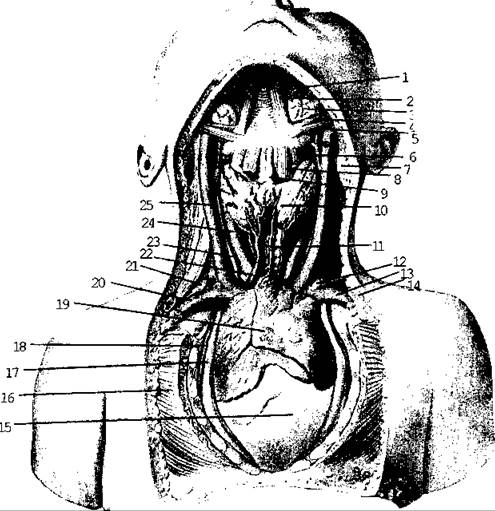
Fig. 3.69. Organs of the neck region
The gland consists of two lobes, right and left, which are connected by an isthmus (Fig. 3.70). A pyramidal lobe extends upward from the isthmus or one of the lobes.

Fig. 3.70. Thyroid gland
The gland is covered by a fibrous capsule, from which extensions (trabeculae) branch out, dividing it into lobules.
The lobules consist of numerous vesicles called follicles, whose walls are lined internally with cuboidal epithelial follicular Cells. The follicular cavity is filled with a viscous substance, colloid, which contains Hormones composed mainly of Proteins and iodine-containing Amino Acids.
The thyroid gland produces iodinated hormones (thyroxine and triiodothyronine) and Calcitonin.
The synthesis of thyroxine and triiodothyronine requires an adequate intake of iodine into the body. Humans obtain iodine primarily through drinking Water.
In endemic areas, iodine is added to table salt, which largely prevents thyroid disorders. Iodinated hormones stimulate body GROWTH AND DEVELOPMENT, sexual maturation, and increase The rate of all metabolic processes in the body: protein, fat, carbohydrate, vitamin, and water-electrolyte METABOLISM, as well as basal metabolism and heat production. Under The Influence of these hormones, Glycogen stores in the Liver decrease, resulting in elevated Blood sugar levels. They stimulate protein breakdown, leading to an increased amount of nitrogen excreted by the Kidneys.
An important indicator of thyroid activity is the basal metabolic rate, as iodine-containing hormones elevate basal metabolism.
THYROID HORMONES are essential for Brain development and the functioning of the central and autonomic nervous systems. They increase The activity of the sympathetic Nervous system, which manifests as heightened excitability, emotionality, accelerated Heart rate, increased respiratory rate, sweating, as well as a decrease in gastrointestinal secretion and motility.
Calcitonin regulates calcium metabolism: it lowers blood calcium levels and activates the function of osteoblasts, which promote Bone tissue formation while simultaneously inhibiting the activity of bone-destroying osteoclasts.
The Regulation of Thyroid activity is mediated by the Hypothalamus-pituitary system. Neurosecretory Cells of the hypothalamus release thyrotropin-releasing hormone, which stimulates the adenohypophysis to secrete thyroid-stimulating hormone. It enters the bloodstream and stimulates the Synthesis and Secretion of thyroid hormones.
Last update: 08/08/2026
Editorial and Educational Adaptation: This material has been compiled based on the primary/original source text. The project team performed an editorial review, corrected technical inaccuracies, structured sections, and adapted the content for an educational format.
What was processed:
- elimination of formatting defects (OCR errors, structural breaks, corrupted characters);
- editorial organization of content;
- standardization of terminology in accordance with academic sources;
- verification of factual statements against the original source text.
All mentions of the author, publication year, and origin of the primary text have been preserved in accordance with the source.