BIOLOGY Volume 3 - A Guide to General Biology - 2004
24. VARIATION AND GENETICS
24.9. Mutations
A mutation is defined as A change in the quantity or Structure OF THE DNA of a given Organism. Mutations lead to alterations in the genotype that can be inherited by Cells descended from the mutant Cell through mitosis or Meiosis. Furthermore, a mutation may give rise to changes in a particular trait within a population. If a mutation occurs in Gametes, it is inherited across generations, whereas somatic mutations are passed on exclusively to daughter cells produced via mitosis, and are appropriately termed somatic mutations.
Mutations involving changes in chromosome number or structure are known as chromosomal mutations or Chromosomal aberrations. In certain types of aberrations, Chromosomes are altered to such a degree that the changes become visible under a Microscope. Today, the term "mutation" is primarily used to denote DNA changes occurring at a single locus, commonly referred to as a Gene mutation or point mutation.
METABOLISM/2.html">THE CONCEPT OF mutation as the cause behind the sudden appearance of a novel trait was first proposed in 1901 by the Dutch botanist Hugo de Vries, who studied heredity in the evening primrose Oenothera lamarckiana. Nine years later, T. Morgan began investigating mutations in Drosophila, and soon, with THE CONTRIBUTION OF geneticists worldwide, over 500 mutations had been identified in this organism.
Class="center">24.9.1. Mutation Rate and Causes
Mutations arise randomly and spontaneously, meaning any gene can mutate at any given moment. The rate at which mutations occur varies among different organisms.
Following the pioneering work of H. J. Müller in the 1920s, it was established that the mutation rate can be artificially elevated above its spontaneous baseline by exposing organisms to X-rays. It was later discovered that high-energy electromagnetic radiation—such as ultraviolet light, X-rays, and γ-rays—can significantly increase mutation frequency. High-energy particles, including α- and β-particles, neutrons, and cosmic radiation, also exhibit mutagenic properties, meaning they are capable of inducing mutations. Similarly, A wide variety of chemical substances act as mutagens, notably mustard gas, caffeine, formaldehyde, colchicine, certain components of tobacco, and a steadily growing number of pharmaceutical drugs, food preservatives, and pesticides.
24.9.2. Chromosomal Mutations
Chromosomal mutations may result from changes in chromosome number or structure. Certain types of chromosomal mutations alter the expression of multiple genes and exert a far more profound effect on the phenotype than Gene Mutations do. Changes in chromosome number typically occur As a result of errors during meiosis, though they can occasionally arise from mitotic irregularities. These alterations manifest either as aneuploidy—the loss or addition of individual chromosomes—or as euploidy (polyploidy)—The addition of entire haploid sets of chromosomes.
Aneuploidy
Aneuploidy can manifest as the Addition of an extra chromosome in daughter cells (n + 1), (2n + 1), etc., or as the deficiency of a particular chromosome (n - 1), (2n - 1), etc. Aneuploidy may occur if homologous chromosomes of one or more pairs fail to segregate during anaphase I of meiosis. In such cases, both members of a pair migrate toward the same pole of The Cell, meaning subsequent Separation of homologous chromosomes in anaphase II can lead to The formation of gametes containing either more or fewer chromosomes than normal (Fig. 24.31). This phenomenon is known as non-disjunction. When a gamete with a missing or extra chromosome fuses with a normal haploid gamete, a zygote with an abnormal chromosome number is formed: instead of having a pair of homologs, such a zygote may possess three or only a single one.
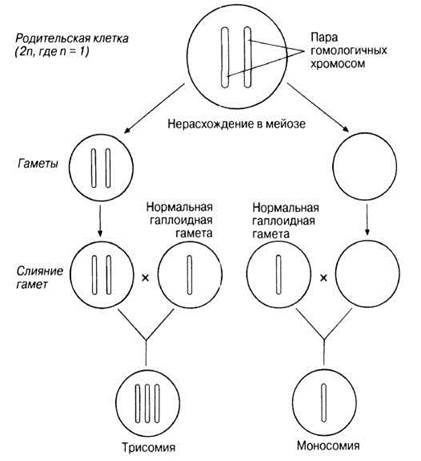
Fig. 24.31. Chromosome non-disjunction during gamete formation and the results of the fusion of aberrant gametes with normal haploid cells. This leads to various types of polysomy, where the chromosome count may be 2n + 1 (trisomy), 2n + 2 (tetrasomy), 2n + 3 (pentasomy), etc., or 2n - 1 (monosomy), depending on the number of homologous chromosomes that failed to segregate properly (see also Fig. 25.34).
A zygote with fewer chromosomes than the diploid number typically fails to develop, whereas zygotes with extra chromosomes are sometimes viable. When this occurs in animals, it most frequently results in individuals with pronounced developmental abnormalities. Among the most common chromosomal mutations in humans arising from non-disjunction is a form of trisomy known as Down syndrome (2n = 47). Named after the physician who first described it in 1866, this condition is caused by the non-disjunction of the 21st pair of chromosomes. This mutation is further discussed in Section 25.7.6.
Non-disjunction can also involve the sex chromosomes, leading to aneuploidy that affects secondary sexual characteristics, fertility, and occasionally cognitive abilities (Sections 25.7.7 and 25.7.8).
Euploidy (Polyploidy)
Gametes and somatic cells with an increased chromosome number that is an exact multiple of the haploid number are termed polyploid. Prefixes such as tri-, tetra-, and so on, indicate the multiple by which the chromosome number has increased, reflecting the level of ploidy: 3n represents a triploid, 4n a tetraploid, 5n a pentaploid, and so forth. Polyploidy is far more prevalent in plants than in animals. For example, roughly half of the 300,000 known species of angiosperms are polyploids. The relative rarity of polyploidy in animals is attributed to the fact that an increased chromosome number substantially raises the probability of errors during meiotic gamete formation. In contrast, most plants are capable of vegetative propagation and can therefore successfully perpetuate in a polyploid state. Polyploid organisms frequently exhibit advantageous traits, such as larger size, greater resilience, and enhanced Disease resistance—a phenomenon often referred to as hybrid vigor (Section 27.4.2). The majority of our cultivated crops are polyploids selected for larger fruits, storage Organs, flowers, or leaves.
There are two primary forms of polyploidy: autopolyploidy and allopolyploidy.
AUTOPOLYPLOIDY. Autopolyploidy can arise either naturally or artificially through an increase in the number of chromosome sets within a single species. For instance, if Chromosome Replication occurs during interphase and chromatids segregate normally in anaphase, but cytokinesis fails to take place, a large-nucleated tetraploid cell (4n) is formed. This cell subsequently divides to produce tetraploid daughter cells. The cytoplasmic volume in these cells increases to maintain a constant nuclear-to-cytoplasmic ratio, which leads to an overall enlargement of the plant or specific parts of it. Autopolyploidy can be induced using the alkaloid colchicine, extracted from the bulb of the autumn crocus (Colchicum). At concentrations around 0.01%, colchicine inhibits spindle formation by disrupting microtubules, thereby preventing chromosome segregation during anaphase. Colchicine and related compounds have been utilized to develop valuable cultivars of crops such as tobacco, tomatoes, and sugar beets. Autopolyploids can be just as fertile as diploids provided they contain an even number of chromosome sets.
A modified form of polyploidy, characterized by the formation of isolated polyploid Cells and Tissues, is occasionally observed in animals. This process, termed endomitosis, involves chromosome replication unaccompanied by Cell Division. The giant chromosomes found in the salivary gland cells of Drosophila and the tetraploid cells in the human Liver both arise via endomitosis.
ALLOPOLYPLOIDY. Allopolyploidy occurs when the chromosome number of a sterile hybrid is doubled, thereby restoring its fertility. F1 hybrids resulting from crosses between different species are typically sterile because their chromosomes are unable to form homologous pairs during meiosis—a phenomenon known as hybrid sterility. However, if the chromosome number becomes a multiple of the original haploid number, such as 2(n1 + n2), 3(n1 + n2), etc., where n1 and n2 represent the haploid chromosome numbers of the parental species, a new species arises. This novel species produces fertile offspring when crossed with similar polyploids, yet remains sterile when crossed with either of its parent species.
Most allopolyploid species possess a diploid-like chromosome count that equals the sum of the diploid numbers of their parental species. For example, Spartina anglica (2n = 122) is a fertile hybrid allopolyploid originating from a cross between Spartina maritima (stricta) (2n = 60) and Spartina alterniflora (2n = 62). The F1 hybrid from this cross is sterile and is known as Spartina townsendii (2n = 62). Most allopolyploid plants differ morphologically from both parent species, and many represent highly valuable crops cultivated by humans. For instance, the common wheat species Triticum aestivum (2n = 42), used for flour production, was developed through centuries of Hybridization and Selection spanning 5,000 years. Crossing einkorn wheat (2n = 14) with an unidentified diploid species (2n = 14) yielded a new wheat species known as emmer wheat (2n = 28). Emmer wheat was subsequently crossed with another wild species (2n = 14) to produce Triticum aestivum (2n = 42), which Functions as a hexaploid (6n) relative to the original einkorn wheat. Another prominent example of interspecific hybridization—the cross between radish and cabbage—will be discussed in Section 27.9.
Allopolyploidy is virtually unknown in animals because interspecific crosses rarely occur in the animal kingdom. While polyploidy does not introduce entirely novel genes into the gene pool (Section 27.4.2), it generates novel combinations of existing genes.
Structural changes in chromosomes
During Crossing Over in prophase I of meiosis, a reciprocal EXCHANGE OF GENETIC material takes place between homologous chromosomes. This leads to an altered sequence of alleles within parental linkage groups, resulting in recombinants without the loss of any gene loci. Similar effects are produced by chromosomal aberrations such as inversions and translocations. In Other types of aberrations—deletions and duplications—the number of gene loci in the chromosomes changes, which can have a profound impact on phenotypes. Structural chromosomal changes associated with inversions, deletions, duplications, and in some cases translocations, can be observed under a microscope when homologous chromosomes undergo synapsis in prophase I of meiosis. Homologous chromosomes form synapses (conjugate; Section 23.3), and in the regions affected by the rearrangement, one of the homologues forms a loop or becomes twisted. Which chromosome forms the loop and how its genes are arranged depends on the type of rearrangement.
An inversion occurs when a segment of a chromosome is excised, rotated 180°, and reinserted into its original position. Although this causes no changes to the genotype, phenotypic alterations may occur (Fig. 24.32). This demonstrates The Importance of gene sequence within a given chromosome, a phenomenon known as the position effect of a gene.
Fig. 24.32. Schematic representation of inversion and translocation and their effect on the arrangement of genes A — G. I Loop formation in meiotic prophase caused by inversion. II. A chromosome segment carrying genes C, D, and E has broken off and attached to a chromosome carrying genes K, L, and M.
During a translocation, a segment breaks off from one chromosome and attaches either to the other end of the same chromosome or to the end of another, non-homologous chromosome (Fig. 24.31). Here too, a position effect may manifest in the phenotype. Reciprocal translocation between non-homologous chromosomes can lead to the formation of two new pairs of homologous chromosomes. In cases where Down syndrome patients retain a normal diploid chromosome number, the cause is the translocation of the extra chromosome 21 onto one of the larger chromosomes, usually number 15.
The simplest form of chromosomal mutation is a deletion (or deficiency), which involves the loss of an intermediate or terminal chromosomal segment, leaving the chromosome deficient in certain genes (Fig. 24.33). A deletion may occur in only one of the two homologous chromosomes; in such cases, the alleles located on the other, normal chromosome are expressed even if they are recessive. However, if the deletion affects the same loci in both homologous chromosomes, it is usually lethal.
Occasionally, a segment of a chromosome is duplicated, resulting in a duplication—the repetition of a set of genes localized within that segment. The additional set may become incorporated into the same chromosome, located at one of its ends, or attached to another chromosome (Fig. 24.33).

Fig. 24.33. Schematic representation of deletion and duplication and their effect on the arrangement of genes A — G. Loops are formed in both cases.
24.9.3. Gene Mutations
WHAT IS A gene mutation?
Sudden spontaneous phenotypic changes that are not associated with chromosomal aberrations (as confirmed by microscopic studies) can only be explained by alterations in The structure of individual genes. A gene or point mutation (so called because it affects a specific gene locus) results from a change in The nucleotide sequence of a DNA molecule within a specific region of a chromosome. Such a change in base sequence within a single gene is replicated during mRNA Transcription and may lead to an altered Amino Acid Sequence in the polypeptide chain produced during ribosomal Translation.
Types of gene mutations
There are various types of gene mutations associated with the addition, loss, or rearrangement of bases within a given gene. They manifest as duplications, insertions, deletions, inversions, or base substitutions. In all cases, they result in an altered nucleotide sequence and frequently lead to The production of a modified polypeptide. For example, a deletion causes a frameshift, the consequences of which are described in Section 23.7.
Consequences of gene mutations
Gene mutations that arise during gamete formation are transmitted to all descendant cells and can influence the future course of the species. Somatic gene mutations occurring within an organism are inherited only by those cells derived from the mutant cell via mitosis. They may affect the organism in which they arise, but upon the death of that individual, they disappear from the population gene pool. Somatic mutations probably occur very frequently and usually go unnoticed, but in some cases, they give rise to cells with an increased rate of growth and division. These cells can initiate tumors—either benign, which do not affect other tissues, or malignant, which parasitize other tissues (Cancer, melanomas, sarcomas).
The effects of gene mutations are extremely diverse. Most minor gene mutations are phenotypically silent because they are recessive; however, numerous instances are known where the alteration of just a single base in The Genetic Code profoundly impacts the phenotype. One example is Sickle-Cell Anemia, a human condition caused by a single base substitution in one of the genes responsible for Hemoglobin synthesis. This disease and its causes are discussed in more detail in Section 25.7.2.
24.9.4. Significance of Mutations
Chromosomal and gene mutations exert a wide variety of effects on the organism. In many cases, these mutations are lethal and disrupt development; in humans, for example, about 20% of pregnancies end in spontaneous Miscarriage within the first 12 weeks, and chromosomal abnormalities are detected in half of these aborted fetuses. If certain genes are brought into close proximity as a result of chromosomal mutations, their combined effect may occasionally give rise to a beneficial trait. Furthermore, such close linkage makes these genes less likely to be separated by crossing over, which is advantageous in the case of beneficial genes.
A gene mutation can result in the presence of multiple alleles at a specific locus. This increases the heterozygosity of a population, enriches its gene pool, and enhances intrapopulation Variability. The shuffling of genes through crossing over, independent assortment, random Fertilization, and mutation can increase continuous variation, but its evolutionary role is often transient, as the resulting changes can be rapidly smoothed out. As for gene mutations, some of them increase discontinuous (discrete) variation, which can have a more profound impact on a population. Most gene mutations are recessive to the 'normal' allele, which has successfully withstood selection over many generations. Being recessive, mutant alleles can persist in a population for generations until they encounter each other—that is, until they reach the homozygous state and are expressed in the phenotype. Dominant mutant alleles may also arise from time to time, manifesting immediately in the phenotype (Section 27.5, Biston betularia).
The material presented in this chapter provides insight into THE ORIGIN OF intrapopulation variability and the mechanisms of inheritance, yet it does not explain how the astonishing diversity of living organisms described in Chapter 2 could have arisen. Attempting to answer this question forms the subject of the next three chapters.
Last update: 06/08/2026
Editorial and Educational Adaptation: This material has been compiled based on the primary/original source text. The project team performed an editorial review, corrected technical inaccuracies, structured sections, and adapted the content for an educational format.
What was processed:
- elimination of formatting defects (OCR errors, structural breaks, corrupted characters);
- editorial organization of content;
- standardization of terminology in accordance with academic sources;
- verification of factual statements against the original source text.
All mentions of the author, publication year, and origin of the primary text have been preserved in accordance with the source.