BIOLOGY Volume 3 - A Guide to General Biology - 2004
24. VARIATION AND GENETICS
24.8. Variation
Variation refers to the entire set of differences in a given trait among organisms belonging to the same population or species. The striking Morphological diversity of individuals within a given species caught the attention of Darwin and Wallace during their travels. The regular and predictable pattern in which such differences are inherited formed the basis for Mendel's research. Darwin established that certain traits can evolve As a result of Selection (Sec. 26.4.2), whereas Mendel explained the mechanism responsible for passing down from generation to generation the traits upon which selection acts.
Mendel described how hereditary factors determine an Organism's genotype, which, in The process of development, is expressed in the morphological, physiological, and Biochemical characteristics of the phenotype. While the phenotypic expression of any trait is ultimately governed by the genes controlling those traits, the degree to which certain traits develop can be heavily influenced by the environment.
The Study of phenotypic differences in any large population reveals two forms of variation: discrete and continuous. To study the variation of a particular trait, such as human height, it is necessary to measure this trait across A large number of individuals within the studied population. The measurement results are presented as a histogram reflecting the frequency distribution of Various Forms of that trait within the population. Fig. 24.29 shows typical results obtained in such studies, clearly demonstrating the difference between discrete and continuous variation.
Class="center">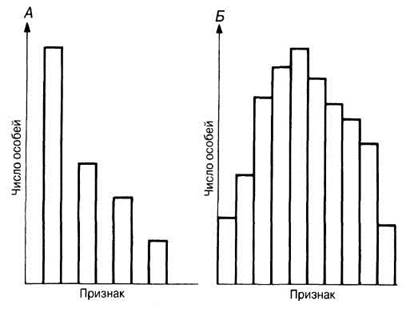
Fig. 24.29. Histograms showing the frequency distribution of variants in discrete (A) and continuous (B) variation.
24.8.1. Discrete Variation
Certain traits are represented in a population by a limited number of variants. In such cases, the differences between individuals are sharply defined, with no intermediate forms. Examples of such traits include human Blood Groups, wing length in Drosophila, melanic and typical forms of the peppered moth (Biston betularia), style length in primroses (Primula), and sex in both animals and plants. Traits characterized by discrete variation are typically controlled by one or two major genes with two or more alleles. Environmental conditions have a relatively minor effect on their phenotypic expression.
Because discrete variation is restricted to certain sharply defined traits, it is also referred to as qualitative variation, in contrast to quantitative or continuous variation.
24.8.2. Continuous Variation
For many traits, a population exhibits a complete spectrum of gradations from one extreme to the other. The most striking examples include traits such as mass, linear dimensions, and the shape and coloration of the body as a whole or of its individual parts. The frequency distribution for a continuously varying trait conforms to a normal distribution curve (see Appendix 2.3.3). Most members of the population fall into the middle portion of the curve, while approximately equal numbers of individuals are found at its tails, which correspond to the two extreme values of the trait. Traits characterized by continuous variation result from the combined action of many genes (polygenes) and environmental factors. Each individual Gene has a very small effect on the phenotype, but their combined impact is highly significant.
24.8.3. Environmental Influence
The primary factor determining any phenotypic trait is the genotype. An organism's genotype is established at the moment of Fertilization, but the extent to which this genetic potential is subsequently expressed depends to a large degree on external factors acting on the organism during its development. For instance, the tall pea variety used by Mendel typically reached a height of 180 cm. However, this required adequate lighting, a sufficient Water supply, and good soil. In the absence of optimal conditions (in the presence of a limiting factor), the tall-stem gene could not fully manifest its effect. The interactive effect of genotype and environmental factors was demonstrated by the Danish geneticist Johannsen. In a series of experiments using dwarf beans, he selected the heaviest and lightest seeds from each generation of these self-pollinating plants and planted them to produce the next generation. By repeating these experiments over several years, he found that within the "heavy" or "light" line, the seeds differed very little in average weight, whereas the differences in average weight between seeds from different lines—i.e., "heavy" and "light"—were substantial. This suggests that both heredity and the environment influence the phenotypic expression of a trait. Based on these results, continuous phenotypic variation can be defined as "the cumulative effect of changing environmental factors acting upon a variable genotype." These results also show that the heritability of a given trait is determined primarily by the genotype. As for The Development of purely human traits such as personality, temperament, and intelligence, available evidence indicates that they depend on both hereditary and environmental factors, which interact to varying degrees in different individuals to influence the final expression of the trait. It is these differences in genetic and environmental factors that create phenotypic diversity among people. We have no definitive data to suggest that any single one of these factors always predominates; however, the environment can never push the phenotype beyond the limits dictated by the genotype (Fig. 24.30).
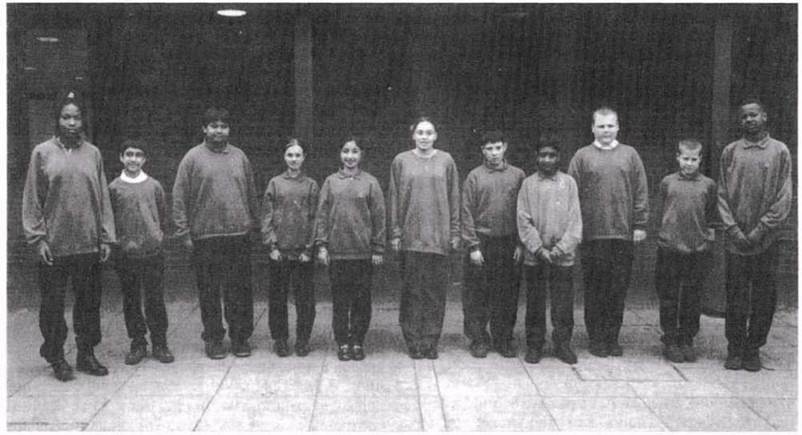
Fig. 24.30. Phenotypic variation in human height. All of these children are the same age.
24.8.4. Sources of Variation
It is essential to understand that the interplay between discrete and continuous variation and the environment makes it impossible for two organisms to possess identical phenotypes. The METABOLISM/36.html">DNA Replication Mechanism during mitosis is so close to perfection that the potential for genetic variation in asexually reproducing organisms is very low. Consequently, any visible variation in such organisms is almost certainly due to environmental influences. In contrast, sexually reproducing organisms have vast opportunities for generating genetic variation. Virtually limitless sources of genetic variation are provided by Crossing Over and the independent assortment of Chromosomes during Meiosis, as well as gamete fusion during fertilization. These processes are briefly outlined below.
1. Crossing over — the reciprocal exchange of genes between chromatids of homologous chromosomes, which can occur during prophase I of meiosis. This exchange creates new Linkage groups and novel combinations of alleles (Sec. 24.3).
2. Independent assortment — the orientation of homologous chromosome chromatids (bivalents) across the spindle equator in metaphase I of meiosis determines the direction in which each member of a pair will move during anaphase I. This chromatid orientation is random. During metaphase II, chromatid orientation is once again random and determines to which of the two opposite poles each chromosome will migrate during anaphase II. Random orientation and subsequent independent assortment (segregation) of chromosomes allow for a vast number of different chromosome combinations in Gametes, the number of which can be calculated (Sec. 24.2.1).
3. Random fertilization — the third source of variation arising in sexual reproduction, resulting from the fact that the fusion of male and female gametes occurs entirely by chance (in theory, at least). Any male gamete has the potential to fuse with any female gamete.
These three sources of genetic variation ensure the constant "shuffling" of genes that underlies continuous variation. The environment acts upon the entire array of phenotypes thus produced, and those best adapted to that environment succeed. This leads to changes in allele and genotype frequencies within the population (Ch. 27). However, these sources of variation do not generate the major Changes in the genotype required by evolutionary theory for The Emergence of new species. Such changes occur as a result of Mutations.
Last update: 06/08/2026
Editorial and Educational Adaptation: This material has been compiled based on the primary/original source text. The project team performed an editorial review, corrected technical inaccuracies, structured sections, and adapted the content for an educational format.
What was processed:
- elimination of formatting defects (OCR errors, structural breaks, corrupted characters);
- editorial organization of content;
- standardization of terminology in accordance with academic sources;
- verification of factual statements against the original source text.
All mentions of the author, publication year, and origin of the primary text have been preserved in accordance with the source.