BIOLOGY Volume 3 - A Textbook of General Biology - 2004
24. VARIATION AND GENETICS
24.5. Linkage groups and chromosomes
The findings presented in this chapter demonstrate the gradual accumulation of knowledge regarding the mechanisms of heredity. Early 20th-century genetic research was primarily focused on elucidating The Role of genes in the TRANSMISSION OF TRAITS. Morgan's work on the fruit fly (Drosophila melanogaster) showed that most phenotypic traits are grouped into four sets, and that traits within each group are inherited together. It was observed that the number of linkage groups corresponds to the number of chromosome pairs.
Studies in other organisms led to similar results. Experimental crosses involving various organisms revealed that some linkage groups are larger than others (i.e., they contain more genes). Chromosomal analysis of these organisms showed that they vary in length. Morgan demonstrated a clear correlation between these observations, providing further confirmation that genes are localized on Chromosomes.
Class="center">24.5.1. Giant chromosomes and genes
In 1913, Sturtevant began mapping genes on Drosophila chromosomes, which was 21 years before it became possible to link visibly distinguishable chromosomal structures with genes. In 1934, it was observed that the chromosomes in the salivary gland Cells of Drosophila are roughly 100 times larger than those in other somatic cells. For reasons still not entirely clear, these chromosomes undergo repeated Replication without separating, until several thousand copies lie side by side. By staining the chromosomes and examining them under a Microscope, one can see that they consist of alternating light and dark bands (Fig. 24.15). Each chromosome is characterized by a distinct and unique banding pattern. It was initially assumed—or rather hoped—that these bands represented actual genes, but the situation turned out to be more complex. Various phenotypic abnormalities can be ARTIFICIALLY INDUCED IN Drosophila, accompanied by specific Changes in the microscopic banding pattern. These phenotypic and chromosomal abnormalities, in turn, correlate with Gene loci mapped using recombination frequencies from experimental crosses. While the bands on the chromosomes indicate the positions of genes, they are not the genes themselves.
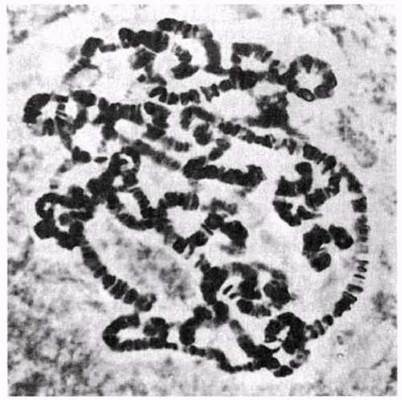
Fig. 24.15. Giant chromosomes from the salivary gland cells of Drosophila melanogaster. Four pairs of chromosomes joined at their centromeres are visible.
Last update: 06/08/2026
Editorial and Educational Adaptation: This material has been compiled based on the primary/original source text. The project team performed an editorial review, corrected technical inaccuracies, structured sections, and adapted the content for an educational format.
What was processed:
- elimination of formatting defects (OCR errors, structural breaks, corrupted characters);
- editorial organization of content;
- standardization of terminology in accordance with academic sources;
- verification of factual statements against the original source text.
All mentions of the author, publication year, and origin of the primary text have been preserved in accordance with the source.