Phycology - Kostikov I.Yu. - 2009-2013
Chapter 4. Biochemical Characteristics of Algal Divisions
Algal Cells, like those of other organisms, consist of various Biopolymers (primarily Proteins, CARBOHYDRATES, and Nucleic Acids) and their monomers (Amino Acids, simple sugars, and NUCLEOTIDES), Lipids, Water, and various Mineral Substances. The Specificity of the algal biochemical composition lies in the presence of a complex of diverse substances within the cells that participate in the light and dark METABOLISM/15.html">Phases of Photosynthesis. Specific substances ensuring the light phase include light-harvesting and light-transmitting colored substances—pigments, as well as specific Enzymes and electron carriers; the specific and most important substances of the dark phase include the enzyme RuBisCo (ribulose-1,5-bisphosphate carboxylase-oxygenase), along with several Other Enzymes.
Although the biochemical Diversity of Algae is enormous, the complex of biochemical characteristics at the division level primarily includes two groups of traits: pigment composition and the composition of reserve nutrients (assimilation products).
Based on their chemical nature, solubility, and Functions, pigments are divided into three main groups: chlorophylls, phycobilins, and carotenoids.
Chlorophylls have a green color, are readily soluble in polar Solvents, function in light harvesting, and are the main substances ensuring the light stage of photosynthesis. Chemically, chlorophylls are magnesium-containing tetrapyrroles. Currently, 4 types of chlorophylls are known in algae: a, b, c (with two forms, c1 and c2), and d, as well as two chlorophyll-like pheophorbides (a and b) capable of performing chlorophyll functions (Fig. 4.1, 4.2).
Class="center">
Fig. 4.1. Structural formula of chlorophyll a and its differences from other chlorophylls and chlorophyll-like pheophorbides. Chlorophyll b: the methyl group (R2) is replaced by a formyl group (-CHO); chlorophyll c1: the phytyl residue is absent (R4 is represented by -CH=CHCOOH), the 7th and 8th carbon atoms in the 4th pyrrole ring are connected by a double bond; chlorophyll c2: similarly to c1, except that the vinyl group (R3) is replaced by a divinyl group (-CH=CH2); chlorophyll d: the divinyl group (R1) is replaced by a formyl group (-CHO); chlorophyll-like pheophorbide a: the vinyl group (R3) is replaced by a divinyl group (-CH=CH2); chlorophyll-like pheophorbide b: the vinyl group (R3) is replaced by a divinyl group (-CH=CH2), and the methyl group (R2) is replaced by a formyl group (CHO).
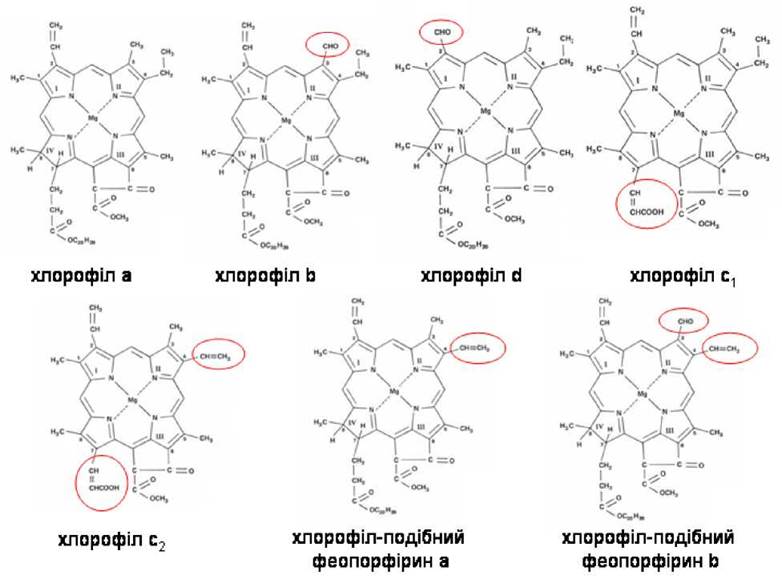
Fig. 4.2. Diversity of chlorophylls.
Chlorophylls are magnesium-containing tetrapyrroles that differ in the radicals of the First and Second pyrrole rings and in the presence or absence of a polyhydric alcohol phytyl residue in the fourth ring. Thus, in chlorophyll b, unlike chlorophyll a, the methyl radical In the second pyrrole ring is replaced by a formyl radical; in chlorophyll d, a formyl radical is present in the first pyrrole ring instead of a divinyl radical; both forms of chlorophyll c lack the phytyl residue, and in addition, chlorophyll c2 features a divinyl radical in the second ring instead of a vinyl one. A similar replacement of the vinyl radical with a divinyl one occurs in chlorophyll-like pheophorbides, but unlike chlorophyll c2, the phytyl residue is retained.
Different chlorophylls have slightly different absorption spectra. For instance, chlorophyll a in acetone extracts absorbs light most intensively in both the blue and red Regions of the spectrum (the wavelength at the absorption maximum is 430 and 660 nm, respectively). For chlorophyll b, the absorption maximum falls in the blue part of the spectrum (435 nm), with a threefold smaller peak observed in the red region (643 nm). Chlorophyll c also absorbs blue rays most intensively; an additional maximum occurs in the red region (630 nm).
A Cell may contain either only chlorophyll a or a combination of two chlorophylls, where the primary one is chlorophyll a, and the secondary one is b or c (Table 4.1). The composition of chlorophylls is an important characteristic at the division level. Overall, the following trend is observed in eukaryotic algae: algae with chlorophyte-type Plastids predominantly have chlorophylls in the a + b combination; prokaryotic algae and eukaryotes with primarily symbiotic glaucocystophyte (cyanoplasts) and rhodophyte (rhodoplasts) plastids contain chlorophyll a; algae with secondarily symbiotic rhodoplasts contain the a + c chlorophyll combination.
Table 4.1. Main pigments of algae across different divisions
Cyano-phyta |
Eugleno-phyta |
Chlorarachnio-phyta |
Raphido-phyta |
Chryso-phyta |
Xantho-phyta |
Eustigmato-phyta |
Phaeo-phyta |
Bacillario-phyta |
Dictyocho-phyta |
Dinop-hyta |
Hapto-phyta |
Crypto-phyta |
Glaucocysto-phyta |
Rhodo-phyta |
Chloro-phyta |
Higher plants |
|
Chlorophylls |
|||||||||||||||||
chlorophyll a |
* |
* |
* |
* |
* |
* |
* |
* |
* |
* |
* |
* |
* |
* |
* |
* |
* |
chlorophyll b |
± |
* |
* |
+ |
* |
* |
|||||||||||
chlorophyll c |
+ |
* |
* |
* |
* |
* |
* |
* |
* |
± |
|||||||
Phycobilin pigments |
|||||||||||||||||
phycocyanin |
* |
* |
* |
* |
|||||||||||||
allophycocyanin |
* |
* |
* |
||||||||||||||
phycoerythrin |
* |
* |
* |
* |
|||||||||||||
Carotenoids |
|||||||||||||||||
carotenes |
|||||||||||||||||
α-carotene |
* |
* |
* |
+ |
+ |
+ |
+ |
||||||||||
β-carotene |
+ |
+ |
+ |
+ |
+ |
+ |
+ |
+ |
+ |
+ |
+ |
+ |
+ |
+ |
+ |
+ |
|
γ-carotene |
* |
+ |
+ |
||||||||||||||
ε-carotene |
* |
* |
* |
* |
|||||||||||||
lutein-series xanthophylls: |
* |
* |
+ |
+ |
+ |
+ |
* |
* |
+ |
+ |
+ |
* |
* |
* |
* |
||
lutein |
+ |
+ |
+ |
* |
* |
||||||||||||
zeaxanthin |
* |
± |
+ |
+ |
± |
± |
+ |
* |
* |
+ |
+ |
||||||
violaxanthin |
+ |
+ |
+ |
* |
* |
± |
* |
* |
|||||||||
neoxanthin |
* |
+ |
+ |
+ |
+ |
+ |
+ |
+ |
* |
* |
|||||||
antheraxanthin |
+ |
+ |
+ |
± |
+ |
+ |
|||||||||||
diatoxanthin-series xanthophylls: |
+ |
* |
* |
* |
* |
* |
* |
* |
* |
||||||||
diatoxanthin |
± |
+ |
* |
+ |
* |
+ |
* |
* |
|||||||||
diadinoxanthin |
+ |
* |
+ |
* |
+ |
* |
+ |
* |
* |
||||||||
dinoxanthin |
+ |
± |
+ |
||||||||||||||
fucoxanthin |
* |
* |
* |
* |
* |
± |
* |
||||||||||
specific xanthophylls: |
|||||||||||||||||
echinenone |
* |
± |
+ |
± |
+ |
± |
+ |
||||||||||
canthaxanthin |
* |
+ |
+ |
± |
+ |
||||||||||||
oscilloxanthin |
+ |
||||||||||||||||
myxoxanthophyll |
+ |
||||||||||||||||
cryptoxanthin |
+ |
± |
+ |
± |
± |
+ |
+ |
+ |
± |
||||||||
astaxanthin |
± |
||||||||||||||||
vaucheriaxanthin |
+ |
* |
+ |
||||||||||||||
heteroxanthin |
+ |
* |
|||||||||||||||
alloxanthin |
* |
||||||||||||||||
crocoxanthin |
+ |
||||||||||||||||
monadoxanthin |
+ |
||||||||||||||||
taraxanthin |
+ |
||||||||||||||||
siphonein |
± |
||||||||||||||||
siphonaxanthin |
± |
||||||||||||||||
Note. An asterisk (*) indicates predominant pigments, a plus sign (+) denotes additional pigments present in relatively small quantities, and a plus-minus sign (±) designates pigments found only in individual representatives.
The second group of pigments is phycobilins. Phycobilins somewhat resemble chlorophylls because they are also tetrapyrroles. However, unlike chlorophylls, phycobilins are linear tetrapyrroles that do not contain magnesium; instead, they are covalently bonded to proteins. Phycobilins are highly water-soluble pigments.
There are three main groups of phycobilins: red phycoerythrin, and blue phycocyanin and allophycocyanin. Phycobilin pigments are characteristic of blue-green, glaucocystophyte, red, and cryptophyte algae. In these divisions, with the exception of Cryptophyta, phycobilins are localized in specialized structures called phycobilisomes, which are located On the surface of thylakoids. In cryptophyte algae, phycobilins are embedded directly into the thylakoid membranes.
The third group of pigments, carotenoids, have a yellow, red, or brown color and are isoprenoid polyene pigments. Carotenoids include Carotenes and Their oxidized derivatives, xanthophylls.
Four types of carotenes have been discovered in algae: α, β, γ, ε. Carotenes are soluble in non-polar solvents. The most widespread is β-carotene, which is present in almost all algal divisions. Other carotene types are found only in certain macro-taxa, which is why carotene composition is used as an additional characteristic at the division level.
Oxidized carotene derivatives, xanthophylls, are water-soluble pigments. Xanthophylls are highly diverse in algae. However, in the most general terms, xanthophylls are subdivided into: a) lutein-series xanthophylls (lutein, violaxanthin, neoxanthin, zeaxanthin, antheraxanthin); b) diatoxanthin-series xanthophylls (diatoxanthin, diadinoxanthin, dinoxanthin, fucoxanthin); c) specific, predominantly minor xanthophylls.
Lutein-series xanthophylls are present in almost all algal divisions as well as in higher plants. Diatoxanthin-series xanthophylls are mainly found in algae that possess secondarily symbiotic plastids derived from rhodoplasts. Specific xanthophylls are typically present in only one specific division; for example, myxoxanthophyll is found in blue-green algae, alloxanthin in cryptophytes, and taraxanthin in red algae.
The composition and quantity of chlorophylls, carotenoids, and phycobilins determine the characteristic color of algal cells. For instance, in blue-green algae, green chlorophylls and blue phycobilins—phycocyanin and allophycocyanin—predominate among the pigments, which is why the cells most frequently have a blue-green color. In brown algae, the yellow xanthophyll fucoxanthin predominates, masking the green chlorophylls; accordingly, the thalli of brown algae are colored dark yellow or brown. In green and euglenoid algae, chlorophylls overwhelmingly predominate over other pigment types, and As a result, the cells of representatives of these divisions are predominantly green.
Assimilation products. As the end product of photosynthesis, algae produce carbohydrates that accumulate in the cells as the primary reserve nutrients. Algae store Polysaccharides of two main groups: firstly, starch- and Glycogen-like polysaccharides, which are α-1,4-glucans (animal glycogen, plant starch, blue-green algal starch, floridean starch); secondly, chrysolaminarin-like polysaccharides: β-1,3-glucans, which include chrysolaminarin, laminarin, and paramylon.
Assimilation products vary among algae of different divisions (Table 4.2) and accumulate either in the Cytoplasm (in most divisions), in the periplastidal space (cryptophyte algae), or in the plastid (green algae and higher plants).
Table 4.2. Main assimilation products of algae from various divisions
Cyano-phyta |
Eugleno-phyta |
Chlorarachnio-phyta |
Raphido-phyta |
Chryso-phyta |
Xantho-phyta |
Eustigmato-phyta |
Phaeo-phyta |
Bacillario-phyta |
Dictyocho-phyta |
Dino-phyta |
Hapto-phyta |
Crypto-phyta |
Glaucocysto-phyta |
Rhodo-phyta |
Chloro-phyta |
Higher plants |
|
glycogen |
± |
||||||||||||||||
starch |
* |
* |
* |
* |
* |
||||||||||||
blue-green algal starch |
* |
||||||||||||||||
floridean starch |
* |
||||||||||||||||
chrysolaminarin |
* |
* |
* |
* |
* |
* |
* |
||||||||||
laminarin |
* |
||||||||||||||||
paramylon |
* |
* |
± |
Note. Asterisks (*) indicate main assimilation products; the plus-minus sign (±) denotes assimilates found only in certain representatives.
A particular assimilation product can be identified most simply by means of cytochemical staining. Specifically, when treated with an iodine-potassium iodide solution, starch turns dark blue, blue-green algal starch turns brown, and floridean starch turns red; paramylon is recognized by its reaction with potassium hydroxide or sodium hydroxide, Swelling significantly upon exposure to alkalis. Laminarin and chrysolaminarin do not exhibit specific colorations or swelling when treated with iodine and alkalis.
In addition to polysaccharides, the cells of almost all algae tend to accumulate oil as they age. In certain divisions (particularly in blue-green algae), nitrogen- and phosphorus-containing compounds may also be stored: cyanophycin (a polymer of the amino acids Arginine and asparagine) and polyphosphate bodies, respectively.
Last update: 07/08/2026
Editorial and Educational Adaptation: This material has been compiled based on the primary/original source text. The project team performed an editorial review, corrected technical inaccuracies, structured sections, and adapted the content for an educational format.
What was processed:
- elimination of formatting defects (OCR errors, structural breaks, corrupted characters);
- editorial organization of content;
- standardization of terminology in accordance with academic sources;
- verification of factual statements against the original source text.
All mentions of the author, publication year, and origin of the primary text have been preserved in accordance with the source.