BIOCHEMISTRY - L. Stryer - 1984
VOLUME 2
PART III. BIOSYNTHESIS OF MACROMOLECULAR PRECURSORS
CHAPTER 23. INTEGRATION OF METABOLISM
23.2. Recurring Motifs in Metabolic Regulation
The complex network of reactions occurring within a Cell is finely regulated and coordinated. There are several ways in which metabolic processes are regulated.
Class="center">Fig. 23.4. Examples of reversible Covalent Modification of Proteins: 1 - phosphorylation; 2 - adenylylation; 3 - methylation
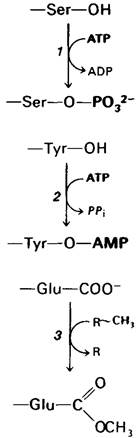
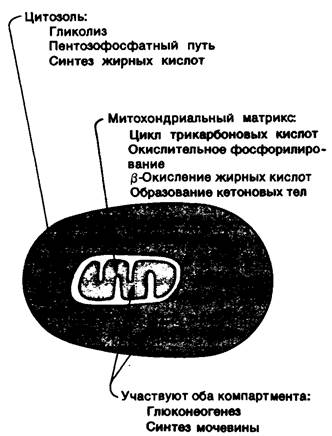
Fig. 23.5. Compartmentalization of Major Metabolic Pathways
1. Allosteric interactions. The flux of molecules through most metabolic pathways is determined primarily by the amount and activity of specific Enzymes rather than by substrate availability. Virtually irreversible reactions are potential regulatory sites. The first irreversible reaction in a metabolic pathway (the committed step) usually serves as an important control element. Enzymes catalyzing committed steps are regulated allosterically, such as Phosphofructokinase in Glycolysis or acetyl-CoA carboxylase in fatty acid synthesis. In addition, subsequent irreversible reactions in the same pathway may also be regulated. Allosteric interactions enable these enzymes to detect diverse signals and integrate the information received.
2. Covalent modification. Some regulatory enzymes are controlled not only allosterically but also by covalent modification. For example, phosphorylation increases the catalytic activity of Glycogen phosphorylase and decreases The activity of glycogen synthase. These covalent modifications are catalyzed by specific enzymes. Another example is Glutamine Synthetase, whose activity is decreased by the covalent attachment of an AMP moiety. Here too, the attachment and removal of the modifying group are catalyzed by specialized enzymes. Why is covalent modification used alongside noncovalent Allosteric Regulation? Covalent modification of key metabolic enzymes is The final stage of a signal-amplifying cascade. This allows a metabolic pathway to be rapidly switched on and off by very weak signals, as exemplified by the stimulatory effect of epinephrine on glycogen breakdown.
3. Enzyme amounts. The amount of an enzyme, as well as its activity, is regulated. The rates of Synthesis and degradation of certain regulatory enzymes are controlled by hormonal factors.
4. Compartmentalization. The overall pattern of METABOLISM varies greatly among different spatially segregated regions (compartments) of Eukaryotic Cells. Glycolysis, the Pentose Phosphate Pathway, and fatty acid synthesis occur in the Cytosol, whereas Fatty acid oxidation, The Citric Acid Cycle, and Oxidative Phosphorylation take place in Mitochondria. Some processes, such as Gluconeogenesis and The Urea Cycle, depend on the interplay of reactions occurring in both compartments. The Fate of certain molecules is determined by their Location—whether they are in the cytosol or in the mitochondria. This enables The regulation of their flux across The inner mitochondrial membrane. For example, Fatty acids, once transported into mitochondria, are rapidly degraded, whereas in the Cytoplasm they are esterified or exported into the extracellular space. Recall that long-chain Fatty acids are transported into the mitochondrial matrix as esters of carnitine, a carrier that enables these molecules to cross the inner mitochondrial membrane.
The Pasteur Effect is the inhibition of glycolysis by Respiration, discovered by Louis Pasteur during his studies on Yeast Fermentation. Under aerobic conditions, carbohydrate consumption is about 7 times lower than under anaerobic conditions. The Pasteur effect can be explained by the inhibition of phosphofructokinase by citrate and ATP.
5. Metabolic specialization of Organs. In higher eukaryotes, regulation is more effective because it is highly influenced by the presence of organs with specific Metabolic Regulation.
23.3. Major Metabolic Pathways and Control Sites
Let us consider the roles of the major metabolic pathways and the key steps at which regulation occurs
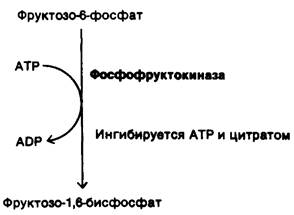
1. Glycolysis. This sequence of reactions, occurring in the cytosol, converts one molecule of glucose into two molecules of Pyruvate, yielding two molecules of ATP and two molecules of NADH. For glycolysis to proceed continuously, NAD+ must be regenerated, which is consumed in the reaction catalyzed by glyceraldehyde 3-phosphate dehydrogenase. Under anaerobic conditions, such as in actively contracting Skeletal Muscle, this is achieved by reducing pyruvate to lactate. Under aerobic conditions, NAD+ is regenerated differently—by transferring electrons from NADH to O2 via the electron-transport chain. Glycolysis serves two major Functions: it degrades glucose to generate ATP and provides carbon skeletons for biosynthetic reactions. The rate of conversion of glucose into pyruvate is regulated to meet these two needs. The most important regulatory site is phosphofructokinase, which catalyzes the committed step of glycolysis. High concentrations of ATP inhibit phosphofructokinase. This inhibitory effect of ATP is enhanced by citrate and reversed by AMP. Thus, the rate of glycolysis is determined by The Need for ATP, signaled by the ATP/AMP ratio, and the need for building blocks, signaled by the concentration of citrate.
2. The Citric Acid cycle. This is the final common pathway for The oxidation of fuel molecules: CARBOHYDRATES, Amino Acids, and fatty acids. It operates in mitochondria. Energy-rich molecules enter the cycle primarily as acetyl-CoA. The Complete oxidation of one acetyl unit yields one molecule of GTP, three molecules of NADH, and one molecule of FADH2. Four pairs of electrons are then transferred to O2 via the electron-transport chain; this generates a proton gradient that drives the synthesis of eleven molecules of ATP. NADH and FADH2 are oxidized only if ADP is simultaneously phosphorylated to ATP. This tight coupling is called Respiratory Control; it ensures that the rate of the citric acid cycle matches the need for ATP. In addition, an excess of ATP decreases the activity of three enzymes in the cycle: citrate synthase, isocitrate dehydrogenase, and α-ketoglutarate dehydrogenase. Furthermore, the citric acid cycle plays an important role in anabolism. It provides intermediates, such as succinyl-CoA, which serves as a source for part of the carbon Skeleton of Porphyrins.
3. The pentose phosphate pathway. This series of reactions, occurring in the cytosol, serves two functions: generating NADPH for reductive biosyntheses and producing ribose 5-phosphate for nucleotide synthesis. Two molecules of NADPH are formed in The conversion of glucose 6-phosphate into ribose 5-phosphate. The committed step of this pathway is the dehydrogenation of glucose 6-phosphate. This reaction is regulated by the concentration of the electron acceptor NADP+. The extra phosphoryl group on NADPH is a tag that distinguishes it from NADH. Because of this difference, a high [NADPH]/[NADP+] ratio and a low [NADH]/[NAD+] ratio can be maintained in the same compartment. Consequently, reductive biosyntheses and glycolysis can proceed simultaneously at high rates.
4. Gluconeogenesis. Glucose can be synthesized in The Liver and Kidneys from noncarbohydrate precursors, such as lactate, glycerol, and amino acids. Various substances enter this pathway primarily via pyruvate, which is carboxylated in mitochondria to form oxaloacetate. Oxaloacetate is then decarboxylated and phosphorylated in the cytosol to form phosphoenolpyruvate. Two other hydrolytic reactions, characteristic of gluconeogenesis, bypass the irreversible steps of glycolysis. Gluconeogenesis and glycolysis are usually coordinated reciprocally so that while one pathway is inactive, the other is highly active. For example, AMP inhibits and citrate activates fructose 1,6-bisphosphatase—a key enzyme of gluconeogenesis—whereas these molecules have the opposite effects on phosphofructokinase, which determines the rate of glycolysis.
5. Glycogen Synthesis and Degradation. Glycogen is a readily mobilized storage form of energy. It is a branched polymer of glucose residues. The activated intermediate for glycogen synthesis is UDP-glucose, which is formed from glucose 1-phosphate and UTP. Glycogen synthase catalyzes The transfer of a glucose residue from UDP-glucose to the terminal hydroxyl group of a growing chain. Glycogen degradation proceeds by a different pathway. Phosphorylase catalyzes the Cleavage of glycogen by orthophosphate to yield glucose 1-phosphate. Glycogen synthesis and degradation are coordinated by a hormone-triggered amplifying cascade, so that when Glycogen synthase is inactive, phosphorylase is active, and vice versa. These enzymes are regulated by phosphorylation and noncovalent allosteric interactions (Section 16.15).
Fig. 23.7. Dehydrogenation of glucose 6-phosphate—the committed step of the pentose phosphate pathway
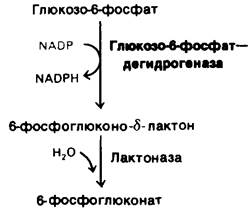
Fig. 23.8. Fructose-1,6-bisphosphatase—the key regulatory step of gluconeogenesis
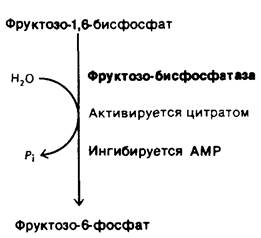
Fig. 23.9. Acetyl-CoA carboxylase—the key regulatory step of fatty acid synthesis

6. Synthesis and degradation of fatty acids. Fatty acids are synthesized in the cytosol by The addition of two-carbon units to a growing chain attached to an acyl carrier protein. The activated intermediate, malonyl-CoA, is formed by the carboxylation of acetyl-CoA. Acetyl groups are transferred from mitochondria to the cytosol by citrate. This shuttle mechanism provides part of the NADPH required for the reduction of the added acetyl group. The remaining NADPH is supplied by the pentose phosphate pathway. Citrate stimulates acetyl-CoA carboxylase, the enzyme that catalyzes the committed step. When The Cell has an excess of ATP and acetyl-CoA, the concentration of citrate increases, which accelerates fatty acid synthesis. Fatty acid degradation occurs via a different pathway and in a different compartment. They are degraded to acetyl-CoA in the mitochondrial matrix by β-oxidation. Then, if sufficient oxaloacetate is available, acetyl-CoA enters the citric acid cycle. Otherwise, acetyl-CoA can be converted into Ketone Bodies. FADH2 and NADH generated by β-oxidation donate their electrons to O2 via the Electron Transport Chain. Like the citric acid cycle, β-oxidation can proceed only if NAD+ and FAD are continually regenerated. Consequently, the rate of fatty acid degradation is also linked to the cell's demand for ATP.
Last update: 06/08/2026
Editorial and Educational Adaptation: This material has been compiled based on the primary/original source text. The project team performed an editorial review, corrected technical inaccuracies, structured sections, and adapted the content for an educational format.
What was processed:
- elimination of formatting defects (OCR errors, structural breaks, corrupted characters);
- editorial organization of content;
- standardization of terminology in accordance with academic sources;
- verification of factual statements against the original source text.
All mentions of the author, publication year, and origin of the primary text have been preserved in accordance with the source.