BIOCHEMISTRY - L. Stryer - 1984
VOLUME 2
PART II GENERATION AND STORAGE OF METABOLIC ENERGY
CHAPTER 16. GLYCOGEN AND DISACCHARIDE METABOLISM
16.14. Glycogen Synthase is Inactivated by the Phosphorylation of a Specific Serine Residue
Glycogen synthesis is tightly coordinated with its degradation. The activity of glycogen synthase, much like that of phosphorylase, is regulated through covalent modification. Upon phosphorylation, glycogen synthase a is converted into the typically inactive form b. The phosphorylated b-form (formerly designated as the D, or dependent form) requires high concentrations of glucose-6-phosphate for its activity, whereas the dephosphorylated a-form (previously known as the I, or independent form) is active both in the presence and absence of glucose-6-phosphate. Thus, phosphorylation exerts opposite effects on the activities of Glycogen synthase and Glycogen phosphorylase.
Class="center">Fig. 16.7. Schematic diagram of the phosphorylase b dimer viewed along the twofold axis of Symmetry, showing the arrangement of domains and binding sites
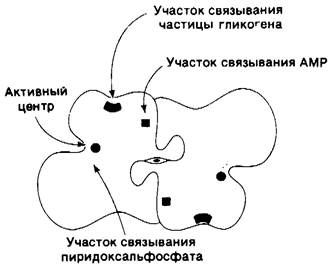
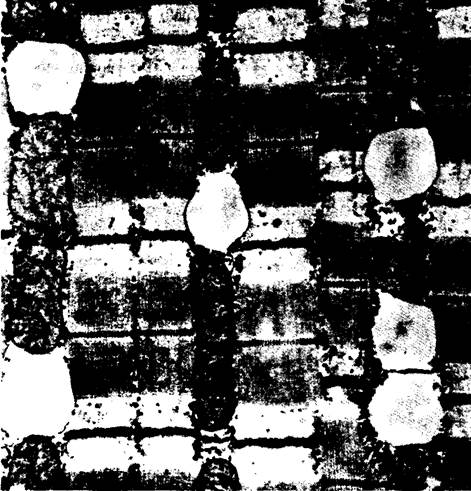
Fig. 16.8. Electron micrograph showing the localization of glycogen particles in cardiac Muscle
16.15. A Cascade of Reactions Controls the Phosphorylation of Glycogen Synthase and Glycogen Phosphorylase
Let us now examine the relationship between Hormones affecting Glycogen METABOLISM and the phosphorylation reactions that determine the activities of glycogen synthase and glycogen phosphorylase. This involves the following sequence of reactions (Fig. 16.9):
1. Epinephrine binds to Cell/30.html">The Plasma Membrane of a muscle cell and stimulates adenylate cyclase.
2. Adenylate cyclase catalyzes The formation of cyclic AMP from ATP within the plasma membrane.
3. Elevated intracellular levels of cyclic AMP activate protein kinase. In the absence of cyclic AMP, this kinase is inactive; the binding of cyclic AMP leads to its allosteric stimulation (Chap. 35).
4. The cyclic AMP-dependent protein kinase phosphorylates phosphorylase kinase and glycogen synthase. The phosphorylation of both Enzymes underlies the Coordinated regulation of glycogen Synthesis and Breakdown. It results in the "turning on" of phosphorylase (mediated by phosphorylase kinase) and the simultaneous "turning off" of glycogen synthase (directly).
Fig. 16.9. Reaction cascades regulating glycogen metabolism: A—glycogen degradation; B—glycogen synthesis. Inactive forms of enzymes are shown in red, active forms in green. The sequence of reactions leading to the activation of protein kinase is identical for The regulation of both glycogen breakdown and synthesis

16.16. Phosphatases Reverse the Regulatory Effects of Kinases
Changes in enzymatic activity induced by phosphorylation can be reversed by the hydrolytic removal of the phosphoryl group. For example, The conversion of phosphorylase a into phosphorylase b is catalyzed by phosphorylase phosphatase.
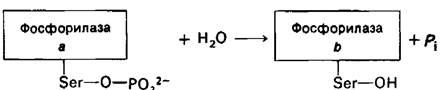
This enzyme also hydrolyzes the phosphoryl group of the active form of phosphorylase kinase, causing its inactivation. Furthermore, this same phosphatase removes the phosphoryl group from glycogen synthase b, converting it into the significantly more active a-form. This represents yet another molecular device ensuring the coordinated Synthesis and degradation of glycogen. Phosphatase activity also appears to be regulated. For example, a combination of Ca2+ and Mg-ATP inhibits phosphorylase phosphatase while activating phosphorylase kinase. Muscle glycogen synthase phosphatase is inhibited by glycogen. Consequently, at high glycogen levels, muscle glycogen synthase remains in the phosphorylated b-form.
The signal generated by the formation of cyclic AMP can also be "turned off." The phosphodiester bond in Cyclic AMP is hydrolyzed by a specific phosphodiesterase to yield AMP, which does not activate protein kinase. The ∆G0' value for this highly exergonic reaction is — 11.9 kcal/mol.

16.17. A Reaction Cascade Amplifies the Hormonal Signal
The cascade of enzymatic reactions in the Regulation of Glycogen metabolism is analogous to the proteolytic cascade in Blood Coagulation (Section 8.17). In both cases, the enzymatic cascade provides a high degree of Amplification. In the case of glycogen breakdown, there are three enzymatic control stages, whereas in glycogen synthesis There are two such stages. If direct regulation of glycogen phosphorylase and glycogen synthase occurred via adrenaline binding, The amount of hormone required to stimulate glycogen breakdown would be more than a thousand times higher than the amount required in the presence of the amplifying cascade.
Last update: 06/08/2026
Editorial and Educational Adaptation: This material has been compiled based on the primary/original source text. The project team performed an editorial review, corrected technical inaccuracies, structured sections, and adapted the content for an educational format.
What was processed:
- elimination of formatting defects (OCR errors, structural breaks, corrupted characters);
- editorial organization of content;
- standardization of terminology in accordance with academic sources;
- verification of factual statements against the original source text.
All mentions of the author, publication year, and origin of the primary text have been preserved in accordance with the source.