Pharmacognosy with the Fundamentals of Plant Biochemistry - Kovalyov V. M. 2004
Special Part
Vitamins
Medicinal plants and raw materials containing vitamin C
ROSE HIPS — FRUCTVS ROSAE
Cinnamon rose, syn. May rose — Rоsa cinnamómea L., rugose rose — Rоsa rugósa Thunb., dog rose — Rоsa canina L., apple rose — Rоsa villоsa L., fam. Rosaceae
Cinnamon rose (May rose), rugose rose, drooping rose, dog rose, apple rose; the name originates from the Greek rhodon, possibly related to the Celtic rhodd — red, and Latin cinnamómea — referring to the brownish color of the branches resembling cinnamon. The genus Rosa is divided into two sections: Cinnamomeae (cinnamon roses) and Caninae (dog roses).
Plant. Species of cinnamon rose are prickly shrubs 0.5-2 m in height. Branches are brownish-red with numerous small, somewhat curved prickles usually paired at the leaf bases. Leaves are imparipinnate, with seven to nine oblong-elliptic or ovate leaflets with serrate margins; stipules are partially fused with the petiole. Flowers are solitary or in groups of two to three. Sepals numbering five are lanceolate, simple, persistent, and erect upon fruit ripening. Fruits (hypanthia) are fleshy, globose, oval, or ovate (rarely fusiform), smooth, glabrous, 0.7-3.0 cm long and 0.6-1.7 cm in diameter, ranging from orange to brownish-red; the inner surface is densely lined with long, very stiff, bristle-like hairs; seeds are small, hard, shaped like angular nutlets. Blooms in May–June; fruits ripen in August–September.
Species of dog rose are shrubs morphologically similar to the cinnamon rose, but the fruits are generally larger and darker (dark red); sepals are pinnate, reflexed toward the Base of the fruit after flowering and appressed to it. After fruit maturation, the sepals fall off, leaving a pentagonal disc in their place.
Distribution. Cinnamon rose grows in the northern regions of Ukraine in forests, among shrubs, particularly along rivers, and less frequently in meadows. Rugose rose grows wild in the Far East and is cultivated in Ukraine. Drooping rose grows in the forest and subalpine belts of the Carpathians, especially in forest clearings. Dog rose is widespread throughout Ukraine on slopes, forest edges, along roadsides, and in waste areas. Apple rose grows in almost all of Ukraine among shrub thickets, at forest edges, in open woodlands, on steep slopes, and along forest streams.
Harvesting. Fruits are harvested by hand during full maturity (avoiding overripeness) while wearing canvas gloves, and placed in fabric-lined baskets. The harvested fruits are dried immediately in a dryer at 80-90 °C, spread in a thin layer. The finished raw material is stored in dry, cool rooms.
Chemical composition of the raw material. Species of the section Cinnamomeae contain an exceptionally high amount of ascorbic acid in their fruits (cinnamon rose up to 14%, rugose rose up to 6%), whereas Vitamin C content in fruits of the section Caninae does not exceed 1%. Rose hips also contain carotene (0.7-8 mg%), Vitamins B1, B2, PP, K1, pantothenic acid, Flavonoids (quercetin, kaempferol and their derivatives; anthocyanins; catechins), phenolic acids, pectic substances (1.5-4%), sugars (0.9-18%), organic acids (0.9-3.7%), Tannins, and salts of iron, manganese, phosphorus, magnesium, and calcium. Seeds contain fatty oil rich in carotenoids and vitamin E.
Class="center">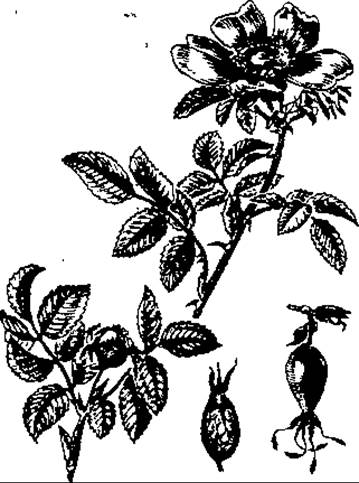
Cinnamon rose
Biological activity and application. Rose hips exhibit antiscorbutic, anti-atherosclerotic, and anti-inflammatory effects, activate enzyme systems and redox processes in the body, favorably influence Carbohydrate METABOLISM, enhance hormone synthesis and tissue regeneration, stimulate the body's resistance to adverse environmental factors, increase Bile secretion, and elevate diuresis. Rose hips are used for the Prevention and Treatment of vitamin C and P hypovitaminosis and avitaminosis, atherosclerosis, nephritis, acute and chronic Liver and intestinal diseases, PEPTIC ULCER DISEASE, hemorrhagic diathesis, hemophilia, hemorrhages (pulmonary, uterine), anticoagulant overdosage, hyperthyroidism and adrenal insufficiency, and Traumatic Shock. Rose hips are a component of vitamin herbal mixtures, as well as the hypoglycemic mixture "Arfazetin". Holosas, a syrup made from an aqueous concentrated extract of rose hips, is prescribed for cholecystitis and hepatitis. A vitamin syrup with added sugar and ascorbic acid is also prepared from the juice of high-vitamin rose hip species.
An oil is manufactured from rose hip seeds and used externally for wound healing, cracked nipples, pressure sores, trophic ulcers of the lower leg, dermatoses, in dental practice, and in the form of microclysters for nonspecific Ulcerative Colitis. Carotolin, an oily extract of carotenoids from the fruit pulp, is used similarly. Canephron, the sum of carotenoids from rose hip fruits excluding the nutlets, has Applications similar to carotolin.
The SCIEP (State Scientific Center of Medicines) has developed a group of preparations from Holosas production waste under the general name "Lipochromin", which is considered an agent for the prevention and treatment of radiation sickness. It is also used during Chemotherapy for malignant neoplasms of various localizations, post-radiation Disorders of the gastrointestinal tract, hematopoietic system, and immune status. This remedy is recommended for adapting the body to hazardous environmental conditions.
BLACK CURRANT FRUITS - FRUCTUS RIBIS NIGRI
BLACK CURRANT LEAVES — FOLIA RIBIS NIGRI
Black currant — Ribes nigrum L., fam. Grossulariaceae
Black currant; the name originates from the latinized Arabic ribas — sour in taste; Latin niger, -gra, -grum — black.
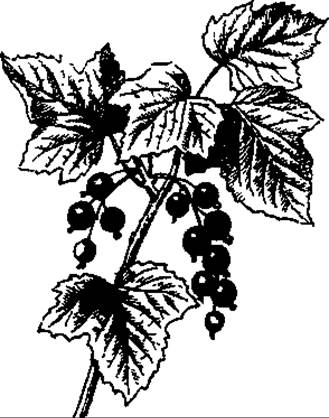
Plant. A small perennial shrub 0.6-2 m in height. Stems are dark brown or red-brown; the bark of young stems is yellowish-gray. Lower branches sometimes rest on the ground. Leaves are petiolate, alternate, up to 10 cm long, three- to five-lobed, serrate-dentate along the margin, glabrous above, pubescent along the Veins beneath, with yellow glands, and aromatic. Flowers are bisexual, regular, campanulate, lilac- or pinkish-gray, in drooping 5-12-flowered racemes 5-8 cm long. Fruits are berries in racemes, globose, black, 7-10 mm in diameter, bearing a whitish membranous calyx at the apex; the surface is covered with glands containing essential oil; the pulp contains numerous small seeds. Blooms in May–June; fruits ripen in July–August.
Distribution. In the wild in Ukraine, black currant grows in the Carpathians, Precarpathia, Polissia, and the Forest-Steppe zone along streams and rivers, in forests, and among shrubs in damp locations. It has been introduced into cultivation and is the progenitor of cultural varieties, which currently number over 100.
Harvesting. Ripe fruits are either consumed and processed fresh or dried in dryers (starting at 35 °C and gradually raising up to 65 °C, avoiding overdrying).
Leaves are harvested in late spring and summer; they are dried at a Temperature of 35-40 °C.
Chemical COMPOSITION OF THE raw material. Fruits contain ascorbic acid (up to 500 mg%), B vitamins, vitamins K, E, and carotene; sugars (17%), Pectins, fatty oil, anthocyanins (cyanidin and delphinidin derivatives), flavonols (kaempferol, quercetin, myricetin and their derivatives), Coumarins, hydroxycinnamic acids, organic acids (malic, tartaric, citric, oxalic, etc.— totaling 4%), essential oil, Enzymes (emulsin), and Mineral Substances.
The leaves have been found to contain essential oil (0.75%) comprising linalool, geraniol, limonene, cymene, sabinene, etc.; flavonoids (quercetin, isoquercitrin, rutin, kaempferol, astragalin, myricetin), hydroxycinnamic acids, tyrosol, gallic acid, methyl gallate, coumarins, phytosterol, pentosans, organic acids, vitamin C (400 mg%), carotenes, sugars, the enzyme emulsin, and tannins.
Biological activity and application. All types of raw material possess diuretic, diaphoretic, antimicrobial, capillary-strengthening, astringent, and tonic properties, and enhance Immunity. Fresh and dried fruits are beneficial for hypochromic anemia, periodontal disease, gastrointestinal disorders, Glomerulonephritis, Cardiac Arrhythmias, Hypertension, cardioneurosis, hemorrhagic vasculitis, and colds and infectious diseases. The raw material is used primarily in herbal mixtures.
At the Department of Pharmacognosy of NUPh, glucorubin, an anti-allergic agent, has been developed from black currant leaves, as well as a leaf tincture—riflan—for use in proctology as a regenerative and anti-inflammatory remedy.
STRAWBERRY LEAVES — FOLIA FRAGARIAE
Wild strawberry — Fragаria vesca L., fam. rose family — Rosaceae
Wild strawberry (Zemlyanika lesnaya); the name comes from the Latin fraga, -arum (strawberry fruit) and fragare (to be fragrant); and the Latin vescus (edible), from vescor (to feed upon).
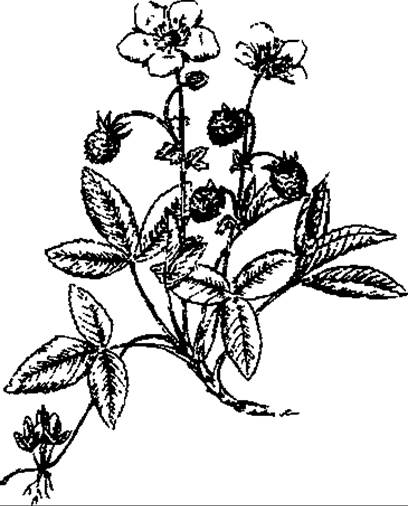
The plant is a perennial herb with a short horizontal or oblique rhizome and long creeping shoots that ROOT at the nodes. Stems are erect or ascending, 5-20 cm high, slightly exceeding the basal leaves, covered underneath with spreading hairs and above with appressed hairs. Leaves are trifoliate; basal leaves have long, spreading-hairy petioles; leaflets are sessile, almost oval-rhombic, the middle leaflet is ovate or rhombic, and the lateral ones are obliquely ovate with large triangular or nearly rounded Teeth ending in short reddish points; the terminal tooth of the leaf is somewhat narrower than the adjacent teeth and does not rise above them; the yellowish central and first-order lateral veins stand out sharply on the underside of the leaflets. The upper surface of the leaflets is dark green and sparsely appressed-hairy; the lower surface is light green and densely covered with appressed silky hairs, 1.5–6 cm long and 1.6–4 cm wide. Flowers are regular, bisexual, on thin, long, appressed-hairy pedicels in a corymbose, few-flowered inflorescence; petals (five in number) are white, ovate or rounded, with a short claw. Fruits are berry-like, drooping, conical, ovate or spherical, bright or dark red, covered at the base with small, dark achenes, about 6 mm long. It blooms in May–June, and the fruits ripen in June–July.
Distribution. Found in most parts of Ukraine, except for the steppe zone. It grows in coniferous and mixed forests, forest glades, edges, among shrubs, in dry meadows and grassy slopes in forest regions and the southern and middle PARTS OF THE Forest-Steppe; further south it occurs less frequently.
Harvesting. Leaves are harvested during the plant's flowering period by plucking or cutting with a sharp knife so that the remaining petiole does not exceed 1 cm. The collected leaves are placed in a loose layer in an open container and transported to the drying site. They are dried outdoors in the shade or on racks in a well-ventilated room spread over canvas or sacking, turning them over from time to time.
Chemical composition of the raw material. The leaves contain ascorbic acid (up to 280 mg% in fresh leaves), flavonoids, Alkaloids (traces), organic acids, sugars, and tannins.
Biological activity and application. Galenical preparations from strawberry leaves dilate peripheral Blood Vessels, lower blood pressure, slow The Heart rate and increase the amplitude of heart contractions, tone and stimulate uterine contractions, promote The excretion of salts from the body, and exhibit diuretic, choleretic, diaphoretic, anti-inflammatory, and hypoglycemic properties. Strawberry fruits and leaves are widely used in dermatology and cosmetics.
In homeopathy, fresh fruits are used for urticaria-like rashes, digestive weakness, and Circulatory Disorders.
PRIMROSE RHIZOMES AND ROOTS — RHІZOMATA CUM RADICIBUS PRIMULA E
PRIMROSE LEAVES — FOLIA PRIMULAE
Cowslip — Primula veris L., syn. Primula officinalis Jacq., fam. Primulaceae
Cowslip (Primovet vesenniy); the name comes from the Latin primus (first) and veris, derived from ver (spring).
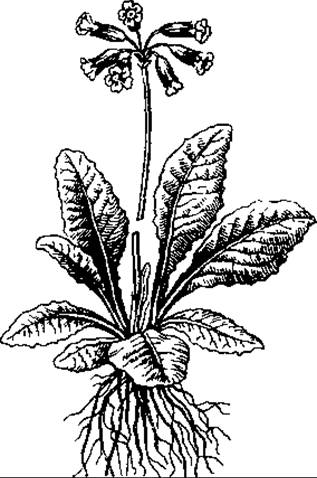
The plant is a perennial herb. It has a short, horizontal, dark brown rhizome, 6-8 cm long, with succulent cord-like roots. The flowering scape is erect, leafless, 5-20 cm high. Leaves are gathered in a basal rosette, ovate or ovate-elongate, wavy-dentate-sinuate, wrinkled, covered underneath with grayish down, narrowing into winged petioles up to 10 cm long and 5-8 cm wide. Flowers are regular, bisexual, gathered at the top of the stem in an umbellate inflorescence of 5-13 flowers drooping to one side; calyx is tubular, pentagonal; corolla is funnel-shaped with a short five-lobed limb, bright yellow, with orange spots on the inside at the base of the limb lobes. The fruit is an ovate capsule of the same length as the calyx. It blooms from mid-April to June. Fruits ripen in June–August. Other species differ in the size of the leaves, scape, and flowers.
Distribution. Cowslip grows in forest and forest-steppe regions, less frequently in the northeastern Regions of the Steppe, in forests, on forest edges, glades, and among shrubs. It is cultivated as an ornamental plant.
Harvesting. Primrose rhizomes and roots are dug up in spring before the plant flowers or in autumn after the leaves have withered; they are thoroughly washed free of soil and dried in the sun or in a warm room, spread in a thin layer on paper or cloth and turned over periodically. Artificial drying is carried out at a temperature of 40-50 °С.
Leaves are gathered at the beginning of the plant's flowering period by hand-plucking or cutting with a knife. Half of the leaves are left on each plant. The leaves should be dried quickly and preferably at a temperature of 70-80 °С, which yields raw material with a high ascorbic acid content.
Chemical composition of the raw material. All parts of the cowslip contain a significant amount of ascorbic acid (up to 6% in the leaves). Primrose roots contain up to 10% triterpene saponins, whose aglycones are primulagenins A, D, and SD, Glycosides (primulaverin, primverin), essential oil (0.08%), and carotene. The leaves contain saponins (up to 2%), flavonoids, carotene (up to 3 mg%), macro- and microelements; the flowers contain saponins, flavonoids, and essential oil.
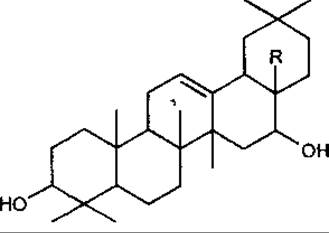
R = CH2OH — Primulagenin A
R = СНО — Primulagenin D
R = СООН — Primulagenin SD
Biological effects and applications. Leaf infusion is used for the prevention and treatment of hypovitaminosis and avitaminosis; the rhizome decoction is primarily employed as an effective expectorant for lung and respiratory tract conditions. It is listed in the British Herbal Pharmacopoeia as a sedative, antispasmodic, and hypnotic agent.
The plant is used for food and is also a good honey source.
Last update: 06/08/2026
Editorial and Educational Adaptation: This material has been compiled based on the primary/original source text. The project team performed an editorial review, corrected technical inaccuracies, structured sections, and adapted the content for an educational format.
What was processed:
- elimination of formatting defects (OCR errors, structural breaks, corrupted characters);
- editorial organization of content;
- standardization of terminology in accordance with academic sources;
- verification of factual statements against the original source text.
All mentions of the author, publication year, and origin of the primary text have been preserved in accordance with the source.