Pharmacognosy with the Basics of Plant Biochemistry - Kovalyov V. M. 2004
Special Part
Vitamins
Medicinal plants and raw materials containing vitamins K1
NETTLE LEAVES — FOLIA URTICAE
Stinging nettle — Urtica dióica L., fam. nettle family — Urticaceae
Stinging nettle; the name originates from the Latin arere, meaning to burn; the Latin dioicus derives from the Greek di, meaning twice, and oikos, meaning house.
A perennial herbaceous dioecious plant covered with stinging hairs. The rhizome is creeping, branched, and covered with clusters of adventitious roots at the nodes. The stem is erect, obtusely quadrangular, 50-170 cm tall, and branched. Leaves are opposite, up to 20 cm long and 9 cm wide, ovate-lanceolate or broadly ovate, acute, dentate-serrate, with large Teeth directed towards the apex. The surface of the leaves is covered with stiff hairs, which are particularly abundant along the Veins;
petioles are 7-8 cm long, round or semi-round in cross-section, with a groove on the upper side, covered with hairs; leaf color is dark green, petiole color is green. Odor is faint. Taste is bitterish. Flowers are yellow-green, small, unisexual, arranged in branched spike-like inflorescences slightly longer than the leaf petioles in the axils of which they are located; perianth is quadripartite. Blooms in June-August, fruits in August-September. The fruit is an achene.
Distribution. Grows throughout Ukraine in damp places, among shrubs, in forests, near fences, along roadsides, and in ruderal and nitrate-rich habitats.
Harvesting. The main harvesting is carried out in May-July, because later some of the leaves, especially the lower ones, wither. Gathered using canvas or leather gloves. The nettle stems are cut with a sickle or knife, and after a few hours, once the leaves lose their stinging property, they are stripped off. Drying must be carried out in the shade, as quickly as possible, in well-ventilated attics or under sheds, spreading the raw material on paper or fabric in a layer 3-5 cm thick. Drying is stopped when the central veins become brittle.
Class="center">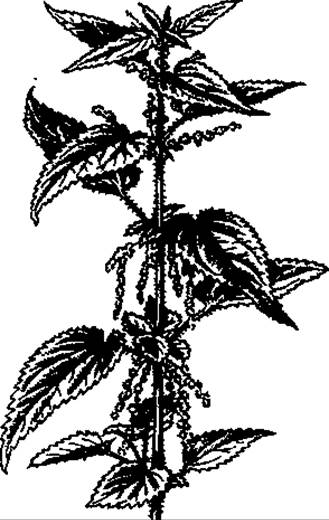
Chemical composition of the raw material. Stinging nettle leaves contain vitamin K (0.2%), carotenoids (ß-carotene, xanthophyll, xanthophyll epoxide, violaxanthin — totaling 50 mg/%), chlorophyll (5%), Vitamins C (0.6%), B2, B3; organic acids, the glycoside urticin, hydroxycinnamic acids, Flavonoids (quercetin, etc.), Tannins (2%), Gums, sitosterol, phytoncides, micro- and macroelements (silicon, iron, copper, manganese, etc.). The Cell sap of the hairs contains formic acid, histamine, and acetylcholine.
The hydrophilic compounds of the roots exhibit lectin- and polysaccharide-like properties; among the lipophilic substances, ß-sitosterol and other phytosterols are abundant.
Biological activity and application. Stinging nettle exhibits hemostatic, diuretic, and general tonic properties, and has a mild cholagogue effect. In addition, preparations made from stinging nettle increase Hemoglobin and erythrocyte counts, normalize Blood composition, reduce blood sugar levels, exert an anti-inflammatory effect, enhance the regeneration of the gastrointestinal mucosa, produce a vasoconstrictive effect, and help normalize a disrupted Menstrual cycle. Nettle is mainly used as a hemostatic agent in the form of an infusion and liquid extract for pulmonary, intestinal, uterine, and Other types of bleeding. Along with this, preparations from nettle leaves are effective remedies for atherosclerosis, iron-deficiency anemia, cholecystitis, gastritis, PEPTIC ULCER DISEASE, Diabetes Mellitus, urolithiasis, ascites, edema, etc. Nettle leaves are included in vitamin, gastric, laxative, and certain other herbal mixtures, as well as the choleretic drugs Allochol and Phytone-SD. A decoction of nettle leaves is used to wash the HEAD to strengthen Hair, and the liquid extract of nettle is an ingredient in the therapeutic shampoo "Phytoval". Young shoots of the plant are edible. Chlorophyll, which possesses tonic properties and stimulates granulation and epithelization of damaged Tissues, can be obtained from nettle leaves and is used in the pharmaceutical and food industries. Anhydro-alcoholic extract of nettle roots is used abroad for prostatitis accompanied by difficult urination.
CORN SILK — STYLE CUM STIGMATIS ZEAE MAYDIS
Maize — Zea mays L., fam. grass family — Poaceae; the name comes from the Greek zeia, the name of a fodder cereal; mays derives from the Mexican folk name mahiz; the Russian common name comes from the Spanish cucurucho.
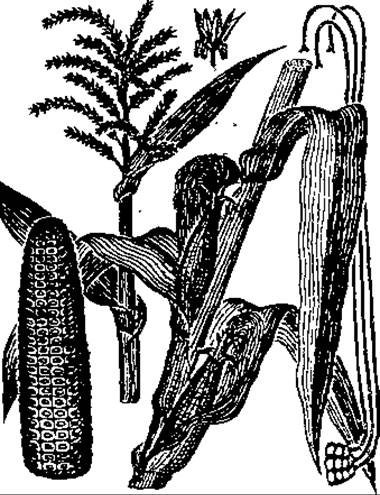
An annual, monoecious herbaceous plant. The stem is straight, 50 cm to 3 m tall, with distinct nodes and internodes filled with spongy parenchymal tissue.
Leaves are alternate, broadly lanceolate, with a wavy margin.
Flowers are unisexual, gathered in separate inflorescences that differ significantly in appearance: male flowers are gathered in a terminal spreading panicle; female flowers are located in the axils of the lower leaves, within ears enclosed in a leaf-like husk; the flowers feature numerous long, thread-like silky styles with a short bifurcated stigma at the apex. The styles are slightly curved, flat, 0.1-0.15 mm wide, 0.5-20 cm long; stigmas are short, 0.4-3 mm long; color is light yellow, brownish, or brownish-red. Fruits are yellow to orange-yellow caryopses arranged in vertical rows on the cob. Blooms in July-August, fruits ripen in September-October.
Distribution. Native to Central and South America. Cultivated throughout Ukraine as one of the most important grain and silage crops.
Harvesting. Corn silk is harvested during the milk-wax ripeness stage of the cobs. Dried in the shade or in a well-ventilated room, spread in a thin layer (1-2 cm thick) on fabric or paper. Artificial drying is carried out at a Temperature of 40 °C.
Chemical COMPOSITION OF THE raw material. Corn silk contains vitamin K (1600 biological units per 1 g), carotenoids, ascorbic and pantothenic acids, vitamins B1, B2, B6, D, E, Inositol alcohol, saponins (3.18%), bitter Glycosides (1.5%), flavonoids, traces of Alkaloids, essential (0.12%) and fatty (3%) oils, sterols (stigmasterol, sitosterol), resins, gums, microelements (accumulates selenium in large quantities), and other substances.
Caryopses contain starch, carotenoids, vitamins E, B1, B2, B3, B6, biotin, fatty oil with a significant amount of linoleic and linolenic acid derivatives, and pentosans (up to 7%).
Biological activity and application. Liquid extract of corn silk exhibits choleretic, diuretic, and hemostatic properties. The raw material is a component of choleretic and diuretic teas, as well as the combined preparation "Palifital-1".
In homeopathy, corn silk is used for edema of cardiac origin.
SHEPHERD’S PURSE HERB — HERBA BURSAE PASTORIS
Shepherd’s purse — Capsella bursa-pastóris (L.) Medik., fam. mustard family — Brassicaceae
Shepherd's purse; Capsella is a diminutive of the Latin capsa (bag), describing the shape of the fruit; Latin bursa pastoris means "shepherd's purse".
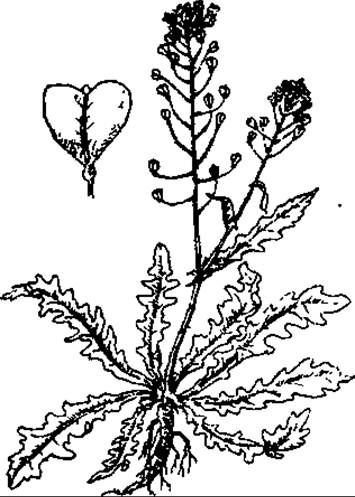
The plant is an annual herb, 10–50 cm in height. The stem is erect, simple or branched, with a ribbed surface, glabrous or slightly pubescent at the base. Basal leaves are arranged in a rosette, lanceolate, petiolate, and pinnately lobed with acute triangular indentations, either entire or serrated; stem leaves are sessile, alternate, lanceolate, and either entire or serrated, being amplexicaul at the base. Flowers are bisexual, small, regular, white, and tetramerous, occurring in terminal racemes; the calyx consists of four elongated-ovate green sepals, and the corolla consists of four obovate petals. Fruits are silicles, inversely triangular-cordate, slightly notched at the apex, flattened, and consist of two dehiscent Valves. Flowering and fruiting occur simultaneously from March to May and throughout most of the summer; fruits mature before the first frost.
Distribution. It grows throughout Ukraine as a weed in fields, along roadsides, and near human settlements.
Harvesting. During flowering, when the lower fruits begin to form, the plant is pulled up by the roots, which are then trimmed, leaving the basal rosette of leaves. The herb is dried under a canopy or in an attic until the stems become brittle.
Chemical composition of the raw material. The herb contains vitamin K1, ascorbic acid, oxycoric acids, Coumarins, flavonoids (quercetin, luteolin, and diosmetin glycosides, etc.), tannins, Amino Acids, amines (Choline, acetylcholine, tyramine, etc.), saponins, organic acids (fumaric, malic, oxalic, citric, and tartaric acids), essential oil, and macro- and microelements (potassium, calcium, iron, copper, etc.). Recently, it has been suggested that biogenic amines should be considered the primary active constituents of this plant.
Biological action and Applications. Galenic preparations exhibit a pronounced hemostatic effect, reduce blood pressure, enhance gastric motility, and accelerate intestinal peristalsis; they also stimulate uterine motor function and are therefore used for postpartum Hemorrhage, uterine atony, and pulmonary, gastrointestinal, and renal hemorrhages. The leaves of the plant exhibit high phytocidal activity.
Used in the form of infusions, liquid extracts, and as part of herbal mixtures.
In homeopathy, the whole fresh flowering plant is used to treat cholelithiasis and urolithiasis, uratic diathesis, Hematuria, and uterine bleeding.
Last update: 06/08/2026
Editorial and Educational Adaptation: This material has been compiled based on the primary/original source text. The project team performed an editorial review, corrected technical inaccuracies, structured sections, and adapted the content for an educational format.
What was processed:
- elimination of formatting defects (OCR errors, structural breaks, corrupted characters);
- editorial organization of content;
- standardization of terminology in accordance with academic sources;
- verification of factual statements against the original source text.
All mentions of the author, publication year, and origin of the primary text have been preserved in accordance with the source.