Principles of Biochemistry, Volume 3 - A. Lehninger 1985
Molecular Mechanisms of Genetic Information Transfer
DNA: Structure of Chromosomes and Genes
Chapter Summary
The Role of DNA as the carrier of Genetic information is supported by a wealth of evidence. The Avery-MacLeod-McCarty experiment demonstrated that DNA isolated from one bacterial strain can enter Cells of another strain and transform them, conferring certain inherited traits of the donor. The Hershey-Chase experiment showed that it is the bacteriophage DNA, rather than its protein coat, that carries the genetic message for viral Replication within the host Cell. All somatic cells of an Organism of a given species contain DNA with an identical nucleotide composition, which is independent of diet or environmental conditions. Although the Nucleotide Composition of DNA varies among species, in the double-stranded DNA of all species, the number of adenine residues always equals the number of thymine residues, and the number of guanine residues always equals the number of cytosine residues.
Based on X-Ray Diffraction Analysis of DNA fibers and THE PRINCIPLE OF base complementarity in DNA, Watson and Crick concluded that native DNA consists of two antiparallel strands wound into a double helix. Complementary bases A—T and G—C form hydrogen-bonded pairs within the interior of the helix, while the hydrophilic sugar-phosphate backbone lies on the outside of the macromolecule. The Base Pairs are stacked tightly, perpendicular to the long axis, at a distance of 0.34 nm from one another; there are approximately 10 nucleotide base pairs per complete turn of The Double Helix. The complementarity of the strands in the double helix provides the structural basis for understanding their precise replication mechanism.
Upon heating or exposure to extreme pH values, native DNA reversibly unwinds and its strands separate. Because G=C base pairs are more stable than A—T pairs, the melting Temperature of DNA rich in G=C pairs is higher than that of DNA with a high content of A=T pairs. Denatured single-stranded DNA from one species can form a hybrid duplex with denatured single-stranded DNA from another species, provided that The nucleotide sequences of the two strands share at least some degree of similarity (Homology). The efficiency of formation of such hybrids is used to assess the evolutionary relatedness of different species and the homology between DNA and RNA.
In DNA-containing bacterial Viruses, the single double-stranded DNA molecule may be either circular or linear; some viral DNAs, such as that of phage фX174, consist of single-stranded molecules. Viral DNAs are supercoiled, which facilitates their tight packaging within the virion. The single bacterial chromosome is a significantly larger, covalently closed circular duplex. Bacterial DNA is folded into A large number of loops, each of which is supercoiled. Eukaryotic cells contain multiple Chromosomes, with each chromosome consisting of a single very long linear DNA molecule that is 4 to 100 times the length of the single prokaryotic chromosome. Eukaryotic DNA wraps around protein particles composed of several molecules of core histone Proteins, which are spaced at regular intervals along the DNA. Such complexes of DNA segments and Histones are called nucleosomes.
Structural Genes are regions of DNA that encode polypeptide chains, tRNA, and rRNA. Viral DNAs contain a relatively small number of genes, in contrast to the DNA of E. coli, which contains more than 3,000 genes. To date, the mapping of many of these genes on the circular chromosome has been accomplished. Bacteria protect their own DNA by methylating specific bases at designated sites within the molecule using Modifying Methylases. Foreign DNA lacking these recognition methyl groups is subsequently degraded by Restriction Endonucleases. Eukaryotic DNA contains a large number of highly repetitive short sequences, a smaller number of longer moderate repeats believed to play a regulatory role, and a set of unique (non-repetitive) regions that apparently represent structural genes. Eukaryotic genes contain intervening, non-translated nucleotide sequences called introns, which are inserted between translated regions called exons. Using recently developed techniques, the nucleotide sequences of A number of genes and viral DNAs have been successfully determined.
General Topics
Ayala F., Kiger J. Modern Genetics, Benjamin-Cummings, Menlo Park, Calif., 1980. An excellent Introduction to the fundamentals of genetics.
Kornberg A. METABOLISM/36.html">DNA replication, Freeman, San Francisco, 1980. A comprehensive and authoritative monograph.
Packaging
Bauer W. R., Crick F. H. C., White J. H. Supercoiled DNA, Sci. Am., 243, 118-133, July 1980.
Novick R. P. Plasmids, Sci. Am., 243, 102-127, December 1980.
Restriction-Modification Enzymes
Nathans D. Restriction Endonucleases, Simian 40, and the New Genetics, Science, 206, 903-909 (1979).
Smith H. Nucleotide Sequence Specificity of Restriction Endonucleases, Science, 205, 455-462 (1979).
Isolation and Synthesis of Genes
Khorana H. G. Total Synthesis of a Gene, Science, 203, 614-625 (1979).
Repetitive Sequences
Britten R. J., Kohne D. E. Repeated Segments of DNA, Sci. Am., 222, 24-31, April 1970.
Davidson E. H., Britten R. J. Possible Role of Repetitive Sequences, Science, 204, 1052-1059 (1979).
Intervening Sequences
Catterall J. F., colleagues. The Chick Ovomucoid Gene Contains at Least Six Intervening Sequences, Science, 204, 264-271 (1979).
Crick F. Split genes and RNA Splicing, Science, 204, 264-271 (1979).
Chromatin and Nucleosomes
Kornberg R. D., Klug A. The Nucleosome, Sci. Am., 244, 52-78, February 1981.
Olins D. E., Olins A. L. Nucleosomes: The Quantum Beyond DNA, Am. Sci., 66, 704-711 (1978).
DNA Nucleotide Sequence
Fiddes J. C. The nucleotide sequence of a Viral DNA, Sci. Am., 237, 55-67, December 1977. An excellent description of how the nucleotide sequence of phage φX174 DNA was deciphered.
Maxam A. M., Gilbert W. A New Method for Sequencing DNA, Proc. Natl. Acad. Sci. USA, 74, 560-564 (1977).
Reddy V. B., et al. The Genome of Simian Virus 40, Science, 200, 494-502 (1978).
Sanger F. Determination of Nucleotide Sequences in DNA, Biosci. Rep., 1, 3-18 (1981).
Cairns J., Stent G., Watson J. D. (eds.). Phage and the Origins of Molecular Biology, Cold Spring Harbor Laboratory, New York, 1966. An account of the early days of Molecular Genetics and some of the key figures who contributed to its flourishment.
Judson H. F. The Eighth Day of Creation, Simon and Schuster, New York, 1979.
Olby R. The Path to the Double Helix, University of Washington Press, Seattle, 1974.
Watson J. D. The Double Helix, Atheneum, 1968. An account of the Discovery of the DNA double helix.
1. Base pairing in DNA. In DNA preparations isolated from two unidentified bacterial species, the adenine content is 32% and 17% of the total base content, respectively. What relative amounts of adenine, thymine, and cytosine would you expect to find in these two DNA preparations? What assumptions did you make? One of these bacteria was isolated from a hot spring (64 °C). Which of the DNAs belongs to the thermophilic bacterium? What is the basis for your answer?
2. Nucleotide sequence of complementary DNA strands. Write the nucleotide sequence of one strand of a double-stranded DNA whose other strand has the sequence (5') ATGCCGTATGCATTC (3').
3. Human DNA. What is the mass (in grams) of a double-stranded DNA molecule stretching all the way from the Earth to the Moon (~384,000 km)? Each 1,000 base pairs of the DNA double helix weighs 1×10-18 g. One kilometer contains 1×10¹² nm, and the length of a single base pair is 0.34 nm. For comparison, It is interesting to note that The Human Body contains ~0.5 g of DNA!
4. What is the length of the Ribonuclease gene? What is the minimum number of base pairs contained in a gene encoding pancreatic ribonuclease (124 Amino Acids)? Why might the actual number of base pairs be much greater than your answer? What accounts for this uncertainty?
5. DNA packaging in a virus. The molecular mass of bacteriophage T2 DNA is 130×106. The phage HEAD has a dimension of 100 nm. Assuming that the molecular mass of a single base pair is 660, determine the length of the T2 phage DNA and compare it with the size of the phage head. Your answer will demonstrate the necessity for extremely compact DNA packing in viruses.
6. DNA packaging in eukaryotic cells. Compare the length of the DNA in a single nucleosome with the diameter of the nucleosome, which is 10–11 nm. Then, compare the length of all the DNA in a human cell with the diameter of the Cell Nucleus, which is about 2 µm. In which of these structures is the DNA more compactly packed?
7. Palindrome. How likely is it that the palindrome shown in Figures 27–28 will spontaneously adopt the cruciform Structure depicted in the illustration when isolated as pure, naked DNA? What might your answer be if this palindrome were located within the chromosome of an intact cell?
8. M13 phage DNA. Bacteriophage M13 DNA has the following nucleotide composition: A – 23%, T – 36%, G – 21%, C – 20%. What do these figures tell you about the DNA of this phage?
9. Separation of DNA in a density gradient. Alkaline sucrose gradient centrifugation allows mixtures of different DNAs to be separated According to the size and shape of their macromolecules, but this process denatures the DNA. This method can be used to distinguish linear from circular DNA forms and to determine the relative sizes of DNA fragments. The replicative form II (RF II) DNA of phage φX174 is a double-stranded circle with a nick in one of the strands.
a) What type and length of molecules should be detected when RF II DNA is centrifuged in an alkaline sucrose gradient? (The φX174 DNA molecule contains 5,386 base pairs.)
b) What type and length of molecules will be detected if the RF II DNA is first treated with a restriction endonuclease that cleaves the RF at only one site?
10. DNA nucleotide sequence. Why must a DNA molecule be labeled at only one end rather than uniformly when sequenced by the chemical method?
11. Nucleotide composition of DNA φX174. The DNA of bacteriophage φX174 can exist in two forms: single-stranded (in the virion) and double-stranded (during replication in the host cell). Do you think the nucleotide composition of these two forms of DNA is the same? Explain your reasoning.
12. Size of eukaryotic genes. Rat Liver contains an enzyme whose polypeptide chain consists of 192 amino acid residues. This enzyme is encoded by a gene comprising 1,440 base pairs. Explain the relationship between the number of amino acid residues in the enzyme and the number of base pairs in its corresponding gene.
13. Species Differences in DNA. If test tubes containing DNA preparations isolated from E. coli and a sea urchin (Table 27-3) were accidentally mixed up, how would you determine which preparation is which?
14. “Eyes” in partially denatured DNA. A sample of double-stranded linear DNA, carefully isolated from a species of crustacea, was mounted on a grid at 20°C and examined by Electron Microscopy. Another sample of the same DNA was preincubated at 60°C for 30 min and then similarly examined by electron microscopy. The schematic appearance of these samples was as follows:
Class="center">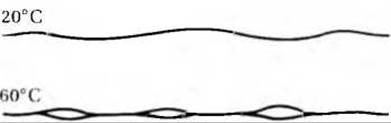
How would you explain this result? What useful information can be derived from this phenomenon?
15. DNA Hybridization. Based on what information regarding The structure of homologous proteins can you predict that DNA strands from different vertebrate species will form double-stranded hybrids?
16. Action of restriction endonucleases. A closed circular viral DNA is treated with a restriction endonuclease. This DNA contains a single restriction site with the following structure:

a) Indicate with a dot the putative center of the restriction site.
b) Why did you conclude that the point you selected represents the center? What are its properties?
c) After Cleavage of both strands by the restriction endonuclease, the mixture is heated to inactivate the enzyme and then slowly cooled. Under the Electron microscope, the viral DNA appears as a circular molecule. How would you explain this?
d) If the resulting solution from the previous question (part c) is made alkaline with 0.1 M NaOH, it turns out to contain only single linear DNA strands. How do you account for this fact?
17. RNA-containing Viruses: Can genes consist of RNA? RNA-containing viruses of E. coli contain no DNA; they possess only RNA, which serves as the viral chromosome. This means that in such viruses, genes are made of RNA rather than DNA. Does this refute the Central dogma of molecular genetics? Explain your answer.
Last update: 06/08/2026
Editorial and Educational Adaptation: This material has been compiled based on the primary/original source text. The project team performed an editorial review, corrected technical inaccuracies, structured sections, and adapted the content for an educational format.
What was processed:
- elimination of formatting defects (OCR errors, structural breaks, corrupted characters);
- editorial organization of content;
- standardization of terminology in accordance with academic sources;
- verification of factual statements against the original source text.
All mentions of the author, publication year, and origin of the primary text have been preserved in accordance with the source.