Principles of Biochemistry, Volume 3 - A. Lehninger 1985
Molecular Mechanisms of Genetic Information Transmission
DNA: Structure of Chromosomes and Genes
Eukaryotic DNA contains a large number of palindromes
Eukaryotic DNA possesses another characteristic feature: it contains numerous (perhaps thousands of) palindromes. A palindrome (from the Greek "to run back") is a word or sentence that reads the same forwards and backwards. Here are two Examples1:
Class="center">Able was I ere I saw Elba
Madam, in Eden I’m Adam.
In biochemical genetics, the term palindrome is used to denote regions of eukaryotic DNA that feature inverted repeats of nucleotide sequences with twofold rotational Symmetry, resembling the short sequences recognized by Restriction Endonucleases. An example of such a region is shown in Fig. 27-28.
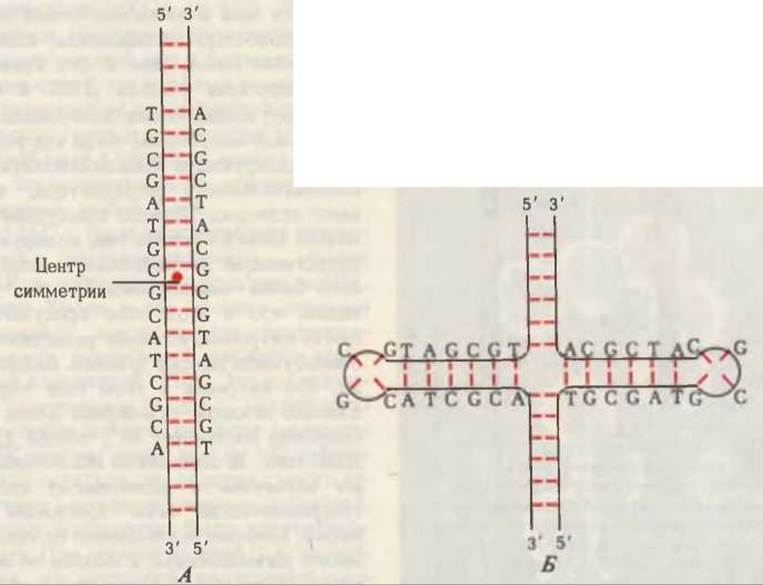
Fig. 27-28. A. A palindrome, or inverted repeat, demonstrating rotational symmetry. The twofold axis of symmetry passes through the central point. B. A cruciform Structure that forms when the bases of the palindrome pair internally within each strand rather than between complementary strands. In native eukaryotic DNA, palindromes may consist of tens or even hundreds of bases.
1 Since the English palindromes given above cannot be translated directly, we provide as examples two Russian palindromes composed by B. Goldstein, a researcher at the Institute of Biophysics of the USSR Academy of Sciences: Уж редко рукою окурок держу. Умер и мир ему.
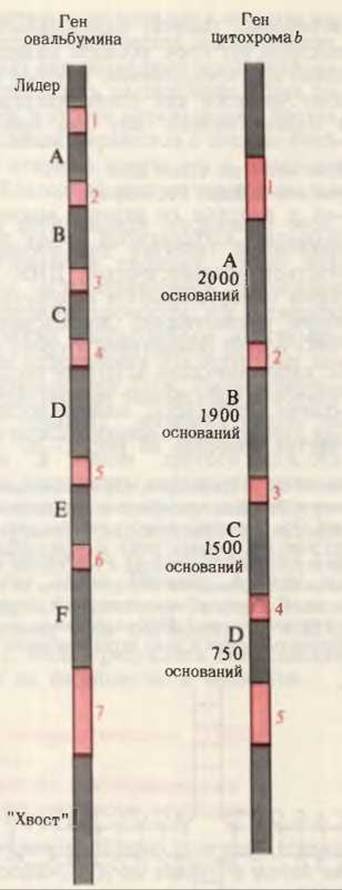
Fig. 27-29. Intervening sequences (introns) in two eukaryotic genes. The Ovalbumin Gene contains six introns (shown in gray and labeled A–F) and is consequently divided into seven segments, or exons (indicated in red and numbered 1–7). The cytochrome b gene contains four introns (gray, A–D) and five exons (red, J–5). In both cases, introns make up the major portion of the gene's DNA. The numbers of Base Pairs comprising the introns of the cytochrome b gene are indicated.
Many palindromes are up to a thousand base pairs long. Shorter palindromes, much like restriction sequences, serve as specific regulatory signals. Longer palindromes are capable of forming cruciform structures through base pairing within each of the double-stranded loops (Fig. 27-28). The function of these long palindromes remains unknown.
Last update: 06/08/2026
Editorial and Educational Adaptation: This material has been compiled based on the primary/original source text. The project team performed an editorial review, corrected technical inaccuracies, structured sections, and adapted the content for an educational format.
What was processed:
- elimination of formatting defects (OCR errors, structural breaks, corrupted characters);
- editorial organization of content;
- standardization of terminology in accordance with academic sources;
- verification of factual statements against the original source text.
All mentions of the author, publication year, and origin of the primary text have been preserved in accordance with the source.