Principles of Biochemistry Volume 3 - A. Lehninger 1985
Molecular Mechanisms of Genetic Information Transfer
DNA Replication and Transcription
DNA replicates in a semi-conservative manner
Now that we have examined The Structure of DNA and The Nature of Chromosomes and genes, let us explore how METABOLISM/36.html">DNA Replication generates daughter molecules and how Transcription produces complementary RNA strands.
The Enzymes and other Proteins involved in DNA Replication and Transcription rank among the most remarkable biological catalysts known. Utilizing The energy released from phosphate group Cleavage, they are capable of assembling these giant macromolecules from precursor mononucleotides with exceptional precision, transferring Genetic information seamlessly from the template to the newly synthesized strand. Furthermore, these enzymes must overcome formidable mechanical challenges because, before replication can even begin, the parental double-stranded DNA must be unwound to grant the enzymes access to The sequence of bases encoded within The Double Helix. In Eukaryotic Cells, moreover, the replication machinery is intimately linked with the complex three-dimensional Organization of Chromatin and nucleosomes.
Transcription enzymes likewise exhibit extraordinary properties. Not only can they catalyze the synthesis of a diverse array of different RNAs, but they also initiate and terminate their activity at specific chromosomal loci in response to various regulatory signals. Through the coordinated action of these enzymes at designated Stages of the Cell Cycle, only specific Genes are transcribed. Thus, DNA and RNA polymerases—along with the accessory proteins that facilitate replication and transcription—are vital for the preservation of genetic information across generations.
According to the Watson-Crick hypothesis, each strand of the DNA double helix serves as a template for the synthesis of a complementary daughter strand. This process yields two daughter double-stranded DNA molecules identical to the parental DNA, with each molecule containing one intact parental strand. The Watson-Crick hypothesis was tested through ingenious experiments conducted by Matthew Meselson and Franklin Stahl in 1957. The underlying principle of these experiments is illustrated in Fig. 28-1. E. coli cells were cultured for multiple generations in a medium containing ammonium chloride (NH4Cl) as the nitrogen source, in which the common abundant isotope [14N] was replaced by the "heavy" isotope [15N]. Consequently, all nitrogen-containing cellular constituents, including the DNA bases, became heavily enriched with [15N]. The density of DNA extracted from these cells was approximately 1% greater than that of normal [14N] DNA. Although this difference is slight, a mixture of "heavy" [15N] and "light" [14N] DNA could nevertheless be resolved by equilibrium density gradient centrifugation in a concentrated cesium chloride solution. Cesium chloride is well-suited for this purpose because the density of its aqueous solution can be adjusted to match that of DNA. When such a CsCl solution is centrifuged for an extended period in a high-speed ultracentrifuge, a stable equilibrium is eventually reached, forming a continuous CsCl density gradient down the centrifuge tube. Due to the strong gravitational field generated by the centrifuge, the concentration of CsCl—and consequently the solution density—is higher near the bottom of the tube than at the top. A DNA sample dissolved in CsCl settles at an equilibrium position where its buoyant density equals that of the surrounding CsCl solution. Because [15N] DNA is slightly denser than [14N] DNA, its equilibrium band in the CsCl gradient forms closer to the bottom of the tube than the band of [14N] DNA (Fig. 28-2).
Class="center">
Fig. 28-1. Principle of the Meselson-Stahl experiment, designed to distinguish between two potential mechanisms of replication for "heavy" [15N] DNA (shown in black) when replicated in a medium containing the "light" nitrogen isotope [14N]. "Light" DNA strands are shown in red. A. Conservative replication mechanism. If replication proceeded via this pathway, one of the two daughter double-stranded molecules would contain two "light" strands, while the other would contain two "heavy" strands. Subsequent duplication of these daughter molecules would yield four double-stranded molecules—one "heavy" and three "light"—with no hybrid DNA molecules ever formed. B. Semiconservative replication mechanism. Under this mode of replication, each of the two daughter double-stranded DNA molecules would consist of one parental ("heavy") strand and one newly synthesized "light" strand. Subsequent duplication of the daughter molecules would produce two hybrid and two "light" DNA molecules.
Meselson and Stahl transferred E. coli cells grown on a [15N] medium and containing "heavy" DNA strands to a fresh medium containing NH4Cl with the standard [14N] isotope. The cells were allowed to grow in this medium for exactly one generation time required for Cell Division. DNA was then extracted from these cells and its density analyzed using the sedimentation technique described above. Centrifugation in a CsCl gradient revealed a single DNA band whose density was precisely intermediate between that of normal "light" [14N] DNA and "heavy" [15N] DNA (Fig. 28-2). This is precisely the outcome expected if the double-stranded DNA of the daughter cells consists of one older 15N-labeled strand inherited from the parental DNA and one newly synthesized 14N-labeled strand (Fig. 28-2).
When DNA was extracted from cells that had undergone two rounds of replication in the [14N] medium, it separated into two distinct bands: one with a density corresponding to normal light DNA, and another with the density of the hybrid DNA observed after the first round of cell division. Based on these findings, Meselson and Stahl concluded that, in strict accordance with the Watson-Crick hypothesis, every daughter DNA duplex after two rounds of cell division contained one parental strand and one newly synthesized strand. This mode of replication was designated as semiconservative, because each daughter DNA molecule preserves only a single parental strand (Figs. 28-1 and 28-2). These results definitively ruled out the conservative model of replication, in which one daughter DNA molecule would retain both original strands while the other would consist entirely of two newly synthesized strands. Furthermore, the Meselson-Stahl experiment disproved the dispersive mechanism of replication, which hypothesized that each daughter DNA strand is composed of alternating short segments of parental and newly synthesized DNA joined together at random.
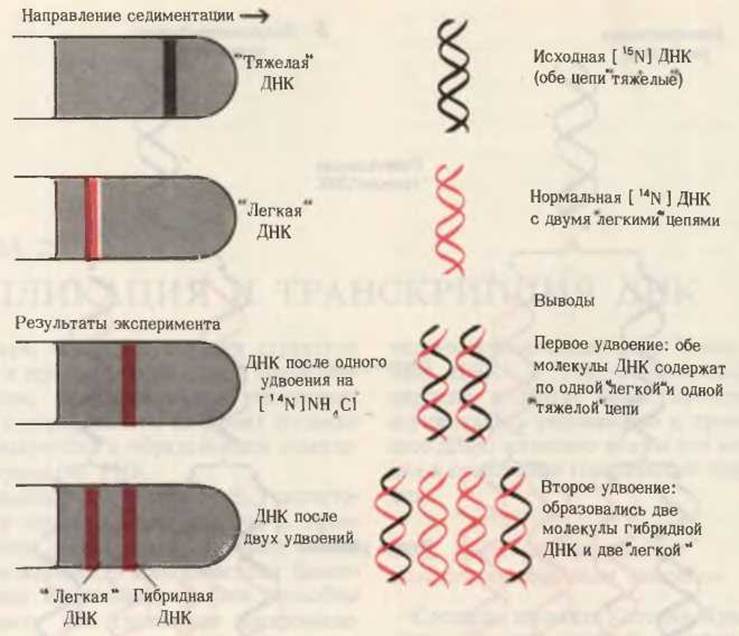
Fig. 28-2. Results of the Meselson-Stahl experiment. In a CsCl density gradient, "heavy" [15N] DNA reaches equilibrium in a band located closer to the bottom of the tube than the equilibrium band of "light" [14N] DNA. The equilibrium position of the hybrid DNA is intermediate between the two. Density determinations of daughter DNA molecules after the First and Second rounds of replication confirmed that DNA is replicated via a semiconservative mechanism.
Last update: 06/08/2026
Editorial and Educational Adaptation: This material has been compiled based on the primary/original source text. The project team performed an editorial review, corrected technical inaccuracies, structured sections, and adapted the content for an educational format.
What was processed:
- elimination of formatting defects (OCR errors, structural breaks, corrupted characters);
- editorial organization of content;
- standardization of terminology in accordance with academic sources;
- verification of factual statements against the original source text.
All mentions of the author, publication year, and origin of the primary text have been preserved in accordance with the source.