Principles of Biochemistry Volume 3 - A. Lehninger 1985
Molecular mechanisms of genetic information transfer
DNA replication and transcription
Some viral RNAs are replicated using an RNA-dependent RNA polymerase
In some E. coli Bacteriophages, the chromosome consists of RNA rather than DNA. These Viruses, which include phages such as O, MS2, R17, and Qß (Table 27-1), have become an important tool for investigating the Structure and function of mRNA. The RNA of these viruses Functions as mRNA during viral Protein Synthesis AND is replicated within the host Cell by Enzymes known as RNA-dependent RNA polymerases, or RNA replicases. These enzymes are normally absent in E. coli Cells and appear only in response to the presence of viral RNA.
RNA replicase isolated from E. coli cells infected with the Qß virus catalyzes The formation of an RNA complementary to the viral RNA, using ribonucleoside 5'-triphosphates. The equation for this reaction is analogous to that catalyzed by DNA-dependent RNA polymerase:
Class="center">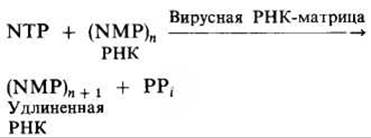
The Synthesis of the new RNA strand proceeds in the 5'→3' direction. RNA replicase cannot use DNA AS A template; it strictly requires RNA for this purpose. Unlike DNA and RNA polymerases, RNA replicases exhibit strict template Specificity. For instance, the RNA replicase of phage Qß can use only the RNA of this specific virus as a template, whereas host cell RNA is not replicated by the enzyme. This circumstance explains why Introduction/7.html">RNA-containing Viruses have a distinct advantage in replicating their RNA within a host cell that contains an Abundance of Other types of cellular RNA.
Thus, purified Qß virus RNA replicase can direct the synthesis of new, biologically active Qß RNA molecules. Using the infectious (+)-strand of the viral RNA as a template, the purified replicase is capable of synthesizing a complementary (—)-strand, which can then serve as a template in the presence of the same enzyme to generate fully infectious Qß RNA identical to the original (+)-strand. Consequently, the Central dogma of Molecular Genetics must be formulated in a slightly modified form, as illustrated in Fig. 28-26.
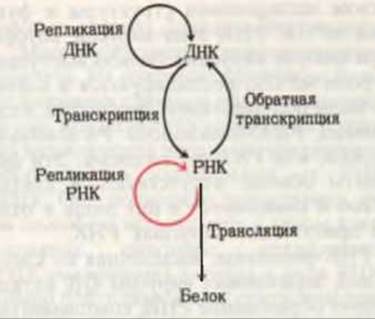
Fig. 28-26. Further refinement of the central dogma, taking into account the possibility of RNA Replication.
Determining the complete nucleotide sequence of the RNA chromosome of virus R17 and the Amino acid sequences of the three viral Proteins encoded by this RNA has provided crucial additional insight into METABOLISM/28.html">The Genetic Code and the specific signals governing the initiation and termination of Polypeptide chain synthesis (Chap. 29).
Last update: 06/08/2026
Editorial and Educational Adaptation: This material has been compiled based on the primary/original source text. The project team performed an editorial review, corrected technical inaccuracies, structured sections, and adapted the content for an educational format.
What was processed:
- elimination of formatting defects (OCR errors, structural breaks, corrupted characters);
- editorial organization of content;
- standardization of terminology in accordance with academic sources;
- verification of factual statements against the original source text.
All mentions of the author, publication year, and origin of the primary text have been preserved in accordance with the source.