LEHNINGER PRINCIPLES OF BIOCHEMISTRY - VOL. 2. BIOENERGETICS AND METABOLISM - 2014
PART II. BIOENERGETICS AND METABOLISM
14. GLYCOLYSIS, GLUCONEOGENESIS, AND THE PENTOSE PHOSPHATE PATHWAY
14.3. Pyruvate Catabolism as an Anaerobic Fate: Fermentation
Under aerobic conditions, the Pyruvate formed in the final step of Glycolysis is oxidized to acetate (acetyl-CoA), which enters The Citric Acid Cycle and is oxidized to CO2 and H2O; meanwhile, the NADH produced during the dehydrogenation of glyceraldehyde 3-phosphate is ultimately reoxidized to NAD+ via electron transfer to O2 in Cell/35.html">Mitochondria. However, under oxygen-limiting conditions (Hypoxia)—such as in vigorously contracting skeletal Muscles, submerged plant Tissues, or lactic acid Bacteria—the NADH generated by glycolysis cannot be recycled back to its oxidized form via O2. The inability to regenerate NAD+ would leave The Cell devoid of the electron acceptor required for The oxidation of glyceraldehyde 3-phosphate, thereby halting the energetically favorable reactions of glycolysis. Consequently, an alternative pathway for NAD+ regeneration must exist.
The earliest Cells, which evolved in an atmosphere largely devoid of oxygen, relied on anaerobic processes to extract energy from fuel molecules. Most modern organisms retain The ability to regenerate NAD+ during anaerobic glycolysis by transferring electrons from NADH to yield reduced end products such as lactate or ethanol.
Pyruvate is the ultimate electron acceptor in Lactic acid Fermentation
When animal tissues cannot obtain sufficient oxygen to support the aerobic Oxidation of Pyruvate and the NADH produced by glycolysis, NAD+ is regenerated from NADH by reducing pyruvate to lactate. As noted above, certain cell and tissue types (such as erythrocytes, which lack mitochondria and cannot oxidize pyruvate to CO2) produce lactate from glucose even under fully aerobic conditions. The reduction of pyruvate is catalyzed by the enzyme Lactate dehydrogenase, which yields the L-isomer of lactate at pH 7:
Class="center">
∆G′° = -25.1 kJ/mol
The equilibrium of this reaction lies far to the right, toward The formation of lactate, as indicated by the large negative standard free-energy change.
During glycolysis, the dehydrogenation of two molecules of glyceraldehyde 3-phosphate (derived from each molecule of glucose) is coupled to The conversion of two molecules of NAD+ into two molecules of NADH. Because the subsequent reduction of two pyruvate molecules to two lactate molecules regenerates two molecules of NAD+, there is no net change in the total pool of NAD+ and NADH.

Lactate produced during strenuous Muscle contraction (or in erythrocytes) can be recycled. During recovery from intense exertion, it is transported via the bloodstream to the Liver, where it is converted back into glucose. During intense physical activity (such as sprinting), large amounts of lactate accumulate; the resulting drop in Blood and muscle pH due to lactic acid dissociation limits the duration of peak athletic performance. Even elite, highly conditioned athletes can maintain maximal running speed for no more than about one minute (Box 14–2).
Although the conversion of glucose to lactate involves two oxidation-reduction steps, there is no net change in the oxidation state of the carbon atoms: glucose (C6H12O6) and lactic acid (C3H6O3) share the same H:C ratio. Nonetheless, a portion of the energy captured within the glucose molecule is released during its conversion to lactate—sufficient to drive the synthesis of two molecules of ATP per molecule of glucose degraded. Such energy-yielding processes (producing ATP) that proceed without the consumption of molecular oxygen or any change in the NAD+/NADH ratio are broadly classified as fermentations. Fermentations are carried out by A wide variety of organisms, often inhabiting anaerobic environments, and yield diverse end products that frequently have Structure/179.html">Practical Applications.
BOX 14–2. Athletes, Alligators, and Coelacanths: Glycolysis at Reduced Oxygen Levels
Most vertebrates are obligate aerobes; they convert glucose to pyruvate via glycolysis and subsequently use molecular oxygen to completely oxidize pyruvate to CO2 and H2O. Anaerobic Catabolism of glucose to lactate occurs during brief bursts of extreme muscular exertion, such as a 100-meter sprint, when oxygen cannot be delivered to the muscles quickly enough to sustain pyruvate oxidation. Under these conditions, muscles rely on internal glucose reserves (Glycogen) as an energy source for ATP production, fermenting it to lactate. During a sprint, blood lactate concentrations rise dramatically. Afterward, during the recovery phase when Respiration slows down, hepatic Gluconeogenesis slowly converts the lactate back into glucose, gradually returning physiological parameters to normal. The excess oxygen consumed during recovery repays the oxygen debt incurred during exertion. This recovery phase requires oxygen to synthesize ATP for gluconeogenesis, the primary purpose of which is to replenish the glycogen reserves "borrowed" from The Liver and muscles during peak activity. This metabolic circuit—involving the conversion of glucose to lactate in muscles and the reconversion of lactate to glucose in the liver—is known as the Cori cycle, named after Carl and Gerty Cori, whose pioneering work in the 1930s and 1940s elucidated The Nature and function of this pathway (see Box 15–1).
The cardiovascular systems of most smaller vertebrates deliver oxygen to muscles rapidly enough to preclude any need for anaerobic breakdown of muscle glycogen. For example, migratory birds often cover vast distances at high speeds without rest, operating well within normal aerobic limits. Similarly, the muscles of many medium-sized running animals sustain an almost exclusively aerobic METABOLISM. In contrast, the circulatory systems of larger animals, including humans, cannot fully support aerobic muscle metabolism during prolonged periods of intense activity. Such animals generally move at a leisurely pace, and intense muscular exertion is reserved for emergencies, since these bursts of activity necessitate a prolonged recovery period to repay the accumulated oxygen debt.
Alligators and crocodiles, for instance, are ordinarily quite sluggish. Yet when provoked, they are capable of lightning-fast lunges and powerful tail strikes. Such explosive activity is extremely brief and is invariably followed by an extended recovery period. These emergency movements are powered by the fermentation of muscle glycogen to lactate to generate ATP. Consequently, muscle glycogen stores are rapidly depleted, and lactate concentrations in muscles and extracellular fluids spike dramatically. While a human sprinter recovers breathing within about half an hour or less after a 100-meter dash, an alligator may require many hours of rest and elevated oxygen consumption following a burst of activity to clear the excess lactate from its bloodstream and restore muscle glycogen levels.
Other large animals, such as elephants and rhinoceroses, as well as diving mammals like whales and seals, exhibit similar metabolic adaptations. It is likely that dinosaurs and other extinct megafauna also relied on lactic acid fermentation to fuel muscular activity, necessitating long recovery periods during which they would have been particularly vulnerable to smaller, more agile predators with higher aerobic capacity and greater endurance.

Deep-sea explorations have revealed a staggering diversity of life in abyssal marine environments where dissolved oxygen concentrations are practically zero. For example, the primitive coelacanth—a large fish inhabiting deep waters (approx. 4,000 m) off the coast of South Africa—relies on Anaerobic Metabolism across virtually all its tissues. In this Organism, CARBOHYDRATES are converted into lactate and other metabolic byproducts that must be systematically cleared. Some marine vertebrates even generate ATP by fermenting glucose into ethanol and CO2.
Ethanol is the reduced product of Alcoholic Fermentation
Yeasts and other microorganisms ferment glucose not to lactate, but to CO2 and ethanol. Glucose is first converted to pyruvate via The Glycolytic Pathway, after which pyruvate is broken down into ethanol and CO2 in a two-step process:
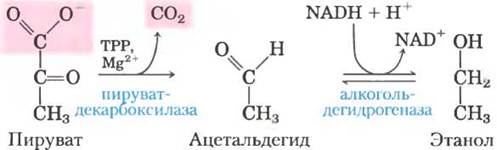
In the first step, pyruvate undergoes irreversible decarboxylation catalyzed by pyruvate decarboxylase. This simple decarboxylation reaction does not result in the oxidation of pyruvate. Pyruvate decarboxylase requires the presence of magnesium ions and the coenzyme thiamine pyrophosphate (TPP). In the second step, acetaldehyde is reduced to ethanol by Alcohol dehydrogenase; here, NADH generated during the dehydrogenation of glyceraldehyde-3-phosphate serves as the reducing agent. This reaction is well-characterized and serves as a classic example of NADH-dependent hydrogen transfer (Fig. 14-13). Thus, the End products of ethanol fermentation are ethanol and СO2, which can be summarized by the overall reaction equation:
Glucose + 2 ADP + 2 Pi —> 2 ethanol + 2 СO2 + 2 ATP + 2 Н2O
Fig. 14-13. Reaction mechanism. The action of alcohol dehydrogenase. MECHANISM OF ACTION of alcohol dehydrogenase

As in lactic acid fermentation, ethanol fermentation does not alter The ratio of hydrogen to carbon atoms when glucose (H:C = 12:6 = 2) is converted into two molecules of ethanol and two molecules of СO2 (overall H:C = 12:6 = 2). In any fermentation process, the H:C ratio remains identical between the starting Materials and the reaction products.
Pyruvate decarboxylase is found in brewer's and baker's Yeast (Saccharomyces cerevisiae), as well as in all other organisms that ferment glucose to ethyl alcohol, including certain plants. The characteristic bubbles in champagne are due to the decarboxylation of pyruvate and the formation of СO2 by brewer's yeast. In addition to alcoholic fermentation reactions, the ancient art of brewing encompasses a wide range of other enzymatic processes (Box 14-3). In bread making, it is the СO2 released when yeast is mixed with sugar that causes the dough to rise. This enzyme is absent in vertebrate tissues and in organisms that carry out lactic acid fermentation.
Alcohol dehydrogenase is found in many organisms capable of metabolizing ethanol, including humans. In the liver, this enzyme catalyzes the oxidation of ethanol—whether ingested by humans or produced by intestinal microflora—a process coupled with the reduction of NAD+ to NADH. In this case, the reaction proceeds in the direction opposite to ethanol formation during fermentation.
Thiamine pyrophosphate carries "active" acetaldehyde groups
When examining the reaction catalyzed by pyruvate decarboxylase, we encounter for the first time the coenzyme thiamine pyrophosphate (TPP; Fig. 14-14), a derivative of Vitamin B1. Dietary vitamin B1 deficiency in humans can lead to beriberi, characterized by fluid retention (edema), pain, and paralysis, and can ultimately be fatal. ■
Box 14-3. Ethanol Fermentation: Brewing and Biofuel Production
Brewing has been practiced by humans since ancient times, and at a certain stage, the process was scaled up to industrial production. Beer is the product of the alcoholic fermentation of carbohydrates found in cereal grains (such as barley) by yeast glycolytic Enzymes. Carbohydrates, primarily Polysaccharides, must first be broken down into di- and Monosaccharides. Therefore, malt is prepared first: barley seeds are allowed to germinate until they synthesize the necessary hydrolytic enzymes, after which further germination is halted by heating. The resulting malt contains enzymes that catalyze the Hydrolysis of β-linkages in Cellulose and other polysaccharides in the cell walls of barley seed coats, as well as Other Enzymes such as α-amylase and maltase.
The next step in brewing is the preparation of wort, the nutrient medium for yeast cell growth. Malt is mixed with Water and then crushed or milled. During this process, malt enzymes act on polysaccharides, breaking them down into maltose, glucose, and Other simple sugars soluble in an aqueous medium. The cellular residue is then removed, and the liquid wort is boiled with The addition of hops for flavoring, cooled, and aerated.
In the next phase, yeast cells are added. In aerobic wort, yeast grows and multiplies rapidly, obtaining energy from the sugars present in the wort. Ethyl alcohol is not produced here because, in the presence of sufficient oxygen, yeast oxidizes the pyruvate generated by glycolysis to СO2 and Н2O via The Citric Acid cycle. Once all the dissolved oxygen in the wort is depleted, the yeast cells switch to anaerobic metabolism and begin fermenting sugars into ethyl alcohol and СO2. The fermentation process is regulated by the concentration of accumulating ethanol, the pH, and The amount of residual sugars. After fermentation stops, the yeast cells are removed, and the green beer is ready for the final Aging stage.
During this final stage of brewing, the amount of foam—caused by dissolved Proteins in the beer—is controlled. Foam formation is typically regulated by Proteolytic Enzymes secreted during malting. If these enzymes act on proteins for too long, too little foam and carbonation will be produced; if insufficient, chilled beer will lack clarity. Sometimes, proteolytic enzymes from other sources are added to beer to aid in foaming.
The technology of large-scale alcoholic beverage production is now also applied to a completely different challenge: The production of alternative fuel ethanol. Driven by the realization that fossil resources are finite and by rising prices for internal combustion engine fuels, there is growing interest in ethanol as an alternative to traditional fuels or as a fuel additive. The primary advantage of ethyl alcohol as a fuel is that it can be derived from relatively inexpensive, renewable sources rich in sucrose, starch, or cellulose (starch from corn or wheat, sucrose from sugar beets or sugarcane, and cellulose from straw, wood-Processing waste, or municipal solid waste). Typically, the raw material is first chemically converted into monosaccharides, and this mixture is then used as a nutrient substrate for specific yeast strains in industrial fermenters (Fig. 1). Fermentation yields not only ethanol but also by-products such as proteins, which can be used as animal feed supplements.
Fig. 1. Industrial fermentation for biofuel and other product production is typically carried out in fermenters with a capacity of thousands of liters of medium.

Thiamine pyrophosphate (TPP) plays a crucial role in the Cleavage of bonds adjacent to a carbonyl group, such as in the decarboxylation of α-keto acids, as well as in Chemical Reactions Involving The transfer of an activated acetaldehyde group between two carbon atoms (Table 14-1). The functional part of the Tpp molecule (the thiazole ring) features a relatively acidic proton at the C-2 position. Dissociation of this proton yields a carbanion, which is the active species in TPP-dependent reactions (Fig. 14-14). The carbanion readily reacts with carbonyl groups, and the thiazole ring acts as an "electron sink," greatly facilitating reactions such as pyruvate decarboxylase-mediated decarboxylation.
Table 14-1. Selected TPP-dependent reactions

Fermentation yields numerous Food Products and chemical Reagents
Several millennia ago, our ancestors utilized fermentation for food production and preservation. Certain microorganisms present in raw food products ferment carbohydrates and convert them into metabolic products that impart the food's characteristic shape, texture, and flavor. Yogurt, known since biblical times, is produced by the bacterium Lactobacillus bulgaricus, which ferments milk carbohydrates into lactic acid; the resulting drop in pH precipitates milk proteins, creating the thick consistency and tart flavor of natural yogurt. Propionibacterium freudenreichii ferments milk carbohydrates to produce propionic acid and СO2; propionic acid precipitates milk proteins, while gas bubbles form the characteristic holes found in Swiss cheese types. Many other foods are also produced by fermentation, including pickles, sauerkraut, sausages, soy sauce, and a multitude of beloved national culinary staples such as kimchi (Korea), tempoyak (Indonesia), kefir (Russia), dahi (India), and pozol (Mexico). The acidification accompanying fermentation helps preserve food because most spoilage microorganisms cannot grow at low pH values. In agriculture, crop residues such as corn stalks are used as livestock feed in the form of silage; to prepare silage, plant material is packed into large containers (silos) where microbial fermentation occurs under limited oxygen access, lowering the pH of the mass. Silage can be stored for long periods without spoiling.
Fig. 14-14. Reaction mechanism. Thiamine pyrophosphate (TPP) and its role in pyruvate decarboxylation. (a) In the form of TPP, vitamin B1 (thiamine) acts as a coenzyme. The reactive carbon atom in the thiazole ring of the TPP molecule is highlighted in red. In the reaction catalyzed by pyruvate decarboxylase, two of the three carbon atoms of pyruvate are temporarily transferred to TPP as a hydroxyethyl ("active" acetaldehyde) group (b), which is subsequently released as acetaldehyde; (c) the thiazole ring in TPP stabilizes the carbanion because it is an electron-deficient structure capable of delocalizing the carbanion electrons through Resonance stabilization. Structures with this property are sometimes called "electron sinks"; they play a vital role in many biochemical reactions (here assisting in the Cleavage of the C–C bond). Mechanism of action of thiamine pyrophosphate

In 1910, Chaim Weizmann (who later became the first president of Israel) discovered that the bacterium Clostridium acetobutyricum converts starch into a mixture of butyl alcohol and acetone. This discovery marked the beginning of industrial fermentation, in which readily available sugar-rich substances (such as cornstarch or molasses) are mixed with a pure culture of specific microorganisms capable of converting them into more valuable products. Thus, methanol used for gasohol production (a blend of alcohol and gasoline), as well as formic, acetic, propionic, butyric, and succinic acids, glycerin, ethanol, isopropanol, butanol, and butanediol, are produced industrially via fermentation. Industrial fermentation is typically carried out in large enclosed vats where Temperature and aeration are regulated to create optimal conditions for the growth of beneficial microorganisms and unfavorable conditions for undesirable ones. The beauty of industrial fermentation lies in the fact that complex, multi-step chemical conversions are achieved with high yields and minimal by-products, driven by self-replicating living "chemical factories"—microbial cells. Some technologies employ cells immobilized on an inert support, enabling continuous processing by passing the starting substrate through a bed of cells and collecting the final product at the outlet. Truly an engineer's dream!
Summary of Section 14.3 Pyruvate Conversion Under Anaerobic Conditions: Fermentation
■ The NADH produced during glycolysis must be continuously recycled back to its oxidized form, NAD+, which is essential to serve as an electron acceptor at the onset of the Second Stage of glycolysis. Under aerobic conditions, this is accomplished in the mitochondria by transferring electrons from NADH to O2.
■ Under anaerobic conditions or when oxygen is limited, many organisms regenerate NAD+ by transferring electrons from NADH to pyruvate molecules, yielding lactate. Other organisms, such as yeast, regenerate NAD+ by reducing pyruvate to ethanol and CO2. In such anaerobic processes (fermentation), there is no net oxidation or reduction of carbon in the glucose molecules.
■ Many microorganisms are capable of fermenting sugars found in raw foods, which alters the acidity (pH), taste, and texture of the products while also protecting them against spoilage. Fermentation is widely used on an industrial scale to produce various valuable products from inexpensive organic raw materials.
Last update: 06/08/2026
Editorial and Educational Adaptation: This material has been compiled based on the primary/original source text. The project team performed an editorial review, corrected technical inaccuracies, structured sections, and adapted the content for an educational format.
What was processed:
- elimination of formatting defects (OCR errors, structural breaks, corrupted characters);
- editorial organization of content;
- standardization of terminology in accordance with academic sources;
- verification of factual statements against the original source text.
All mentions of the author, publication year, and origin of the primary text have been preserved in accordance with the source.