Biochemistry - The Chemical Reactions of Living Cells, Volume 2 - D. Metzler 1980
Coenzymes - specialized natural reagents
Lipoic acid and the oxidative decarboxylation of α-keto acids
Chemical reactions involving lipoic acid
The most notable chemical feature of Lipoic Acid is the ring strain (~17–25 kJ∙mol-1) present in its cyclic disulfide. As a result, thiol groups and cyanide ions readily react with oxidized lipoic acid to form mixed disulfides
Class="center">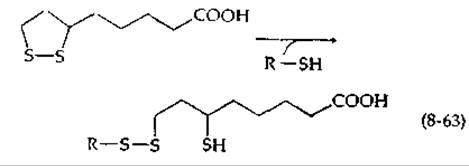
and isothiocyanates
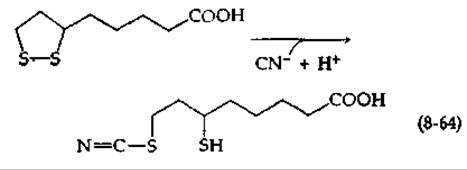
Another consequence of the ring strain is that the reduction potential E0' (pH 7, 25°C) is —0.30 V, which is very close to the corresponding value for reduced NAD+ (—0.32 V). Thus, the reoxidation of the reduced lipoic acid amide by NAD+ is thermodynamically feasible [137]. Yet another property stemming from the ring strain in lipoic acid is the presence of an absorption maximum at 333 nm.
Last update: 06/08/2026
Editorial and Educational Adaptation: This material has been compiled based on the primary/original source text. The project team performed an editorial review, corrected technical inaccuracies, structured sections, and adapted the content for an educational format.
What was processed:
- elimination of formatting defects (OCR errors, structural breaks, corrupted characters);
- editorial organization of content;
- standardization of terminology in accordance with academic sources;
- verification of factual statements against the original source text.
All mentions of the author, publication year, and origin of the primary text have been preserved in accordance with the source.