Biotechnology - Yu.O. Sazykin 2006
General Biotechnology
Biological Objects: Methods of Creation and Improvement
Enzyme Engineering. Immobilized Biological Objects
Since its inception, biotechnology has been grounded in enzymatic processes. However, until the 20th century, knowledge regarding protein-based catalysts remained extremely limited. Only in modern times has the biotechnologist gained The ability to rely on a profound understanding of enzyme structures and the mechanisms of enzymatic reactions.
On the one hand, The Use of isolated Enzymes in biotechnological production has dramatically elevated overall standards and improved the predictability of results at every manufacturing stage. Yet, this approach introduced The Challenge of instability in many enzymes. Because isolated enzymes lack the protection of METABOLISM/37.html">Cellular Homeostasis systems, most of them relatively quickly lose activity in this state—an activity that can be compromised even by minor physicochemical shifts in the environment.
On the other hand, the cyclic nature of production processes demands the continuous, repetitive generation of highly purified enzyme preparations, which entails a heavy expenditure of effort and resources. This problem was resolved through the creation of so-called "industrial biocatalysts"—immobilized enzymes.
In this context, immobilization refers to binding an enzyme to an insoluble carrier while preserving its functional, i.e., catalytic, activity. The production and application of immobilized Enzymes in Industry, including the pharmaceutical sector, form the foundation of enzyme engineering. Enzyme Immobilization not only significantly enhances their stability but also allows a single batch or series of an industrial biocatalyst to be used over an extended period.
Over recent decades, alongside enzyme immobilization, another approach has developed—the immobilization of whole Cells (primarily microbial) to carry out multi-stage metabolic processes, such as The Biosynthesis of an antibiotic. Once immobilized, such cells can "work" for weeks and months without losing their viability.
THE CONCEPT OF "bioobject immobilization" implies the physical Separation of the biocatalyst and the solvent, allowing substrate and product molecules to freely pass from the liquid medium to the solid phase and vice versa. In other words, the substrate in a stream of solvent is delivered to the bioobject bound to an insoluble carrier, while the reaction product is carried away from the bioobject by the solvent stream and harvested as the target product.
Inorganic and organic substances are used as insoluble carriers; the latter, in turn, can be either natural or synthetic.
A bioobject is immobilized on a carrier by:
✵ adsorption;
✵ forming covalent bonds with it;
✵ entrapment within a gel formed by the carrier.
Materials used for the adsorption of bioobjects include aluminum oxide, calcium carbonate, bentonite, carbon, Cellulose, Collagen, ion-exchange resins, silica gel, etc.
For the covalent binding of enzymes, researchers use agarose, dextrin, cellulose, polyacrylamide copolymers, polyurethanes, etc. In some cases, covalent attachment to a carrier requires its preliminary activation, resulting in The formation of highly reactive electrophilic groups on the carrier surface that interact with the nucleophilic groups on the protein (such as amino and SH groups).
When immobilizing via entrapment within a gel, various Polysaccharides are employed, such as calcium alginate gel (alginate being a heteropolysaccharide derived from marine Algae), polyacrylamide (polyacrylamide gel), and other polymers. A crucial parameter during immobilization is the maximum carrier "loading," i.e., the maximum amount of enzyme that can be immobilized on a specific quantity of carrier.
Each immobilization method has its own Advantages and disadvantages. Adsorption is a relatively "mild" method of binding to an insoluble carrier (without a sharp drop in enzyme activity). However, the enzyme may not bind securely enough to the carrier and can easily desorb if there are minor fluctuations in the conditions of the catalytic process.
Binding a bioobject to a carrier via covalent bonds is naturally more robust. The choice of different "types" of immobilized bioobjects in manufacturing depends on the specific goals pursued by the biotechnologist. For example, if the catalysis of a single enzymatic reaction is required, the enzyme used is typically either isolated, contained within an intact Cell, or housed in a cell with increased membrane permeability; if complete biosynthesis of a target product is needed, a complex of enzymes within an intact cell participating in a multi-step biochemical process is utilized; and finally, if the goal is the biosynthesis of a target product followed by its transformation, "systems open to elaboration" (cell + enzyme, etc.) are employed.
Bioobjects chosen for immobilization can be enzymes lacking a coenzyme (such as Hydrolases and isomerases) or possessing a prosthetic group tightly bound to the apoenzyme. However, enzymes with dissociating Coenzymes consumed in equimolar amounts relative to the substrate are poorly suited for immobilization (requiring the regeneration of these coenzymes during a continuously running reaction). Difficulties associated with using such enzymes in industry are eliminated if the enzyme is not isolated, but rather contained within a viable cell (in this case, both the delivery and regeneration of the coenzyme are automatically ensured).
If the target product is intracellular, extracting it from cells requires disrupting the entire system, which raises the question of whether bioobject immobilization is practical. Nevertheless, in such scenarios, Introduction/32.html">Genetic Engineering techniques can be used to construct and introduce a transport system into the producer Organism to export the target product from The Cell into the medium.
Despite all efforts to optimize operating conditions, The activity of an isolated (and immobilized) enzyme remains lower than its activity within an intact cell. Therefore, for catalyzing a specific reaction, it is preferable to use an enzyme maintained inside the cell. However, this is only feasible provided that neither the substrate nor the target product is subjected to the action of other cellular enzymes. Sometimes this Interference can be avoided by adjusting the Temperature, pH level, and other environmental parameters under which the enzymatic reaction takes place.
At the same time, the efficiency of an intracellular enzyme can be limited by The Cell wall, which restricts substrate access to the enzyme. Cell wall permeability can be increased through brief Treatment with organic Solvents, such as a 5% dimethyl sulfoxide solution. It is vital to avoid any adverse effects on the intracellular enzyme catalyzing the desired reaction. As a result, the cell should be "permeabilized" (from permeability), meaning it has heightened membrane permeability while maintaining its viability.
Entrapping living cells that carry out multi-stage enzymatic processes within a gel requires mild immobilization conditions and relatively low-toxicity carriers. First, the diffusion of both substrate molecules and carrier particles into the cell, as well as the target product out of the cell, must be ensured. Second, since immobilized cells respire, gas exchange must be maintained for them. At the same time, the carrier must be sufficiently durable. Various Methods exist for entrapping bioobject cells in a gel; for instance, a cell suspension is mixed with a sodium alginate solution, after which an excess of calcium chloride solution is introduced into the mixture. This forms a calcium alginate gel with cells entrapped in its matrix. The solidification process takes about 20 minutes to complete.
Currently, approaches for creating "systems open to elaboration" are actively being developed. In this setup, a producer organism synthesizing a specific substance and an enzyme that transforms that substance are immobilized within a single bioreactor. An example is the simultaneous immobilization of the microorganism Penicillium chrysogenum, a benzylpenicillin producer, and penicillin acylase, an enzyme isolated from Escherichia coli. As a result, the synthesized penicillin undergoes Enzymatic Hydrolysis to yield 6-aminopenicillanic acid (a key intermediate for the synthesis of novel Penicillins). The system can be further "elaborated" by incorporating another immobilized enzyme that catalyzes the attachment of a new radical to the 6-aminopenicillanic acid in place of the cleaved one. Ultimately, utilizing this combination of industrial biocatalysts makes it possible to produce entirely new semi-synthetic penicillins (Fig. 4).
Various bioreactor designs are employed when working with industrial biocatalysts. The simplest Column-type bioreactor (Fig. 5, a) is suitable when the immobilized bioobject is exclusively an enzyme, meaning a single-stage substrate conversion occurs within the Reactor. The column is packed with spherical particles of an insoluble carrier with the bound enzyme. Using small particle sizes increases the surface area and improves the diffusion of both the substrate and the reaction product. However, this also increases the pressure drop across the height of the column. Therefore, optimal carrier particle sizes are selected for each specific case, taking into account parameters such as surface area, pressure drop, and uniform Column packing. If the bioobjects are immobilized living cells with active Respiration, special attention must be paid to gas diffusion. Using a basic column-type reactor is impractical here, so a modified version is used. At the top of such a reactor, a nozzle is provided for gas outlet (predominantly CO2), situated just above a rigidly secured mesh with a pore size that minimizes the agitation and fluidization of carrier particles (Fig. 5, b). The third type is a stirred-tank bioreactor (Fig. 5, c); however, in this case, one must account for the potential risk of carrier particles being damaged by the stirrer blades.
Class="center">
Fig. 4. Application of a "system open to elaboration" in The production of semi-synthetic penicillins
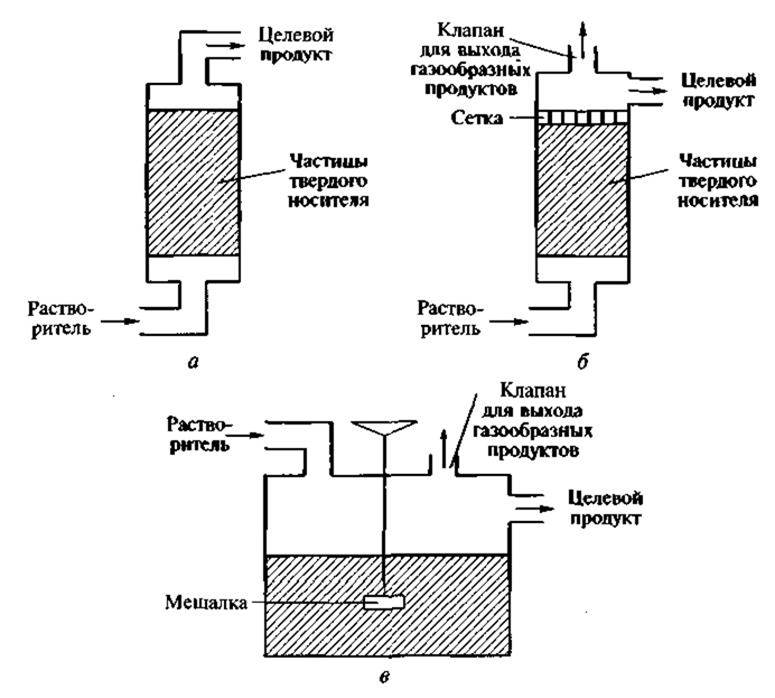
Fig. 5. Reactors used for the immobilization of biological objects: a — column type; b — modified column type; c — stirred-tank type
When immobilizing whole cells performing multistep synthesis of a target product, this process is influenced by:
✵ the biosynthesis of the target substance, occurring concurrently with the GROWTH AND REPRODUCTION of producer cells;
✵ the nutrient medium, which varies in physicochemical parameters and composition across different stages of biosynthesis;
✵ individual fermentations or Fermentation cycles that vary in The amount of the target product as well as impurities in the culture fluid that must be removed.
In Conclusion, we can cite Examples of the successful application of Protein Engineering methods in the production of one of the most important groups of microbial drugs—beta-lactam Antibiotics—as well as in amino acid manufacturing facilities.
The production process of semi-synthetic Cephalosporins involves both "classic" biosynthesis and organic synthesis, alongside two key stages that utilize immobilized enzymes: a hydrolase from Pseudomonas sp. and synthetases from Xanthomonas sp. and E. coli. Fig. 6 illustrates the sequential application of several immobilized enzymes in obtaining semi-synthetic oral and injectable cephalosporins with various spectra of clinical efficacy from cephalosporin C (a natural cephalosporin of little practical value). The lower part of Fig. 6 shows differences in the substrate Specificity of synthetases from E. coli and Xanthomonas sp. The former is advisable to use for the synthesis of cephalothin, cephaloridine, and cefazolin, while the latter is used to obtain cephaloglycin and cefoperazone. In other words, when substituting different radicals for the amino group in 7-aminocephalosporanic acid (7-ACA), the catalytic activity of the compared synthetases varies differently depending on The Structure of the radical.

Fig. 6. Production of semi-synthetic cephalosporins using immobilized enzymes
Despite the fundamental similarity of KEY STAGES IN the production of semi-synthetic penicillins by different companies, the Supports for industrial biocatalysts may vary. Ready-made commercial preparations of activated supports ("matrices") are typically used for the immobilization of both enzymes and cells. In Russia, a penicillin acylase preparation has been developed consisting of E. coli cells entrapped in a polyacrylamide gel; in the USA (Squibb), its analogue is used—penicillin acylase from the spore-forming soil bacterium Bac. megaterium sorbed onto bentonite; in Sweden (Astra), penicillin acylase from E. coli covalently linked to an activated polysaccharide support is used.
In Amino Acid Production, immobilized aminoacylases are widely used as Reagents for the transformation of BIOLOGICALLY ACTIVE SUBSTANCES (e.g., N-acylamino acids). It is known that Amino Acids obtained by chemical synthesis represent a mixture of L- and D-isomers (a racemate), whereas The Human Body can utilize only L-isomers; D-isomers accumulate in the body and can exert harmful effects. Various chemical methods exist to separate L- and D-isomers in an amino acid racemate, but the simplest and most precise is enzymatic resolution using aminoacylase. This enzyme, possessing a unique ability to hydrolyze the acyl derivatives of all Natural Amino Acids (except Proline), exhibits L-stereospecificity—i.e., it hydrolyzes the C—N bond only in the acyl derivatives of L-isomers. Let us examine the reaction using the N-acetyl derivative of an amino acid as an example:
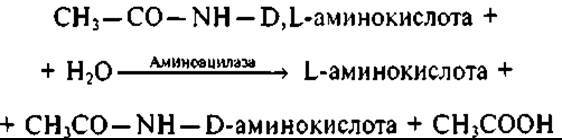
Taking advantage of differing solubilities, the L-Amino Acid and N-acetyl-D-amino acid are separated: one component remains in solution while the other precipitates. Using microbial aminoacylase, for instance, L-phenylalanine is produced (an amino acid that is part of the drug L-DOPA, used to treat Parkinson's disease). L-amino acid isomers are used in the production of Panangin and Quadevit, whereas D-isomers are used in manufacturing certain semi-synthetic chemotherapeutic agents. Specifically, D-phenylglycine is employed in the Synthesis of the semi-synthetic antibiotic ampicillin.
The economic benefits of using immobilized biological objects in industrial settings are undeniable. The USE OF IMMOBILIZED systems makes biosynthesis conditions more standardized and the entire production process more compact. The resulting biological object Functions for extended periods while consuming less raw material per unit of product. In pharmaceutical manufacturing, the target substance remains free of culture fluid components (mycelium, products of partial cell lysis, complex nutrient medium components, etc.), which significantly simplifies the task of Isolation and Purification of the target product and guarantees the absence of protein and other harmful impurities in the final preparation.
The environmental advantages are also substantial: waste volumes are reduced, as are the number of "out-of-specification" operations—for instance, when large volumes of culture fluid must be discharged into the sewage system due to medium contamination.
1. What is The Role of the biological object in biotechnological production? What can be used as biological objects in biotechnology?
2. What properties of a biological object can be harnessed for its improvement to establish an efficient and safe drug manufacturing process?
3. What does the repair of a biological object mean for the biotechnological production of pharmaceutical preparations?
4. How are mutagenesis and Selection implemented in obtaining more productive biological objects?
5. What Types of Mutations exist?
6. What is the fundamental difference between cell engineering and Genetic engineering METHODS?
7. What is the key moment in creating novel recombinant structures?
8. What factors determine the choice of a producer microorganism in the industrial production of recombinant Proteins?
9. What types of immobilization of biological objects are the most promising?
10. What types of bioreactors are used to work with industrial biocatalysts?
Last update: 06/08/2026
Editorial and Educational Adaptation: This material has been compiled based on the primary/original source text. The project team performed an editorial review, corrected technical inaccuracies, structured sections, and adapted the content for an educational format.
What was processed:
- elimination of formatting defects (OCR errors, structural breaks, corrupted characters);
- editorial organization of content;
- standardization of terminology in accordance with academic sources;
- verification of factual statements against the original source text.
All mentions of the author, publication year, and origin of the primary text have been preserved in accordance with the source.