INVERTEBRATE ZOOLOGY IN THREE VOLUMES - VOLUME 2 - H.Y. Shcherbak - 1996
PHYLUM TARDIGRADA
CLASS TARDIGRADA
Tardigrades are a distinctive group of animals inhabiting numerous aquatic and terrestrial biotopes; however, dividing them into strictly aquatic and terrestrial species is somewhat imprecise, as active life for all terrestrial species is possible only in the Presence of Water. Over 400 species have been described, with 50 known in Ukraine.
Tardigrades possess a more or less cylindrical, short, thick body with a slightly flattened ventral side and no prominent segmentation. It is generally considered to consist of five segments. The first segment, fused with the HEAD lobe, lacks appendages, while the subsequent four bear pairs of legs: three pairs are located laterally, and the fourth is at the posterior end of the body (Fig. 209). The legs are short, unsegmented, and tubercle-like body outgrowths terminating in movable claws. Most tardigrades are nearly colorless and even transparent, occasionally yellow-green, plum-green, violet, or reddish.
Class="center">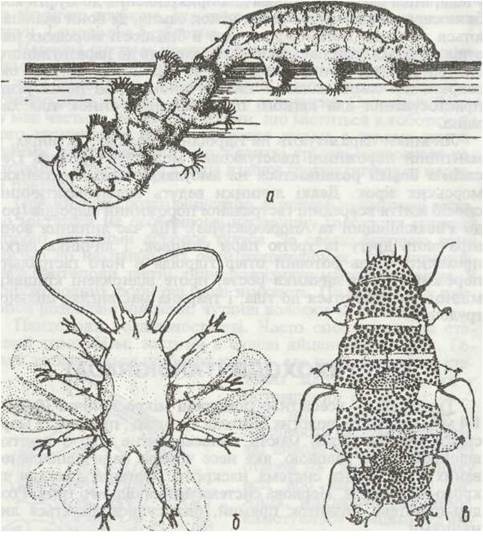
Fig. 209. Tardigrades
A characteristic feature of tardigrade body Organization is the fixed Cell constancy of certain Tissues and Organs—specifically the integument, Muscles, and midgut—which in certain species consist of a precisely determined number of Cells that remains constant throughout the animal's life.
Externally, the tardigrade body is covered by a cuticle that differs in fine Structure and Chemical composition from the arthropod cuticle. It consists of an epicuticle and a procuticle (Fig. 210). The surface of the epicuticle lacks a cement layer, instead bearing a layer of mucus composed of acidic mucopolysaccharides; the wax layer lies between the epi- and procuticle. Pore canals are absent in the procuticle. The tardigrade cuticle does not contain Chitin.
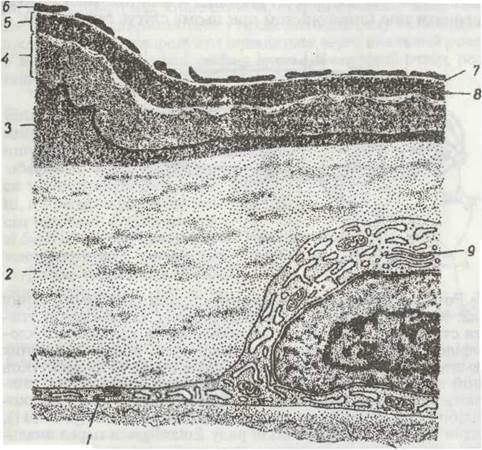
Fig. 210. Diagram of The structure of the tardigrade body integument:
1 - site of contact between epithelial cells; 2 - procuticle; 3 - wax layer; 4 - intermediate layer; 5 - epicuticle; 6 - mucus layer; 7 - cuticulin plate; 8 — protein part of the epicuticle; 9 - epithelial cell
The cuticle is typically thin, occasionally thickening to form segmental plates, and in some species bears various bristle-like, tubercular, or spine-like outgrowths. Underlying the cuticle is an epithelium that is never ciliated.
The body cavity is a mixocoel filled with hemolymph, which contains cells packed with nutrient reserves.
Tardigrade muscles are smooth, represented by separate longitudinal and transverse bundles on the dorsal, ventral, and lateral sides; additionally, There is a system of muscles associated with the limbs. Through the action of trunk muscles, tardigrades can bend their bodies (with the hemolymph serving as an antagonist).
The Mouth is located on the ventral side of the anterior end of the body. The Oral Cavity contains a pair of sharp, forward-directed stylets used by tardigrades to puncture predominantly chlorophyll-containing cells of mosses and Algae, and less frequently, small nematodes, rotifers, other tardigrades, etc., to suck out their contents. The ducts of the Salivary Glands empty into the Pharynx, which features a suctorial expansion. The pharynx leads into a long, sac-like midgut that transitions into the hindgut (Fig. 211). In Representatives of the order Eutardigrada, the hindgut expands before the anus to form a cloaca.

Fig. 211. Diagram of the Internal Structure of a female Macrobiotus:
1 - lateral lobe of the Brain; 2 — eye; 3 - salivary gland; 4 - longitudinal muscles; 5 - transverse muscles; 6 — midgut; 7 - Ovary; 8 - Malpighian tubules; 9 - seminal receptacle; 10 - anus; 11 - nerve ganglia; 12 - suctorial expansion of the pharynx; 13 - stylet; 14 - mouth
At the boundary between the mid- and hindgut, many species feature three blind-ending outgrowths: a short dorsal one lying upon the intestine, and two longer ones along its sides; these are regarded as excretory organs analogous to the Malpighian tubules of Arthropods. Furthermore, they likely participate in osmoregulation. An indirect confirmation of this is the absence of Malpighian tubules in marine species, in which case the intestine performs the excretory function.
Circulatory organs are absent; tardigrades respire through their entire body surface.
The Nervous system consists of a four-lobed supraesophageal ganglion, circumesophageal connectives, and a ventral nerve cord with five ganglia (Fig. 212). Nerves extend from the supraesophageal and ventral ganglia to small ganglia located at the Base of the legs, Stomach, etc.
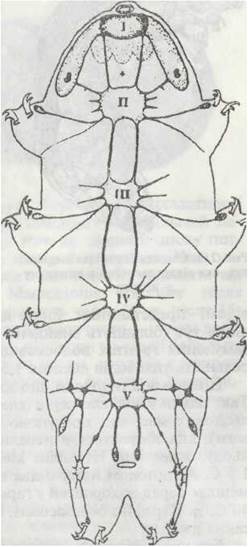
Fig. 212. Diagram of the STRUCTURE OF THE tardigrade nervous system (ventral view)
Sense Organs are poorly developed; the anterior part of the body contains a pair of ocelli consisting of several sensory cells surrounded by pigmented eyecups. Marine species also possess several pairs of sensory appendages in this region, which are innervated by the supraesophageal ganglion.
Tardigrades are gonochoric. Their Gonads are unpaired, sac-like, and located above the intestine. In representatives of the order Eutardigrada, the genital ducts (oviducts or spermdicts) open into the cloaca, and reproductive products are expelled through the anus. Species of the order Heterotardigrada possess a separate genital opening situated near the anus.
Some tardigrades (order Eutardigrada) can reproduce via parthenogenesis. Males are significantly rarer than females in the populations of certain species, while in others they are entirely unknown. Several parthenogenetic generations of Hypsibius dujardini and Milnesium tardigradum that developed and lived normally have been successfully obtained in experiments.
Fertilization can be either internal or external and occurs in various ways. Many tardigrades lay fertilized eggs inside their discarded cuticle (Fig. 213) and cling to it for a long time, dragging it along with the eggs. Less commonly, eggs are deposited freely onto the substrate, either singly or in small clusters.
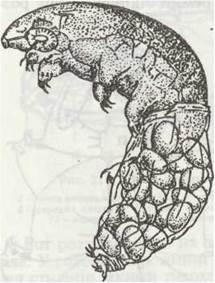
Fig. 213. Female Hypsibius megalonyx laying eggs in its discarded cuticle
Tardigrade eggs are spherical and covered by a sturdy membrane, which often bears various species-specific projections. The number of eggs laid depends not only on the species but also on the physiological condition of the female, particularly her nutritional status.
The embryonic development of tardigrades remains insufficiently studied. Available data indicate that their Cleavage is total and equal, and Gastrulation occurs via delamination. At the gastrula stage, five pairs of lateral outpouchings form in the midgut, which subsequently pinch off to give rise to coelomic sacs (enterocoelous Formation of the coelom).
Development is direct, and growth is accompanied by molting. Because many tardigrade organs consist of a constant number of cells, growth is primarily driven by an increase in cell volume rather than Cell Division.
As already mentioned, tardigrades inhabit an exceptionally wide range of aquatic and terrestrial biotopes. Marine tardigrade species primarily live in the coastal zone on sediments and algae. Among them are commensals that settle in the mantle cavity of Mollusks, on barnacles and isopods, etc., as well as a parasitic species, Tetiakentronsynaptae, which lives on the tentacles of the holothurian Leptosynapta galliennei and feeds on The Cell contents of its living host. Freshwater tardigrades occur in ponds, lakes, reservoirs, springs, etc., though representatives of only a few strictly freshwater genera are known so far (with most having been discovered on land as well). Data indicate that in the silted bottoms of the Dnieper Cascade reservoirs, tardigrade Abundance can reach 1.5 million per 1 m2.
Tardigrades inhabiting extreme conditions are of particular interest. For instance, the species Hypsibius klebelsbergi lives exclusively in glacial meltwater (a glacier being a terrestrial accumulation of ice masses gradually moving under METABOLISM/18.html">The Influence of gravity) that collects in small hollows or ice cracks at temperatures of 0–1.5°C. Its antipode comprises two species: Thermoxozodium esakii, which dwells among algae in hot springs at 40°C, and Hypsibius oberbaeuseri, found in mosses along the edges of such springs.
The majority of known tardigrade species inhabit A wide variety of porous substrates across various terrestrial biotopes: deciduous and coniferous forest litter, soil, Lichens, and mosses, including those growing on rocks, trees, roof gutters,
and the like. Some of these substrates remain permanently submerged in water, but most undergo cycles of desiccation and rehydration; the optimal condition for active tardigrade life is the presence of a thin water film or droplets, where the animal's body is completely surrounded by water. When the substrate dries out, tardigrades do not die; instead, they enter a state of suspended animation (cryptobiosis, from the Greek kryptos meaning hidden, and bios meaning life). During this process, the animal decreases in volume, its appendages are retracted, the elastic Regions of the cuticle contract to form characteristic folds, and the tardigrade takes on the appearance of a microscopic barrel (Fig. 214).

Fig. 214. Milnesium tardigradum in a state of cryptobiosis
An important condition for the long-term preservation of tardigrade viability is the gradual desiccation of the substrate and a slow transition into cryptobiosis. Once the animals are reimmersed in water, they revive quite rapidly. The time required for metabolic recovery depends on the duration of the drying period. For example, Macrobiotus coronifer revives within 25 minutes after nine months of desiccation, within 35 minutes after 15 months, and within a day after 22 months.
Experiments have demonstrated that tardigrades in the tun (barrel) stage can withstand extreme conditions they never encounter in nature. For instance, Macrobiotus tuns maintained their viability for 20 months at temperatures ranging from -190°C to -200°C, for 8 hours at -272°C, and during brief heating up to +100°C. Tardigrades even survived being kept for several months in an atmosphere saturated with hydrogen, which is well known to be incompatible with life.
Tardigrades are most commonly divided into two orders: Heterotardigrada and Eutardigrada (with a separate order, Mesotardigrada, occasionally erected within the latter for the aforementioned species Thermoxozodium esakii); however, all researchers note that this Classification is artificial.
Last update: 13/08/2026
Editorial and Educational Adaptation: This material has been compiled based on the primary/original source text. The project team performed an editorial review, corrected technical inaccuracies, structured sections, and adapted the content for an educational format.
What was processed:
- elimination of formatting defects (OCR errors, structural breaks, corrupted characters);
- editorial organization of content;
- standardization of terminology in accordance with academic sources;
- verification of factual statements against the original source text.
All mentions of the author, publication year, and origin of the primary text have been preserved in accordance with the source.