Molecular Biology of the Cell - Volume 1 - Alberts B., Bray D., Lewis J., Raff M., Roberts K., Watson J. 1994
Introduction to Cell Biology
Small Molecules, Energy, and Biosynthesis
Biosynthesis and the Generation of Order
At any given moment, thousands of different Chemical Reactions are taking place within a Cell. These reactions are interconnected, forming pathways in which the product of one reaction serves as the substrate for the next. Broadly speaking, most intracellular reactions can be divided into two main categories: catabolic and biosynthetic. Having examined catabolic reactions in the previous section, we now turn our attention to Biosynthesis. Such processes originate from the intermediates of Glycolysis and The Citric Acid Cycle (along with related compounds), ultimately yielding the larger and more complex molecules required by The Cell.
2.4.1. The spontaneity of a reaction is determined by the magnitude of its free-energy change [18]
Although Enzymes accelerate energetically favorable reactions, they are entirely incapable of driving energetically unfavorable ones. Using a Water analogy, we can say that enzymes on their own cannot force water to flow uphill. Yet, for a cell to grow and divide, precisely such processes must occur: Cells are required to construct large, complex molecules from small, simple ones. As we have seen, this is achieved primarily through the action of enzymes, which couple energetically favorable reactions—those utilizing solar energy and generating heat—with energetically unfavorable ones that increase the degree of biological disorder. Let us examine this coupling mechanism in greater detail.
First, we must take a closer look at the term "energetically favorable" reaction, which we have used rather loosely thus far. As noted above, only those reactions that increase the overall disorder of the universe can occur spontaneously. Disorder increases whenever energy is released as heat; the criterion for this increase in disorder is a property known as Free energy, $G$. This quantity is defined such that its change, denoted as $\Delta G$, measures the degree of disorder introduced into the universe by a given reaction (Scheme 2-7). By definition, "energetically favorable" reactions are those that release a large amount of free energy;
in other words, such reactions are characterized by a large negative $\Delta G$ and generate a high degree of disorder. These reactions exhibit a strong tendency to proceed spontaneously, although their actual rate depends on other factors, notably the presence of specific catalysts or enzymes (see below). Conversely, reactions in which $\Delta G$ is positive (such as The formation of a peptide bond between Two Amino Acids) increase the order of the universe and cannot occur spontaneously. Such energetically unfavorable reactions take place only when they are coupled to other processes possessing sufficiently large negative $\Delta G$ values to render the $\Delta G$ of the overall process negative.
The course of most reactions can be predicted quantitatively. A wealth of thermodynamic parameters is available, allowing
one to calculate the free-energy changes, $\Delta G$, for most major metabolic reactions within the cell. The total free-energy change for a given metabolic pathway is expressed as the sum of the energy changes across each individual step of that pathway. Consider two sequential reactions:
Class="center">A → B and B → C,
whose $\Delta G$ values are +1 and -13 kcal/mol, respectively. (Recall that one mole of a substance contains $6 \times 10^{23}$ molecules.) When these reactions are coupled, the $\Delta G$ of the coupled reaction becomes -12 kcal/mol. It follows that the energetically unfavorable reaction A → B, which cannot proceed spontaneously, can be driven by the energetically favorable reaction B → C, provided a mechanism exists to couple the two processes.
2.4.2. Biosynthetic reactions are frequently coupled directly to ATP Hydrolysis
Consider a typical biosynthetic process in which two monomers—A and B—must be joined via a dehydration reaction (also known as Condensation), accompanied by the release of water:
A-H + B-OH → A-B + H2O.
The reverse reaction (hydrolysis), in which a water molecule cleaves the covalently bonded compound A-B, is almost invariably energetically favorable. This occurs, for example, during the hydrolytic Breakdown of Proteins, Nucleic Acids, and Polysaccharides into their constituent subunits.
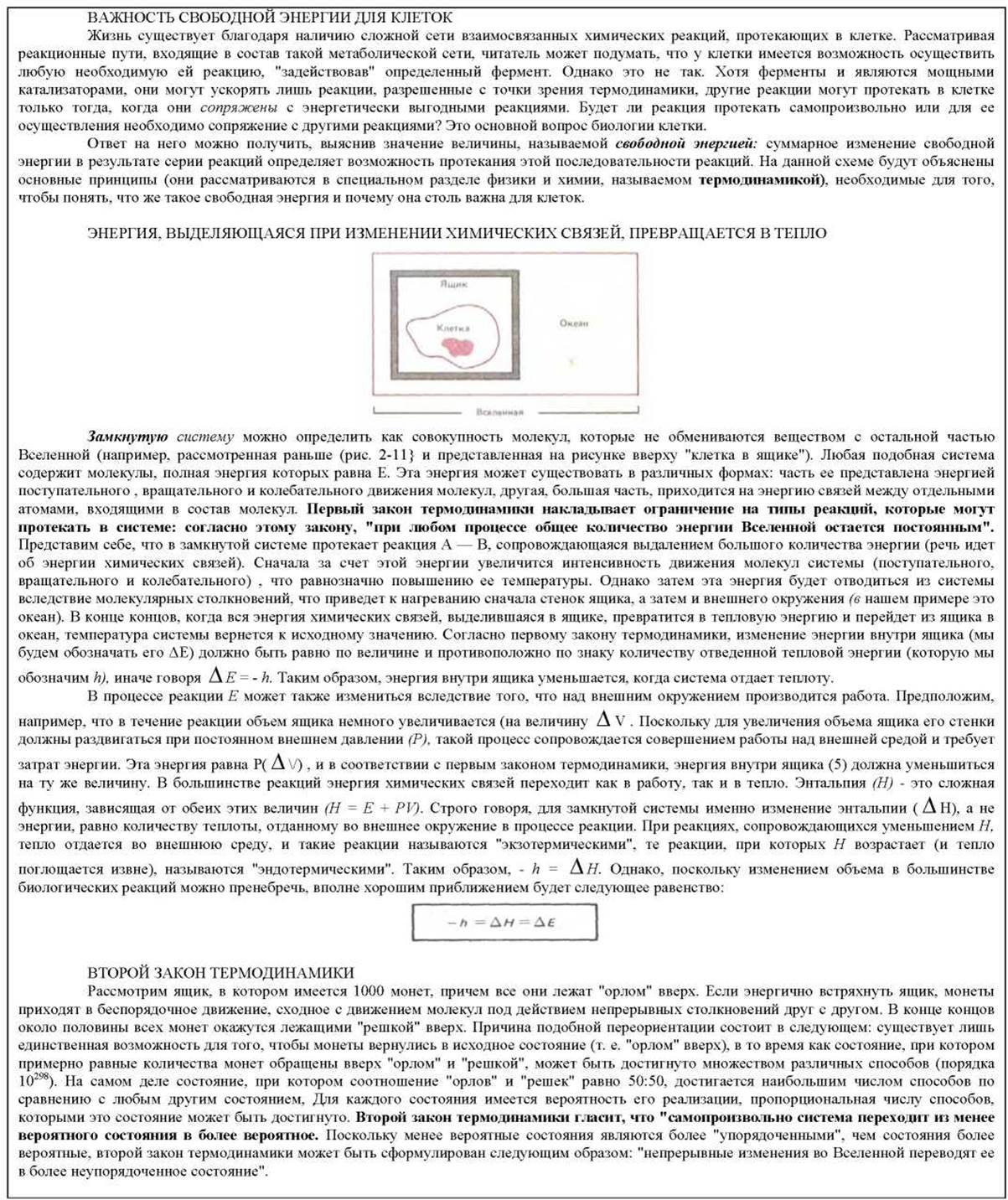
Scheme 2-7. Free Energy and biological reactions.

The general strategy enabling the cell to synthesize A-B from A-H and B-OH involves a multi-step sequence of reactions that couples the energetically unfavorable Synthesis of the desired compound to a strongly favored driving reaction (Fig. 2-17). Because ATP hydrolysis has a large negative $\Delta G$ (Fig. 2-26), it frequently serves as the energetically favorable reaction that drives intracellular biosynthesis. In the pathway from A-H and B-OH to A-B coupled with ATP hydrolysis, the energy of hydrolysis first converts B-OH into a high-energy intermediate, which then reacts directly with A-H to form A-B. The simplest mechanism for this process involves The transfer of a phosphate group from ATP to B-OH, yielding B-PO3
 , whereupon the overall reaction is accomplished in just two stages:

Since the resulting intermediate  is subsequently consumed, the net reactions can be described by the following equations:
A-H + B-OH → A-B and ATP → ADP + Pi.
The first, energetically unfavorable reaction is rendered possible because it is coupled to the second, energetically favorable reaction (ATP hydrolysis). A classic example of such coupled biosynthetic reactions is the synthesis of The amino acid glutamine (Fig. 2-27).
The $\Delta G$ for the hydrolysis of ATP to ADP and inorganic phosphate depends on the concentrations of all reactants and typically ranges from -11 to -13 kcal/mol under physiological cellular conditions (see Section 7.1.10). In principle, ATP hydrolysis can be harnessed to drive a thermodynamically unfavorable reaction with a $\Delta G$ of, say, +10 kcal/mol, provided an appropriate reaction sequence is available. However, for many biosynthetic pathways, even a $\Delta G$ of -13 kcal/mol is insufficient. In such cases, the ATP hydrolysis pathway is modified such that AMP and PPj (pyrophosphate) are initially produced (Fig. 2-28). In the subsequent step, the pyrophosphate is further hydrolyzed, bringing the overall free-energy change for the entire process to approximately -26 kcal/mol.

Fig. 2-26. The hydrolysis of ATP can involve the Cleavage of the terminal phosphate, releasing useful energy that ranges from 11 to 13 kcal/mol depending on intracellular conditions. The large negative $\Delta G$ of this reaction is attributable to several factors. First, the removal of the terminal phosphate eliminates the energetically unfavorable electrostatic repulsion between adjacent negative charges. Furthermore, the released inorganic phosphate ion is stabilized by Resonance and the formation of energetically favorable Hydrogen Bonds with water.
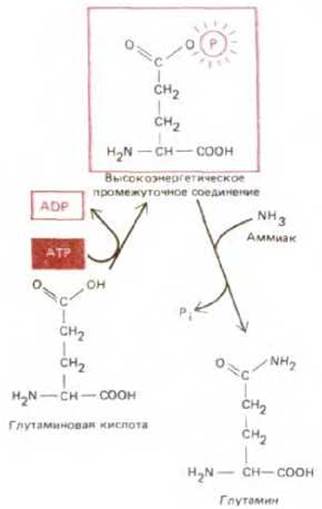
Fig. 2-27. An example of a biosynthetic dehydration reaction driven by ATP hydrolysis. Glutamic acid is first converted into a high-energy phosphorylated intermediate (corresponding to compound B-O-P in the text), which then reacts with ammonia to form glutamine. In this example, both reactions take place On the surface of the same enzyme, glutamate synthetase. Note that both molecules are shown in uncharged form for simplicity.

Fig. 2-28. An alternative pathway of ATP hydrolysis: pyrophosphate is formed first and subsequently hydrolyzed. This pathway yields nearly twice as much energy as the reactions considered in Fig. 2-26. The H atoms extracted from water are shown to become attached to the phosphate groups following hydrolysis. However, at the pH values typical of the Cytoplasm, most of these atoms dissociate to form a free hydrogen ion (H+).
How is the energy of Pyrophosphate hydrolysis utilized in biosynthetic reactions? One mechanism can be illustrated by the aforementioned example of the synthesis of compound A-B from A-H and B-OH. With the help of an appropriate enzyme, B-OH can react with ATP to form a high-energy compound B-O-
The reaction now proceeds in three stages:

The overall reaction can be written as follows: A-H + B-OH → A-B and ATP + H2O → AMP + 2Pi.
Since an enzyme always accelerates both the forward and reverse directions of the reaction it catalyzes, compound A-B can break down by reacting with pyrophosphate (the reverse of stage 2). However, the energetically favorable reaction of pyrophosphate hydrolysis (Stage 3) helps maintain the stability of compound A-B by keeping the concentration of pyrophosphate very low (thus preventing the reverse of reaction 2). Thus, the energy of pyrophosphate hydrolysis drives the reaction in the forward direction. An example of an important biosynthetic reaction of this type (polynucleotide synthesis) is shown in Fig. 2-29.

Fig. 2-29. The synthesis of a polynucleotide (RNA or DNA) is a multi-step process driven by ATP hydrolysis. In the first step, a nucleoside monophosphate (e.g., CMP) is activated by the sequential addition of terminal phosphates from two ATP molecules. The resulting high-energy intermediate—a nucleoside triphosphate, such as CTP—exists in free solution until it reacts with the terminal region of a growing RNA or DNA chain, releasing pyrophosphate. The extremely energetically favorable hydrolysis of pyrophosphate to inorganic phosphate ensures that the overall process proceeds in the direction of polynucleotide synthesis.
2.4.3. Coenzymes Participate in the Transfer of Specific Chemical Groups
Because the terminal phosphate bond of ATP is readily cleaved with the release of free energy, this compound serves as an efficient phosphate donor for A wide variety of phosphorylation reactions. Many diverse, chemically labile bonds behave similarly. For example, specific carrier molecules contain acetyl or methyl groups linked by reactive bonds, enabling these groups to be readily transferred to other molecules (Table 2-2). The same carrier molecule frequently participates in many different biosynthetic reactions that require its specific reactive group.
An example of such a carrier molecule is acetyl-coenzyme A (acetyl-CoA), which is generated during The breakdown of glucose.
Table 2-2. Some Coenzymes Involved in Chemical Group Transfer Reactions
|
Coenzyme 1) |
Group transferred |
|
ATP |
Phosphate |
|
NADH, NADPH |
Hydrogen + electron (hydride ion) |
|
Coenzyme A |
Acetyl |
|
Biotin |
Carboxyl |
|
S-Adenosylmethionine |
Methyl |
1) Coenzymes are small molecules associated with certain enzymes that are essential for their activity. Each of the listed coenzymes acts as a carrier molecule for a small chemical group and participates in various reactions in which this group is transferred to another molecule. Some coenzymes are attached to enzymes via covalent bonds, whereas others are bound less tightly. Covalently bound coenzymes are sometimes referred to as prosthetic groups of enzymes.
It carries an acetyl group linked to CoA via a labile thioester bond (Fig. 2-19). This acetyl group is readily transferred to another molecule, such as a fatty acid. Another notable example is biotin, which mediates the transfer of a carboxyl group in many biosynthetic reactions (Fig. 2-30). Molecules like acetyl-CoA, biotin, and ATP are called coenzymes because they are closely associated with the surfaces of various enzymes and are required for enzymatic activity. Many coenzymes cannot be synthesized by animals and must be obtained from the diet (derived from plants and microorganisms). Vitamins—crucial nutritional factors required by animals in trace amounts—are often precursors of the required coenzymes.

Fig. 2-30. Transfer of a carboxyl group by the coenzyme biotin. Biotin acts as a carrier molecule for the carboxyl group (—COO-). In the reaction sequence shown, biotin is covalently bound to the enzyme Pyruvate carboxylase. An activated carboxyl group derived from a bicarbonate ion (HCO-3) is attached to biotin in a reaction driven by the energy of ATP hydrolysis. The carboxyl group is then transferred to the methyl group of pyruvate to form oxaloacetate.
2.4.4. Biosynthesis Requires Reducing Equivalents
We have already seen that Oxidation and reduction reactions occur continuously within the cell. The chemical energy stored in nutrient molecules is released through oxidative processes, whereas for the construction of biological molecules, the cell requires, among other things, a series of reduction reactions that consume chemical energy. THE PRINCIPLE OF coupled reactions we discussed earlier enables cells to directly utilize the chemical energy of Catabolism to synthesize NADH (see Fig. 2-21). Subsequently, the high-energy bond between hydrogen and the nicotinamide ring in the NADH molecule provides energy for other thermodynamically unfavorable enzymatic reactions in which hydrogen (in the form of a hydride ion) is transferred to another molecule. Therefore, NADH and NADPH, which is readily formed from it, are referred to as carriers of "reducing power".
To understand how this works in practice, let us consider just a single step in biosynthesis: the final reaction in the synthesis of the lipid molecule Cholesterol. In this reaction, two hydrogen atoms are added to the polycyclic steroid ring, reducing a carbon–carbon double bond (Fig. 2-31). As in most biosynthetic reactions, the two hydrogen atoms required for this process are supplied as a hydride ion from an NADPH molecule and a proton (H+) from the solution (H+ + H- = 2H). As with NADH, the hydride ion to be transferred from NADPH is part of the nicotinamide ring and is easily detached from it, because the nicotinamide ring thereby becomes aromatic, thus achieving a more stable state (see Fig. 2-22). Consequently, in both NADH and NADPH, the hydride ion is attached by a high-energy bond whose cleavage allows it to be transferred to another molecule, provided that a suitable enzyme capable of catalyzing this transfer is present.
Chemically, the difference between NADH and NADPH is minor: NADPH has an additional phosphate group in the region of the molecule distant from its Active Site (Fig. 2-32). This phosphate group does not participate directly in the reaction. However, it acts as a "handle" by which the coenzyme NADPH binds to its specific enzymes. NADH typically operates with enzymes that catalyze catabolic reactions, whereas NADPH interacts with biosynthetic enzymes. Consequently, catabolic and biosynthetic pathways can be regulated independently of each other by altering the levels of NADH and NADPH, respectively.
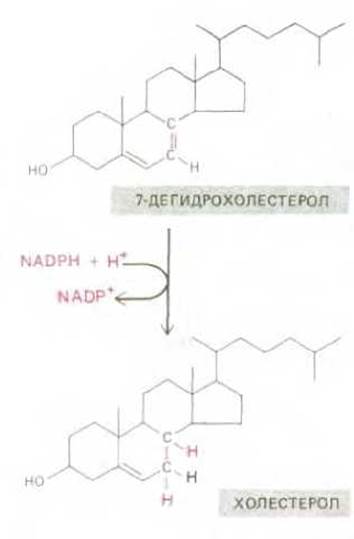
Fig. 2-31. The final step in one of the Cholesterol Biosynthesis pathways. The reduction of the C—C bond occurs via the transfer of a hydride ion from an NADPH carrier molecule and a proton (H+) from the solution.

Fig. 2-32. Structure of NADPH, which differs from NADH (Fig. 2-22) only by the presence of an additional phosphate group that allows specific enzymes (typically involved in biosynthetic processes) to selectively recognize this compound.
2.4.5. The synthesis of biological polymers proceeds through the repetition of elementary dehydration reactions
The principal macromolecules synthesized by cells are polynucleotides (DNA and RNA), polysaccharides, and proteins. These macromolecules exhibit remarkable structural diversity and represent some of the most complex molecules known. Despite this complexity, they are assembled from a relatively small set of small molecules (termed monomers or subunits) utilizing a limited repertoire of chemical reactions.
The addition of monomers to proteins, polynucleotides, and polysaccharides is illustrated in highly simplified form in Fig. 2-33. Although the synthesis of each polymer involves covalent bonds of different types, as well as various enzymes and Cofactors, all these reactions share a striking similarity. In each case, monomer addition occurs via a dehydration reaction—the removal of a water molecule from the reacting species.
As in the more general case discussed earlier (see Section 2.4.2), the formation of these polymers requires chemical energy, ultimately supplied through the standard Mechanism of coupling the biosynthetic reaction to the energetically favorable hydrolysis of a nucleoside triphosphate. For all three macromolecule types, at least one of the nucleoside triphosphates involved in the process is cleaved to yield pyrophosphate, which is subsequently hydrolyzed in turn, providing the extra energy required to drive the reaction (Fig. 2-29).

Fig. 2-33. Schematic representation of polymerization reactions leading to the synthesis of Three types of biological polymers. In each case, synthesis involves the loss of a water molecule (dehydration). The diagram does not reflect the fact that prior to the addition of each monomer, the monomers must be activated by high-energy nucleoside triphosphates. The reverse reaction—the breakdown of all three polymer types—proceeds via the simple addition of water molecules (hydrolysis).

Fig. 2-34. HEAD-to-tail and tail-to-head polymer growth.
Activated intermediates in polymerization reactions can be oriented in two ways, resulting in either "tail-to-head" or "head-to-tail" polymerization. In head-to-tail polymerization, the activated bond is located at the end of the growing polymer chain and therefore must be regenerated with each monomer addition. In this scenario, each incoming monomer brings along the activated group that will be used in the reaction with the next monomer in the sequence (Fig. 2-34). In tail-to-head polymerization, the activated bond carried by each new monomer is utilized to attach that very monomer. Both types of polymerization are employed in the synthesis of Biopolymers. While the synthesis of polynucleotides and certain simple polysaccharides occurs via tail-to-head polymerization, Protein Synthesis proceeds via head-to-tail polymerization.
Summary
ATP hydrolysis is commonly coupled to energetically unfavorable reactions, such as The biosynthesis of macromolecules, which proceeds through the formation of phosphorylated intermediates. Other reactive carrier molecules, known as coenzymes, transfer different chemical groups during biosynthesis; for instance, NADPH carries hydrogen in the form of a proton and two electrons (a hydride ion), whereas acetyl-CoA carries acetyl groups. Polymer molecules, such as proteins and nucleic acids, are assembled from small activated precursor units through the repeated cycling of dehydration reactions.
Last update: 12/08/2026
Editorial and Educational Adaptation: This material has been compiled based on the primary/original source text. The project team performed an editorial review, corrected technical inaccuracies, structured sections, and adapted the content for an educational format.
What was processed:
- elimination of formatting defects (OCR errors, structural breaks, corrupted characters);
- editorial organization of content;
- standardization of terminology in accordance with academic sources;
- verification of factual statements against the original source text.
All mentions of the author, publication year, and origin of the primary text have been preserved in accordance with the source.