Biochemistry - The Chemical Reactions of Living Cells, Volume 2 - D. Metzler 1980
Biosynthesis: how new molecules are formed
Utilization of ATP energy
Pyrophosphate hydrolysis
The Cleavage of inorganic pyrophosphate (PPi) into two phosphate (Pi) groups (Ch. 7, Sec. D, 1) is catalyzed by pyrophosphatases, which appear to be present in all Cells. Their function seems to be simply the removal of the generated PPi as it is formed (Table 7-2), thereby driving the equilibrium toward The formation of the desired product. An example is the formation of activated Amino Acids (aminoacyl-tRNA molecules), which play a vital role in METABOLISM/35.html">Protein Biosynthesis. It follows from equation (11-2) that two ATP molecules are required to activate a single amino acid molecule [2]. Although from a thermodynamic standpoint it might seem unnecessary to "pay" with two ATP molecules for The addition of a single monomer unit to a polymer chain, this cost is frequently incurred, and the Hydrolysis of PPi ensures that the reaction goes to completion. tRNA molecules tend to bind with amino acids in accordance with equation (11-2) even when the concentration of free amino acids in the Cytoplasm is low.
Class="center">
However, kinetic laws must also be taken into account here. A sequence of biosynthetic reactions would likely proceed much too slowly if the removal of PPi did not accelerate them. It should also be borne in mind that biosynthetic pathways are tightly regulated, and the observed complexities may partly be explained by regulatory mechanisms that are not yet fully understood. Although pyrophosphatases are ubiquitous, one cannot be entirely certain that PPi always undergoes hydrolysis. In some cases, the energy of the phosphoanhydride bond may be conserved by The Cell (Ch. 13, Sec. D, 6).
In certain metabolic reactions, pyrophosphate esters are formed As a result of the sequential transfer of terminal phosphate groups from two ATP molecules to a hydroxyl group. These esters frequently react with the release of PPi; an example is the activation of prenyl units (type 6 B reaction, Table 7-1; Fig. 12-11). Here too, hydrolysis proceeds all the way to Pi. Thus, pyrophosphate cleavage represents a second very common mechanism for coupling ATP cleavage to synthetic reactions.
There are several known instances where Group activation is coupled with the cleavage of ATP at C 5' (Fig. 7-7) to form a tripolyphosphate bond, PPP1, which in turn is hydrolyzed to Pi and PPi, and ultimately to three Pi molecules. An example is the formation of S-adenosylmethionine (SAM) [3], as illustrated in equation (11-3).
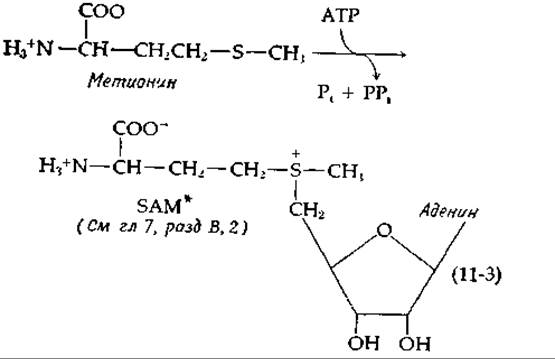
This reaction represents a Substitution at the 5'-methylene group of ATP by the sulfur atom of Methionine. The initial product could theoretically be an enzyme-bound PPP1. In reality, however, the initial products are Pi and PP1, which dissociate from the enzyme [3]. It has been established that Pi originates from the terminal phosphorus (Pγ) of ATP.
Last update: 06/08/2026
Editorial and Educational Adaptation: This material has been compiled based on the primary/original source text. The project team performed an editorial review, corrected technical inaccuracies, structured sections, and adapted the content for an educational format.
What was processed:
- elimination of formatting defects (OCR errors, structural breaks, corrupted characters);
- editorial organization of content;
- standardization of terminology in accordance with academic sources;
- verification of factual statements against the original source text.
All mentions of the author, publication year, and origin of the primary text have been preserved in accordance with the source.