BOTANY WITH BASICS OF HYDROBOTANY (AQUATIC PLANTS OF UKRAINE) - B.Ye. Yakubenko - 2011
VI. THE PLANT WORLD SYSTEM
LOWER SPORE PLANTS
GENERAL CHARACTERISTICS AND FEATURES
Division Cyanoprokaryota (Blue-Green Algae) — Cyanoprokaryota (Cyanophyta, Cyanobacteria)
Cyanoprokaryotes (blue-green Algae) unite prokaryotic photoautotrophic plant organisms and number about 2,000 species. This is one of the most ancient groups of organisms on Earth, with an age of about 3.5–3.8 billion years. They are similar in Structure to photosynthetic Bacteria, yet possess A number of distinctive features and differences: 1) they are obligate phototrophs incapable (except for certain species) of utilizing exogenous Organic compounds; 2) they are distinguished by the presence of Two Photosystems located on the membranes of specialized photosynthetic structures — thylakoids, which are predominantly unattached to the Plasmalemma; 3) oxygen production is associated with Water photolysis, driven by sunlight energy; 4) the absence of Respiration in the light; 5) the ability for two processes to occur within The Cell — oxygenic Photosynthesis and anaerobic Nitrogen Fixation within the thylakoid membranes, which alternately perform the Functions of Plastids and Mitochondria, as well as the absence of flagella and motile stages.
Their external morphological similarity to bacteria, prokaryotic Cellular Organization, and genomic composition provide grounds for some scientists to classify these organisms within the bacterial kingdom as cyanobacteria and subject them to the rules of the International Code of Nomenclature of Bacteria. However, considering the aforementioned characteristics and specifics of these organisms, it is more appropriate to regard them among other plants of the kingdom Plantae as prokaryotic representatives in accordance with the nomenclatural principles of the International Code of Botanical Nomenclature.
Cyanoprokaryotes (blue-green algae) are extremely widespread in various aquatic and terrestrial biotopes, possessing a broad ecological amplitude and adaptations for surviving under diverse growth conditions. Their color spectrum ranges from blue-green (typical of most representatives) to yellow-green, green, steel-gray, red, or black.
The coloration pattern is determined by growth conditions and the manifestation of pigment composition, which includes chlorophyll a (with chlorophyll b as an exception), phycobilin pigments — phycocyanin, allophycocyanin, phycoerythrocyanin, and phycoerythrin (red pigment); carotenoids — $\beta$-caroten, xanthophylls of the lutein cycle (lutein and zeaxanthin), and specific xanthophylls — oscilloxanthin, myxoxanthin, aphanicin, and aphanizophyl).
Chlorophyll b (a chlorophyll-like pigment — divinyl-chlorophyll a-like Mq-porphyrin), and sometimes also $\alpha$-carotene, are characteristic of the group of green prokaryotic algae (previously considered at the rank of Prochlorophyta), whose affiliation with cyanoprokaryotes has been proven by molecular genetic studies.
The primary assimilation product of cyanoprokaryotes is a Glycogen-like polysaccharide — blue-green algal starch, as well as cyanophycin and volutin.
Blue-green algae are unicellular, colonial, or Multicellular Organisms, often surrounded by mucus, forming loose mucous aggregates. Unicellular and colonial forms exhibit a coccoid body type, whereas multicellular forms are filamentous, sometimes showing a tendency toward lamellar or volumetric cell arrangements.
The aggregate of physiologically connected Cells forming a filamentous structure (branched or unbranched) is called a trichome. These cells are interconnected via plasmodesmata passing through the pores of the transverse cell walls. Individual trichomes or their aggregates may be enclosed in a mucous sheath.
Trichomes can be unbranched (cells divide in only one plane) and branched (cells are capable of division in multiple planes). The latter type of trichome branching is termed true branching, whereas if the filaments branch while the trichomes themselves remain unbranched, such branching is considered false. Trichomes also differ in function and cell shape: homocytic — formed by uniform, undifferentiated vegetative cells, and heterocytic — cells varying in shape and function. Heterocytic trichomes consist of vegetative cells, heterocysts (which perform the function of atmospheric nitrogen fixation under aerobic conditions), and akinetes (resting cells that allow algae to survive unfavorable conditions). Sometimes filamentous forms possess apical cells, through the division of which the thalli grow.
The cell shape of cyanoprokaryotes is diverse, but spherical, hemispherical, and ellipsoidal forms are most common, while spindle-shaped, elongated, pyriform, and others are less widespread. Vegetative cell sizes range from 0.2 to 10 $\mu m$.
Vegetative cells, which carry out photosynthesis and are capable of division, contain a protoplast surrounded by specialized envelopes — The Cell wall, capsules, and mucous sheaths.
Cyanoprokaryotes possess a typical prokaryotic structure: they lack a morphologically defined nucleus, mitochondria, METABOLISM/14.html">Chloroplasts, Endoplasmic reticulum, Golgi apparatus, Lysosomes, and flagella. These algae are incapable of mitosis, Meiosis, and sexual reproduction.
The cell wall is bilayered, with the outer layer primarily composed of pectic substances and microfibrils, and the inner layer formed by
murein. Exterior to the cell wall in most species, pectic substances are secreted, forming colonial mucus or mucous sheaths (Fig. 10). All cell walls (along with the mucus) are derivatives of the protoplast, which corresponds to the Cytoplasm surrounded by the cytoplasmic membrane — the plasmalemma, featuring various folds.
Class="center">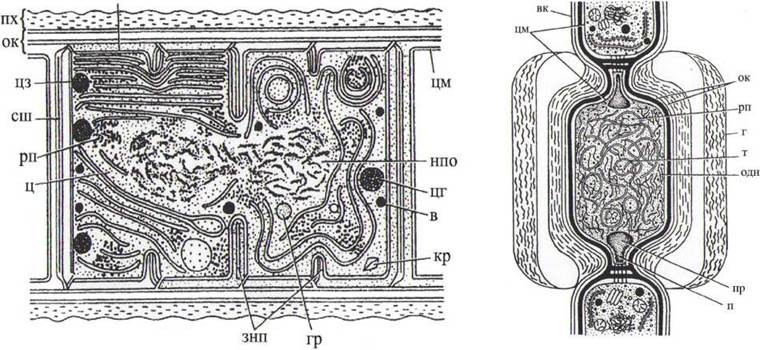
Fig. 10. Schematic representation of The structure of a vegetative cell (A) and a heterocyst (B) of blue-green algae: v - polyphosphate granule (volutin); vc - vegetative cell; sh - sheath; h - heterocyst; gr - granule of unknown composition; pcb - precursors of new transverse cell walls (septa); cw - cell wall; cr - crystal; npo - nucleoplasmic region (nucleoplasm); p - heterocyst pore; cp - plug-like structure sealing the heterocyst pore channel; dna - individual DNA strands; rp - Ribosomes and Polysomes; ms - Middle layer of the transverse part of the cell wall (transverse septum); th - thylakoid; cy - cytoplasm; cm - cytoplasmic membrane; cg - cyanophycin granule (structured granule).
A formed nucleus (as well as a nucleolus) is absent; its functions are performed by the nucleoid. The bulk of the nucleoid is concentrated in the center of the cell, which is why this zone of the cytoplasm is called the nucleoplasm or centroplasm. In this part of the cell, distinct structures are distinguished — Chromatin elements, which, In addition to DNA, contain basic Proteins. The photosynthetic apparatus is not organized into plastids, but is represented by thylakoids, which are derivatives of plasmalemma invaginations that do not separate from the cytoplasm by a double-membrane envelope. Thylakoids are located singly; under an optical Microscope, this zone has an intense coloration. On the surface of the thylakoids are specialized structures — phycobilisomes, containing phycobilin pigments. Polyhedral bodies, which are precursors of the pyrenoid in eukaryotic algae, also indirectly belong to the elements of the photosynthetic apparatus.
In the cytoplasm of cyanoprokaryotes, There are also ribosomes, gas vacuoles, and inclusions represented by granules of specific blue-green algal starch, cyanophycin, and polyphosphate granules. It is likely that large cyanophycin granules (over 1 $\mu m$) serve as a nitrogen source during environmental deficiency and can be utilized as an energy source while the cell is in the dark under anaerobic conditions.
Gas vacuoles (pseudovacuoles) play The Role of a "floating bladder," maintaining cells in a suspended state in water as well as during sedimentation to the bottom of a water body (under unfavorable conditions). Typical vacuoles (containing cell sap) are absent in blue-green algae, but certain species exhibit a peculiar reverse form of vacuolization (keritomy) during cell death or pathological states.
The reproduction processes of all blue-green algae are based on Cell Division. During cell division, the plasmalemma first grows centripetally into the protoplast, followed by the murein layer of the cell wall, dividing the cell into two (rarely more) equal or unequal parts. This division can be either complete or incomplete. In complete division, the plasmalemma and The cell membrane completely separate the daughter cells from one another. In this case, pores and plasmodesmata are not formed, and each daughter cell represents a physiologically independent individual. Complete division is characteristic of unicellular cyanoprokaryotes.
In the case of incomplete division, the transverse septum does not completely separate the daughter cells, and they remain connected by plasmodesmata. Such division results in The formation of multicellular filamentous trichomes. Short, motile fragments of trichomes consisting of 2-50 cells are called hormogonia, while non-motile ones are termed hormocytes. Hormogonia and hormocytes are specialized reproductive structures of multicellular blue-green algae. Some species of cyanoprokaryotes reproduce via gonidia, endospores formed within the cell, or exospores pinched off from the apex of the mother cell. Colonial unicellular and multicellular cyanoprokaryotes are also capable of reproducing through colony fragmentation.
The reproduction of blue-green algae is considered to be both vegetative and asexual. A typical sexual process is absent, but parasexual processes have been detected, resulting in the partial fusion of genomes from different cells.
Blue-green algae are capable of fixing atmospheric nitrogen. During nitrogen fixation, molecular nitrogen is reduced to ammonium compounds, in which form it is incorporated into the Main Pathways of cellular metabolism. Nitrogen fixation typically occurs in an anaerobic environment because it is catalyzed by The Nitrogenase Enzyme complex, The activity of which is completely inhibited by molecular oxygen. At the same time, many multicellular cyanoprokaryote species also fix atmospheric nitrogen in the presence of oxygen due to the presence of specialized cells—heterocysts—during periods of active development.
Blue-green algae grow actively in water, soil, and aerophytic conditions, developing across a Temperature range from + 750 С to - 830 С, within the water Column, near bottom sediments, among the periphyton of various substrates, and as components of Lichens, specific Organs of flowering plants, and invertebrate animals. They are among the first to colonize terrestrial substrates (tolerating extremely high radiation levels of 1,280 thousand roentgens per hour), thrive in fresh waters and seas, and rank among the absolute primary producers of organic matter on the planet. As nitrogen-fixing organisms, these algae contribute to increased soil productivity, the preservation of virgin soil fertility, and crop yields. Due to their physiological and chemical characteristics, they serve as supplementary food additives in animal and human diets, as well as producers of medicinal substances. For instance, species of the genus Arthrospira (A. platensis and A. maxima), known as "spirulina," are industrially valuable, brought into active cultivation, and their biomass is utilized in various sectors of the national economy (light, food, and medical industries), while the natural biomass of Nostoc species serves as a food source for the inhabitants of Central Africa.
Among the negative characteristics of these algae is their capacity for mass proliferation, which causes water "blooms" in reservoirs, particularly
in sluggishly flowing water bodies under high-temperature conditions (above 23-25° С) and elevated concentrations of nutrients (nitrogen, phosphorus, potassium), subsequently leading to secondary water pollution and fish kills, as well as the presence of potent poisons (toxins) among their exometabolites. The primary causative agents of water "blooms" in the water bodies of Ukraine are Microcystis aeruginosa, Anabaena flos- aquae, and Aphanizomenon flos-aquae.
The division comprises two classes — Cyanophyceae and Hormogoniophyceae — which, based on morphological features (type of cell division, characteristics of mucilage formation, type of trichomes, and their ability to undergo true branching), are further subdivided into the orders Chroococcales, Oscillatoriales, Nostocales, and Stigonematales.
Last update: 07/08/2026
Editorial and Educational Adaptation: This material has been compiled based on the primary/original source text. The project team performed an editorial review, corrected technical inaccuracies, structured sections, and adapted the content for an educational format.
What was processed:
- elimination of formatting defects (OCR errors, structural breaks, corrupted characters);
- editorial organization of content;
- standardization of terminology in accordance with academic sources;
- verification of factual statements against the original source text.
All mentions of the author, publication year, and origin of the primary text have been preserved in accordance with the source.