BOTANY VOLUME 2 - PLANT PHYSIOLOGY - 2007
6. PHYSIOLOGY OF METABOLISM
6.18. Mechanisms of Substance Secretion and Excretion in Plants
Substances are eliminated from the protoplasts of individual Cells or Tissues in multicellular plants when they are present as metabolic wastes or other ballast Materials (e.g., Inorganic Compounds) that are no longer used (or cannot be used) in METABOLISM and may even interfere with it (e.g., high concentrations of NaСI or Са(ОН)2 in submerged aquatic plants). The process of eliminating such waste or ballast products is called excretion, and the eliminated substances are referred to as excretes (or excretory products). In addition, plants frequently secrete compounds that perform specific Functions outside The Cell, such as gamones (see 8.2.1.1), attractants and nutrients for animal pollinators (see 11.2), Antibiotics in microorganisms, or Enzymes in carnivorous plants (see 9.1.2). These compounds are called secretions (or secretes).
It is often difficult to determine—or even pointless to try—whether a given eliminated substance belongs to secretions or excretes. For instance, the elimination of sugar by extrafloral nectaries (see Fig. 11.251) is considered excretion, whereas in flowers, where sugar serves to attract pollinators, it is considered secretion.
Based on the Location and mode of elimination, five distinct mechanisms are distinguished (Fig. 6.136).
Class="center">Fig. 6.136. Some modes of substance elimination by the cell: A — excretion of excretes (intracellular); C — precipitation in the Cytoplasm; G1, G2— granulocrine elimination via the Plasmalemma and plasmalemma + Cell wall, respectively; E1, E2— eccrine elimination via the plasmalemma and plasmalemma + cell wall, respectively; H — holocrine elimination resulting from cell lysis

• Intracellular precipitation of excretes: the products are deposited directly within the cytoplasm and cytoplasmic Organelles.
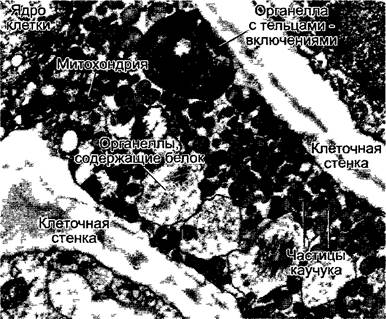
Examples include rubber particles in the articulated laticifers of Hevea (Fig. 6.137), Papaver, and Taraxacum, located directly in the intercellular matrix. In contrast, in Euphorbia, they are contained within vacuoles.
Fig. 6.137. Rubber particles in the cytoplasm of a laticifer of Hevea brasiliensis. In addition to typical cellular components such as the Cell Nucleus, Mitochondria, and cell wall, the laticifer contains characteristic organelles of unknown function—organelles with protein fibrils and Frey-Wyssling particles, named after their discoverer, which contain inclusion bodies of unknown nature (20,000x)
• Intracellular elimination of excretes: in this case, the substances leave the cytoplasm but remain inside the cell.
For example, Essential Oils in many plant families (Araceae, Zingiberaceae, Piperaceae, Lauraceae, Valerianaceae) are eliminated into an extraplasmic space—an oil cavity adjacent to The cell wall. This category also includes substances transported into vacuoles, as they are separated by the tonoplast from active metabolic sites.
• Granulocrine elimination: following synthesis in the cytoplasm or organelles (such as Plastids), a secretion or excrete (or their precursors) undergoes compartmentalization involving the internal cytoplasmic membrane formed by The Endoplasmic reticulum, Golgi apparatus, or vacuole. Subsequently, they are transported (often after being modified within these vesicles) along with their membrane envelopes to the cell surface, where they are discharged outward via vesicle rupture (exocytosis).
Elimination is very frequently carried out by the Golgi apparatus (see 2.2.6.3). Every major group of macromolecules can be eliminated in this manner. An example of granulocrine elimination via vacuoles is the discharge of fluids through pulsing or contractile vacuoles in lower plants and freshwater animals, which functions in osmoregulation.
• Eccrine elimination: the substance is transported not in a membrane-bound vesicle, but passes outward7 directly through the plasmalemma. Eccrine products include, for example, certain Components of the cell wall (see 6.17.1.1, while others are eliminated granulocrine-style), nectar in most cases (although in the nectaries of sepals in Abutilon, nectar is secreted via ER vesicles or the "secretory reticulum"), Water (although in some plant flagellates water is expelled granulocrine-likely with the participation of the Golgi apparatus), and salts. The majority of lipophilic secretions and excretes are likely eliminated by this same mechanism.
Most nectaries, external hydathodes, and salt glands presumably share a similar elimination mechanism, as they are frequently linked by transitional forms. This secretory mechanism is not yet fully understood. Since there is no granulocrine elimination, sugars or salts are likely transported outward across the plasmalemma via specific translocators, after which water follows osmotically. Although this secretory mechanism explains the strict dependence of secretory processes on metabolism, it struggles to account for the high diversity of metabolites within secretions; for instance, nectar typically contains, alongside various sugars, Amino Acids, enzymes, Vitamins, phytohormones, inorganic substances, etc. This is easily understood if the secretory mechanism involves a local increase in the permeability of the glandular cells' plasmalemma at the sites of secretion, through which cell turgor (maintained by the active uptake of substances from neighboring cells) "forces" the aqueous solution out via pressure filtration. The characteristic Chemical composition of nectar, for example, compared to that of the glandular tissue itself, is likely established through the (experimentally proven) reabsorption of specific substances.
Each of these eccrine elimination mechanisms requires an extensive surface area of the glandular cells, which is why they frequently take the form of so-called transfer cells, distinguished by characteristic wall ingrowths and thickenings (see 3.2.5, Fig. 3.27).
Such transfer cells are found not only in specialized glands (nectaries, hydathodes, salt glands of halophytes, and digestive glands of carnivorous plants) but also in cells that absorb substances from the environment (e.g., epidermal cells of submerged plants like Elodea, Vallisneria, or water-permeable leaves of Nymphaea), cells that absorb substances from neighboring cells (e.g., embryo cells, haustoria of parasitic angiosperms such as Orobanche or Cuscuta), and finally, cells that release substances to neighboring cells (e.g., endosperm and cotyledon cells, the tapetum, companion cells and phloem parenchyma in fine leaf Veins, and cells in ROOT nodules).
The activity of such isolated glands that eliminate substances outward (exotropically), such as salt glands and nectaries, or inward into the Organism (endotropically), such as companion cells, transfer cells in root nodules, and epithelial cells in resin ducts (see 3.2.5.2, Fig. 3.29), is frequently crucial. Salt glands, for instance, are primarily found in plants growing on saline soils (e.g., species of Plumbaginaceae and Frankeniaceae) and often play a significant role in salt metabolism. In the mangrove plant Aegialitis annulata, for example, there are over 900 salt glands per 1 cm2 on the upper leaf surface, which exude a salt solution with concentrations of 450 µmol mL-1 Cl-, 355 µmol mL-1 Na+, and 27 µmol mL-1 K+. Since the Na+/K+ ratio in the leaf tissue is only 3:1, elimination (or reabsorption during pressure filtration) occurs here selectively and actively. It can also be inhibited by toxic metabolic products.
• Holocrine elimination: the substance is ultimately released As a result of cell dissolution (via a lysigenous pathway). This process can occur either endotropically (e.g., excretory cavities in the fruit peel of Citrus, see Fig. 3.30) or exotropically, such as the release of chemotactic substances by archegoniate plants via the dissolution of neck and venter canal cells (see 11.2), or The formation of the pollination drop in gymnosperms through the dissolution of the nucellus apex.
In addition to the aforementioned elimination mechanisms, substances can pass from the plant into the environment through the shedding and breakdown of cells, such as in roots during the continuous sloughing and formation of root-cap cells (see Fig. 3.6). Released substances—such as sugars, nitrogenous compounds, Hormones, vitamins, and secondary metabolites (including those involved in allelopathy)—exert a profound and direct influence on the root surface and the rhizosphere, which is the microbial habitat surrounding roots. A significant quantity of substances is also released during leaf fall. Furthermore, heavy leaching (e.g., during rain) can wash numerous ions out of leaves (primarily K+, with much lower amounts of Ca2+).
Last update: 07/08/2026
Editorial and Educational Adaptation: This material has been compiled based on the primary/original source text. The project team performed an editorial review, corrected technical inaccuracies, structured sections, and adapted the content for an educational format.
What was processed:
- elimination of formatting defects (OCR errors, structural breaks, corrupted characters);
- editorial organization of content;
- standardization of terminology in accordance with academic sources;
- verification of factual statements against the original source text.
All mentions of the author, publication year, and origin of the primary text have been preserved in accordance with the source.