Plant Physiology - Musiyenko M. M. 2001
Water Regime of Plants
Root System as an Organ of Water Absorption
To perform its primary Functions — absorbing Water and mineral salts from the soil — the ROOT must be capable of spatial orientation, responding to gradients of vital factors, advancing accordingly through soil profiles, and maximizing the surface area for soil contact.
All Structural Features of the root are intimately connected with the performance of these functions. The Role of this organ lies primarily in utilizing its enormous surface area to ensure the uptake of water into the plant from a large volume of soil. For instance, under favorable conditions, a single winter rye plant can develop 143 first-order roots, 35 thousand second-order roots, 2.3 million third-order roots, and 11.5 million fourth-order roots, totaling 14 million roots. Their total length reaches 600 km, with a combined surface area of 225 m2. They bear 15 billion root hairs, whose total length is about 10 thousand km and area is 400 m2. Meanwhile, the aerial part of the same rye plant (all shoots and leaves) has a total surface area of approximately 4.5 m2 (Lebedev, 1978). The Root System is capable of actively moving water within root Cells in a specific direction — through root hairs, cortical parenchyma cells, endodermis, and pericycle to the xylem Vessels of the root central cylinder (Fig. 25).
Class="center">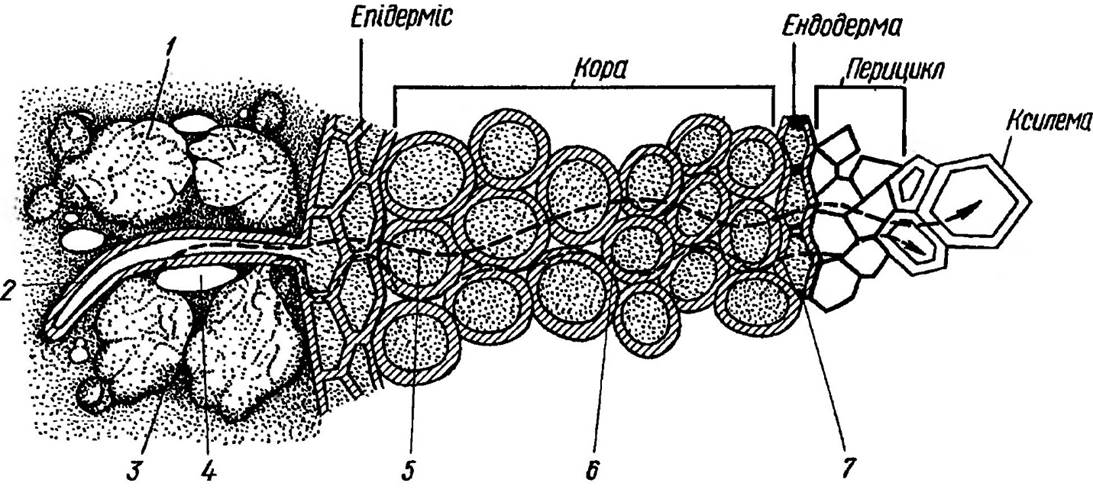
Fig. 25. Water uptake from the soil into root cells:
1 — soil particles, 2 — root Hair, 3 — soil water, 4 — air space, 5 — symplast, 6 — apoplast, 7 — Casparian strip
The zone of most intensive water absorption by the root coincides with its elongation zone and the zone of root hair development. Some water can also be absorbed through the suberized zone of the root, which is typical mainly of trees. In such cases, water penetrates through lenticels or wounds of the root. Two pathways of water transport are possible through the cortical parenchyma cells: through the Cytoplasm via plasmodesmata (symplast) and through The Cell walls (apoplast). Since the resistance of cell walls to water is significantly lower than that of the cytoplasm, radial water transport in this part of the root occurs predominantly via the apoplastic pathway. However, at the level of the endodermis, this water movement pathway becomes impossible due to water-impermeable Casparian strips in its cell walls.
Water in this part of the root can bypass the endodermis only by passing through the membranes and cytoplasm of these cells. The Regulation of Water uptake at the endodermal level is achieved, on the one hand, by shifting from rapid apoplastic water movement to the slower symplastic one, and on the other hand, by the fact that the diameter of the root central cylinder, where water subsequently enters
through the endodermis, is 5–6 times smaller than the diameter of the cortical surface and the root absorption zone. It should be noted that the impermeability of endodermal cell walls to water is not absolute. In particular, in the endodermis of root regions that continue to grow, the Casparian strips are not yet fully formed, and therefore shifts in water transport types probably do not occur. Furthermore, in root regions where lateral roots are initiated, the endodermis is interrupted, and water can continue its path through passage cells. Overall, however, the mass flow of water across the endodermis via the apoplast drops sharply. Inside the central cylinder, water movement from the endodermis to the xylem vessels encounters minor resistance and presumably also proceeds via the apoplastic pathway.
Two main processes ensure The transport of water and dissolved substances throughout the plant: the Transpiration stream and the movement of photoassimilates (Fig. 26). Conducting Tissues exist for such transport: vessels and tracheids in the xylem for the transpiration stream, and sieve tubes of the phloem for assimilates. These are the pathways of long-distance transport.
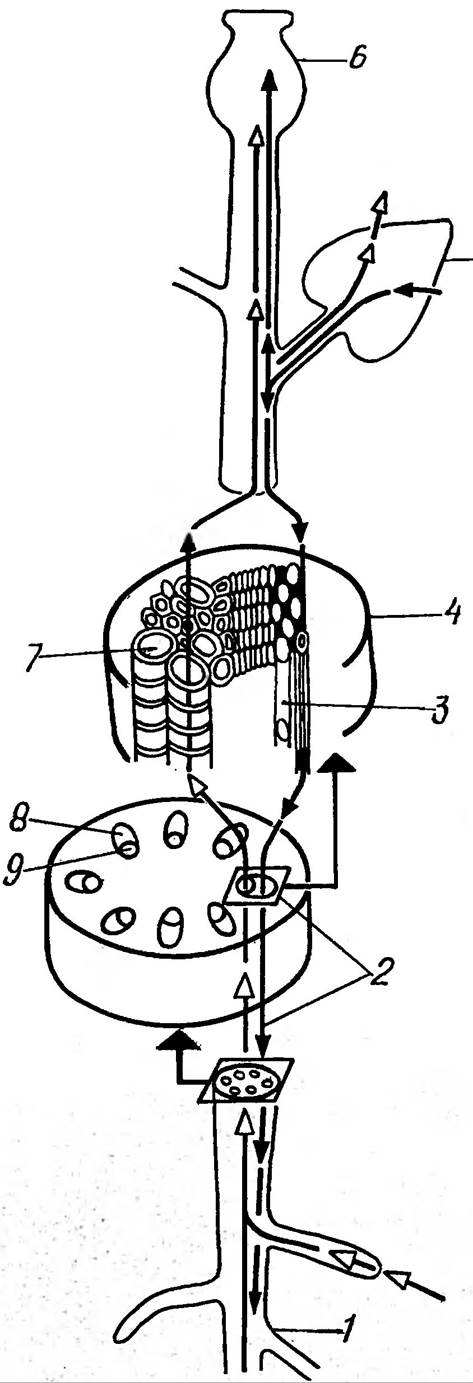
Fig. 26. Schematic diagram of the main transport pathways for the transpiration stream (— — Δ) and the assimilate stream (— — →):
1 — roots, 2 — SHOOT axis, 3 — sieve tube, 4 — vascular bundle, 5 — leaf, 6 — fruit, 7 — vessel, 8 — phloem, 9 — xylem
Translocator cells exist between the phloem and xylem, whose function is to switch the flows of phloem and xylem transport. These cells contain specific Proteins — translocators, whose Molecular Mechanism of action remains unknown.
Short-distance transport to and from the conducting vessels is carried out through cells of unspecialized tissues. The latter consist of A number of delineated, i.e., mutually separated systems — the apoplast and the symplast.
All these systems serve short-distance transport: the symplast for mineral and organic substances, and the apoplast for water and inorganic salts. Vacuoles, as discrete systems, serve exclusively for water.
It should be noted that symplastic transport occurs faster than diffusion (1–6 cm per hour). The Mechanism of movement has not been fully elucidated; it may involve diffusion as well as convection (mixing of substances mediated by The Endoplasmic reticulum).
Water moves through the plant from a zone of high water potential (soil) to a zone of lower water potential (atmosphere) along its gradient. The water potential of moderately humid air is tens of thousands of kilopascals lower than that in the plant, which is why water tends to leave plant tissues.
Forces of the upward water stream in the plant. It is generally accepted that water absorption and its upward movement are carried out through the combined action of such factors as root pressure or the lower terminal driver (Fig. 27) and transpiration — the upper terminal driver (Fig. 28). Water that has entered the root cells moves through the conducting elements of the xylem under METABOLISM/18.html">The Influence of water potential gradients generated by transpiration and root pressure. Normally, water leaves the plant as vapor. Solar energy is utilized for the transition of water from the liquid to the vapor state. Water evaporates throu
gh Stomata, cuticle, and lenticels (in deciduous trees after leaf fall).
Thus, under natural conditions, a water stream exists in the xylem As a result of transpiration. Under weak transpiration, the salt concentration in the xylem increases and, According to the laws of osmosis, promotes movement into the root. Moving through the root tissues toward the central cylinder, water must penetrate the membrane and protoplasts of endodermal cells, since their walls are impermeable

Fig. 27. Diagram illustrating how root pressure is generated under the influence of water movement from the root to the stem:
1 — manometer tube, 2 — mercury,
3 — exudate, 4 — rubber connection, 5 — stump of the cut shoot
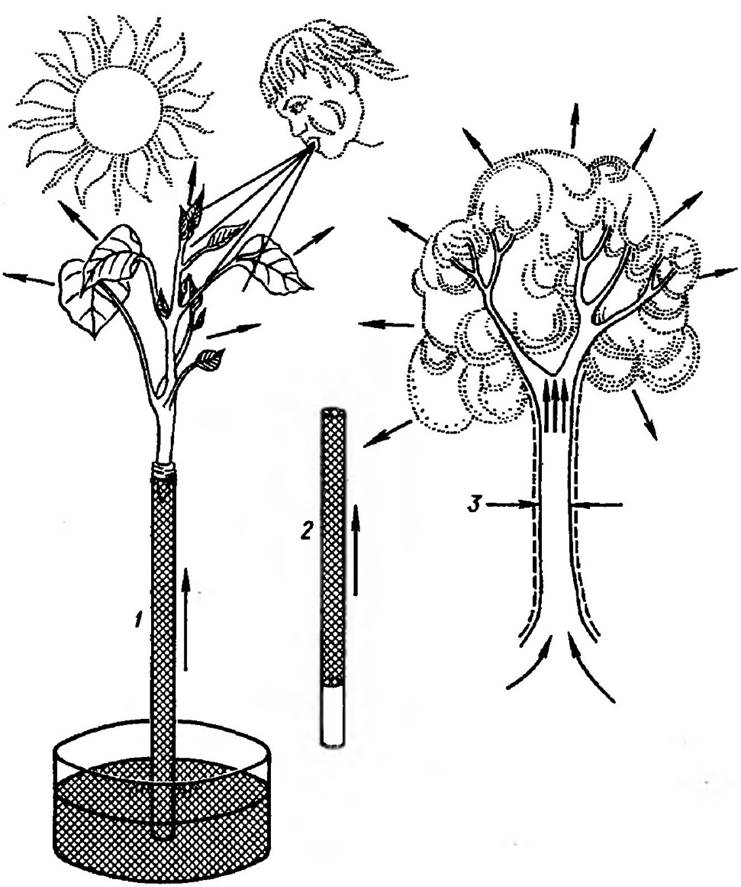
Fig. 28. Mechanism of water ascent in plants:
1 — under conditions of intense transpiration, a shoot can drive water to a considerable height exceeding the barometric limit; 2 — a gas-free water Column ascends as a single continuous unit due to cohesive forces between water molecules; 3 — when water loss exceeds absorption, water tension develops in the vessels, causing their walls to pull inward.
to water. Therefore, the cylindrical layer of endodermal cells acts almost like a single membrane, with a concentrated solution on one side (in the xylem) and a much more dilute solution on the other (toward the soil and root tissues). Consequently, water diffuses from the soil into the xylem through this "so-called membrane" driven by the concentration gradient.
The impermeable Cells of the endodermis (or more accurately, their walls) perform another function: they prevent salts that have entered the xylem from taking a return path, i.e., escaping outward through the apoplast. Under these conditions, a pressure of several atmospheres develops within the root system — root pressure. At the base of a tree trunk, it can reach 1.013 MPa. If the stem of a herbaceous plant is cut close to the ground, sap begins to ooze from the cut zone. This phenomenon is known as bleeding in plants.
Plant bleeding proves the presence of root pressure. The latter can be measured using a standard mercury manometer, as shown in Fig. 28. Its value even in herbaceous plants reaches 2-3 atm. This raises the question: is plant bleeding a pathological condition resulting from the plant being wounded during cutting?
The fact that plant bleeding is a normal process is evidenced by another phenomenon — guttation. Guttation is the exudation of water droplets through hydathodes — specialized pores located along the leaf margins near the endings of leaf Veins. Under natural conditions, guttation occurs mainly in the morning when root pressure rises. It is also promoted by moderately warm and humid weather, when the air surrounding the plant is saturated with water vapor (Fig. 29). In the laboratory, it is easily observed by placing wheat seedlings under a Glass bell jar, for example. Water droplets will form on the tips of young wheat leaves. Guttation does not cause any damage to the plant; rather, driven by root pressure, the plant exudes water droplets. Moreover, plants possess special adaptations to protect against potential mineral loss during guttation. Specifically, hydathodes release water into an air cavity lined with small parenchyma cells called epithem; as the water filters through it, most of the mineral solutes are retained within the tissue (Fig. 30).
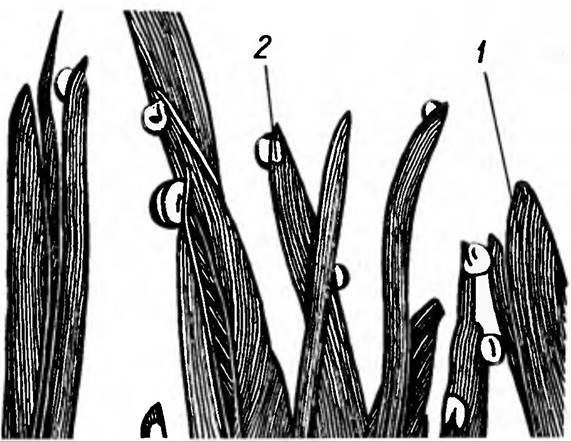
Fig. 29. Guttation.
Water droplets (2) at the tips of the leaves (1) indicate the presence of root pressure. These droplets do not condense from the water vapor of the surrounding air. They are forced out of the leaf through specialized openings — hydathodes — located at its tips
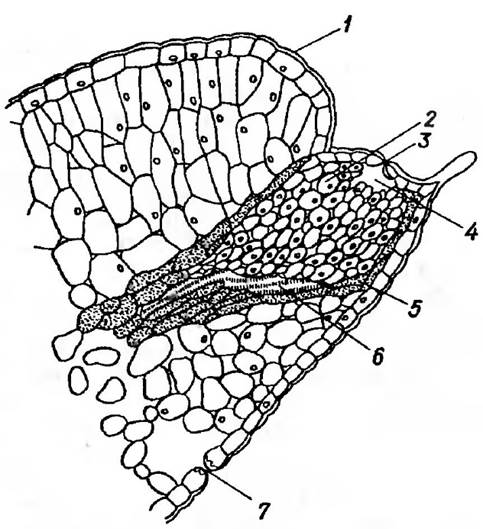
Fig. 30. Longitudinal section through a leaf hydathode:
1 — cuticle, 2 — epithem, 3 — water stoma (pore, 4 — subepidermal cavity, 5 — bundle sheath, 6 — tracheid, 7 — stomatal slit
Thus, both plant bleeding and guttation demonstrate that the root system absorbs water and pumps it into the plant. For this reason, the plant root system is referred to as the lower terminal engine.
The force that drives a unidirectional flow of water with dissolved substances in a plant independently of transpiration is called root pressure. Characteristically, not only the death of root cells, but even a decline in their metabolic activity—particularly Respiration intensity—halts plant bleeding.
According to D.A. Sabinin, plant bleeding is a vital, unidirectional flow of water associated with Energy Expenditure. The mechanism of this phenomenon is not yet fully understood. It is hypothesized that water moves passively via an osmotic pathway along a water potential gradient. A more negative, i.e., lower water potential is generated in the xylem vessels due to the influx of dissolved salts from the soil and the minimal resistance offered by their inelastic walls. Salts enter actively, which requires energy. Therefore, root pressure can be defined as the pressure developed in the xylem through the METABOLIC ACTIVITY OF the root. Since energy is supplied via respiration, the work of the lower terminal engine—root pressure—correlates with oxygen availability and depends on the presence of respiration inhibitors and activators. According to V.M. Zholkevich, root pressure consists of two components: osmotic and metabolic, with the latter requiring ATP consumption. It is suggested that Actin-like proteins play a significant role here, whose energy-dependent contraction and relaxation drive changes in hydrostatic pressure within the cells. As a result, local water potential gradients arise along the water flow path toward the xylem vessels, facilitating The entry of water into the vessels.
Recently, data have emerged indicating the presence of so-called water pumps in plant roots (Kundt, Robnik, 1998). Such pumps may consist of contractile cells equipped with Valves in their plasmodesmata. They are hypothesized to be localized in the endodermis and sometimes in the exodermis. The walls of these pumps are reinforced with wavy Casparian strips, while the valves are formed by pore fields located in the outer periclinal cell walls, each pierced by numerous plasmodesmata. Submicron folds of the outer periclinal walls act as a moving piston during the operation of these pumps. According to these authors, root pressure is generated by the combined action of many pump cells operating at a frequency of about 1 Hz, functioning similarly to a human Heart.
In some perennial plants during winter, the xylem vessels become filled with air, meaning that water transport in the spring relies entirely on the lower terminal engine.
Let us also recall the movement of sap, which is not directly related to root pressure. The outflow of sap in spring is primarily driven by the buildup of pressure within tree trunks. Warm sunny days, especially when alternating with cold nights, trigger an intense flow of sap. The reason is that during cold nights, starch stored in the xylem parenchyma cells is hydrolyzed into sugars, which are subsequently transported actively through the xylem vessels. As the Temperature rises, CO2 comes out of solution, generating pressure within the xylem. It is this pressure that forces water, along with dissolved sugars, to move upward through the tree trunk prior to the onset of spring growth. Evidence for this can be seen in the example of a freshly cut young sapling: if placed in a barrel of water, water will be sucked up from the barrel as sap exudes, despite the complete absence of a root system.
Thus, water entering the root Cells under the influence of water potential gradients—and potentially with the involvement of water pumps—moves toward the conducting elements of the xylem to begin its upward journey to the aerial Organs. The approximate distribution of water potentials driving water transport is as follows: WATER POTENTIAL OF the soil (-0.05 MPa), root (-0.2 MPa), stem (-0.5 MPa), leaves (-1.5 MPa), and air at 50% relative humidity (-100.0 MPa). Girdling experiments have demonstrated that the upward transport of water in plants occurs primarily through the xylem. Only a minor fraction moves outside the xylem pathway.
The speed of water transport is determined by the water potential difference between the starting point and the destination, as well as the resistance encountered by the water.
Physiological Role of the stem. Water ascent in tree trunks. Water supplied by the roots moves rapidly through the plant to the leaves. Trees are capable of transporting water from the soil to the canopy in amounts that often exceed one ton per day. How does this happen? Water absorbed by root hairs travels a distance of several millimeters through living cells before finally entering the dead vessels of the xylem. Movement of water through living cells is made possible by differences in their water potentials. Suction pressure increases progressively from the root hair to the living cells adjacent to the xylem vessels. It has been established that for water to move through living cells, such as those in a leaf, the suction pressure of each successive cell must differ by 0.1 atmospheres.
This explains why plants lacking Vascular Tissues (mosses, Lichens) do not attain large sizes. Only with the evolutionary appearance of tracheids (pteridophytes, gymnosperms) and vessels (angiosperms) did it become possible for plants to reach heights of several tens or even over a hundred meters (eucalyptus, sequoias). Water traverses only a small fraction of its path within the plant through living cells—first in the roots and later in the leaves. Transpiration from the leaf surface creates a suction pressure within the cells of leaves and roots, thereby maintaining water transport throughout the plant. For this reason, plant leaves are termed the upper terminal engine, in contrast to the root system, which forces water into the plant. By evaporating water from their leaf surfaces, plants automatically draw water upward through the vessels.
At the same time, it is well known that any suction pump cannot lift water to a height exceeding 10 m, because the weight of such a water column corresponds to atmospheric pressure and would thus be counterbalanced by it. The difference between such a pump and a plant stem is due to the forces of adhesion between water and vessel walls, as well as cohesion between water molecules themselves. Continuous water columns filling the vessels are held firmly together by cohesive forces. The weight of a 100-m-tall water column corresponds to only 10 atmospheres. Such immense cohesive strength allows water in plant stems to ascend to heights far exceeding the barometric limit.
Root pressure and the suction action of leaves drive the water column to considerable heights. Transverse partitions within the vessels also play a vital role: if air enters the vessels, it becomes trapped, so that only small localized sections are excluded from the overall water supply system.
Recall that the water potential of moderately humid atmospheric air is negative and tens of thousands of kilopascals lower than that of the plant, which is why water tends to escape from it. Due to transpiration, the water potential at the top of the plant is lower than at its base. Furthermore, The rate of water evaporation exceeds the rate of its supply. Consequently, negative pressure—i.e., tension—exists in the water columns filling the xylem of tall trees. This occurs because water molecules in the xylem vessels are bound not only to one another via cohesive forces (cohesion), but also to the highly hydrophilic vessel walls via adhesive forces (adhesion). The tensile strength of a water column against breaking is 30 MPa, which is more than sufficient to pull water to a height of 130–140 m.
These forces prevent the water columns from breaking and creating voids or cavities. It is precisely the synergy of the transpiration stream, capillary and osmotic forces, as well as cohesion and adhesion, that drives the upward movement of water in tree trunks. Root pumps in plants are also believed to play a role in these processes. The rate of Water movement through the vessels is relatively slow. For deciduous tree species, it averages 20 cm3 per hour per 1 cm2 of wood cross-section, while for conifers it is only 5 cm3 per hour. For comparison, Blood moves through Arteries at a speed of 40–50 cm3 per second, and water through utility mains at 100 cm3 per 1 cm2 of cross-section per second.
Last update: 07/08/2026
Editorial and Educational Adaptation: This material has been compiled based on the primary/original source text. The project team performed an editorial review, corrected technical inaccuracies, structured sections, and adapted the content for an educational format.
What was processed:
- elimination of formatting defects (OCR errors, structural breaks, corrupted characters);
- editorial organization of content;
- standardization of terminology in accordance with academic sources;
- verification of factual statements against the original source text.
All mentions of the author, publication year, and origin of the primary text have been preserved in accordance with the source.