BIOLOGY Volume 2 - A Guide to General Biology - 2004
17. COORDINATION AND REGULATION IN ANIMALS
17.6. The endocrine system
17.6.4. The thyroid gland
The Thyroid Gland synthesizes three Hormones: triiodothyronine (T3), thyroxine (T4), and Calcitonin. T3 and T4 regulate metabolic rate, growth, and development, while calcitonin, as mentioned in the previous section, helps maintain normal Blood calcium levels.
Structure OF THE thyroid gland
In humans, the thyroid gland is shaped like a bowtie. It is located in the neck region and consists of two lobes situated on either side of the Trachea and Larynx, connected by a narrow isthmus (Fig. 17.52). The gland's tissue is composed of hundreds of thousands of tiny follicles about 0.1 mm in diameter. Each follicle is a hollow sphere with walls formed by a single layer of cuboidal epithelium; these Cells secrete T3 and T4. When the thyroid gland is activated by thyrotropin (TSH), secreted by the anterior Pituitary gland, the follicular cells become columnar, and microvilli appear on their free inner surface.
Class="center">
Fig. 17.52. Structure of the thyroid gland. A. The gland has a bilobed structure and wraps around the front of the trachea. B. Schematic section through a group of follicles.
Synthesis and release of T3 and T4
The triiodothyronine molecule contains three iodine atoms, and the thyroxine molecule contains four, hence their abbreviated names: T3 and T4 (Fig. 17.53). Iodine enters the thyroid gland as ions (I-) from the numerous capillaries surrounding the follicles via Active Transport. Once inside the follicular cavity, iodine is used to synthesize T3 and T4, which are initially bound to the protein thyroglobulin produced by the follicular cells. For T3 and T4 to enter the bloodstream, the follicular cells engulf the resulting complex by pinocytosis and hydrolyze it to release the active hormones. T3 and T4 differ only in the number of iodine atoms in their molecules and have identical effects on the body, although T3 is 5–6 times more potent. However, since T4 (thyroxine) is secreted in much larger quantities, we will focus only on its Functions below.
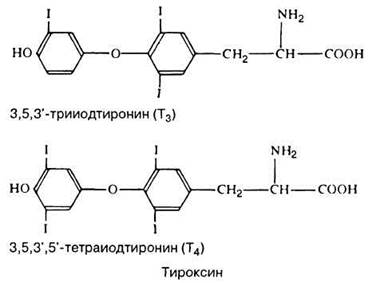
Fig. 17.53. Structural formulas of the main THYROID HORMONES — T3 and T4.
Functions of thyroxine (T4)
The primary function of T4 is to regulate the basal metabolic rate (BMR), which is The rate of all biochemical reactions when the body is at rest. This rate is directly proportional to the rate at which cells utilize oxygen and nutrients to release energy, and therefore directly proportional to the rate of cellular Respiration. The basal metabolic rate in humans averages 160 kJ/h per 1 m2 of body surface area and is maintained at a stable level by thyroxine, which promotes The breakdown of glucose and fats to release energy (Section 19.5.2). This is associated with increased cellular oxygen uptake, enhanced respiration rate, and an increase in both the size and number of Cell/35.html">Mitochondria. Ultimately, this leads to increased ATP and heat production in Tissues. Concurrently, Heart rate and Cardiac Output increase.
Thyroxine also has a major influence on many other processes. In combination with Growth Hormone (GH), it stimulates Protein Synthesis, accelerating tissue growth, particularly skeletal growth. However, unlike GH, it also promotes Brain development, which is why thyroxine deficiency in children can cause mental retardation (see below).
Apparently, T4 enhances the Effects of Other hormones, such as Insulin, adrenaline, and glucocorticoids, on many metabolic processes (Section 19.5.2).
Regulation of thyroxine secretion
Thyroxine has a longer-lasting effect than many Other Hormones, so maintaining its constant level is vital for the body. This is one of the reasons why T3 and T4 are stored in the thyroid gland, ready to be released into the bloodstream at any moment.
The release of T4 from the thyroid gland is regulated by its blood concentration via a negative feedback mechanism involving the Hypothalamus and the anterior pituitary gland. Fig. 17.54 shows that an excess of T4 inhibits its own secretion by suppressing the release of TRH (thyrotropin-releasing hormone) by the hypothalamus and TSH (thyroid-stimulating hormone) by the anterior pituitary. This operates through a negative feedback mechanism, the general principle of which is to halt a process once the level of one of its products reaches a threshold value. This is similar to how a thermostat works, turning off at a certain Temperature and turning back on when it drops slightly below that mark. A similar situation is observed with thyroxine: when blood thyroxine levels drop, its inhibitory effect on the secretion of TRH and TSH is lifted.
This mechanism is further influenced by environmental factors, such as ambient temperature, which affects higher brain centers and directly acts on the thermoregulatory center of the hypothalamus. For instance, prolonged exposure to cold leads to a "resetting" of the anterior pituitary to a higher threshold level of T4. Via the negative feedback mechanism, this stimulates TSH release (Fig. 17.54) and, consequently, increases basal metabolic rate and heat production.
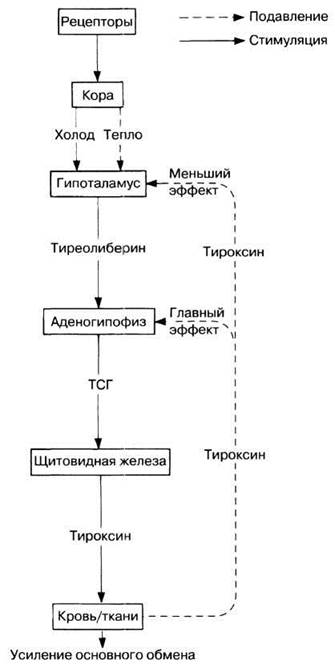
Fig. 17.54. Involvement of various factors in The regulation of thyroxine secretion and the homeostatic control of basal metabolic rate.
Hypofunction of the thyroid gland (hypothyroidism)
Hypothyroidism can be caused by insufficient TSH secretion by the anterior pituitary, dietary iodine deficiency, or defects in the enzyme systems involved in thyroxine synthesis. Congenital hypothyroidism leads to cretinism, which is characterized by stunted growth and mental retardation. If detected early, normal GROWTH AND DEVELOPMENT can be restored through thyroxine administration. A deficiency of this hormone in adulthood causes a condition known as Myxedema. It manifests as a decrease in basal metabolic rate, oxygen consumption, ventilation, heart rate, and body temperature. Mental activity also declines, movements become sluggish, and body weight increases due to the accumulation of a semi-fluid exudate under the Skin. As a result, the face and eyelids become puffy, the Tongue swells, the skin becomes rough, Hair falls out, and eyebrows thin. The condition is treated with thyroxine tablets, which resolve all of these symptoms.
Hyperfunction of the thyroid gland (hyperthyroidism)
Both overactivity and underactivity of the thyroid gland can lead to its enlargement, resulting in a goiter. Hyperthyroidism develops when the enlarged thyroid gland secretes excessive amounts of thyroxine. Its symptoms include an increased heart rate, rapid breathing, and elevated body temperature. The basal metabolic rate, and consequently oxygen consumption and heat production, can increase by 50%. Such patients lose weight, become highly nervous and irritable, and exhibit hand tremors when their arms are extended. An extreme form of hyperthyroidism, known as thyrotoxicosis or Graves' disease, is accompanied by increased myocardial excitability, which can lead to Heart Failure. Treatment consists of surgical removal of most of the thyroid gland or its destruction through the administration of radioactive iodine.
Last update: 06/08/2026
Editorial and Educational Adaptation: This material has been compiled based on the primary/original source text. The project team performed an editorial review, corrected technical inaccuracies, structured sections, and adapted the content for an educational format.
What was processed:
- elimination of formatting defects (OCR errors, structural breaks, corrupted characters);
- editorial organization of content;
- standardization of terminology in accordance with academic sources;
- verification of factual statements against the original source text.
All mentions of the author, publication year, and origin of the primary text have been preserved in accordance with the source.