BIOCHEMISTRY - L. Stryer - 1984
VOLUME 3
Part IV INFORMATION
CHAPTER 27. PROTEIN SYNTHESIS
27.5. Codon Recognition Involves the Anticodon, Not the Activated Amino Acid
We have already mentioned that the tRNA anticodon is the region that recognizes the mRNA codon, and that this recognition occurs via base pairing. Does The amino acid attached to the tRNA play any role in this process? The answer to this question was obtained in the following way. First, Cysteine was attached to its corresponding tRNA (designated as tRNACys). The attached cysteine residue was then converted into Alanine by treating Cys-tRNACys with Raney nickel. As a result, the sulfur atom was removed from the activated cysteine residue, while the bond between cysteine and the tRNA remained intact.
Class="center">
This yielded a hybrid aminoacyl-tRNA in which alanine is covalently attached to the tRNA specific for cysteine.
Which codon is recognized by this hybrid tRNA—that for alanine or cysteine? The answer was obtained by using this hybrid tRNA in a Cell-free protein-synthesizing system. The template used was a random copolymer composed of U and G in a 5:1 ratio; normally, this induces the incorporation of cysteine (UGU) but not alanine (GCX). However, when Ala-tRNACys was added to the incubation mixture, alanine was incorporated into the polypeptide. In other words, alanine was incorporated as if cysteine were attached to the cysteine-specific tRNA. It was concluded that codon recognition does not depend on the amino acid attached to the tRNA.
The same result was obtained when Hemoglobin mRNA served as the template. 14C-alanyl-tRNACys was used as the hybrid aminoacyl-tRNA. The sole radioactive tryptic peptide (i.e., the peptide containing 14C-alanine) corresponded to the peptide that normally contains cysteine rather than alanine. Conversely, no label was detected in any peptide that normally contains alanine rather than cysteine. This experiment, like the previous one, convincingly proved that the amino acid in aminoacyl-tRNA plays no role in codon Selection.
27.6. A Transfer RNA Molecule Can Recognize More Than One Codon Through "Wobble"
What are the rules governing codon-anticodon recognition in tRNA? The simplest assumption is that each of the codon bases forms a Watson-Crick base pair with the complementary Base of the anticodon. In this case, the codon and anticodon must match each other perfectly, taking into account their antiparallel orientation (in the diagram, a prime denotes the complementary base):

Thus, X and X' must be either A and U (or U and A), or G and C (or C and G). It follows from this model that each anticodon can recognize only one codon. However, the available evidence contradicts this. Certain isolated tRNA molecules can recognize more than one codon. For example, Yeast alanine tRNA, studied by Holley, binds to three codons: GCU, GCC, and GCA. Only the first two bases of these codons are identical; the third differs. Could it be that recognition of the third codon base is sometimes less selective than recognition of the other two? The general pattern of METABOLISM/28.html">The Genetic Code's degeneracy suggests that this may indeed be the case. XYU and XYC always code for the same amino acid, and XYA and XYG usually have the same meaning. Based on these data, Crick postulated that less stringent steric constraints are imposed on the pairing of the third base than on the pairing of the other two. Models of various base-pairing arrangements were constructed to determine which of them resemble standard A–U and G–C pairs with respect to the distance and angle between glycosidic bonds. Inosine was included in this study because it occurs in certain anticodons. If one assumes that some steric freedom (“wobbling” or ambiguous pairing) is permissible in the pairing of the third codon base, the combinations listed in Table 27.2 appear entirely plausible.
Table 27.2. Permissible types of third-base codon pairing according to The Wobble Hypothesis

At present, the validity of the wobble hypothesis has been proven. tRNA anticodons with known sequences bind to the codons predicted by this theory. For example, the anticodon of yeast alanine tRNA is IGC. This tRNA recognizes the codons GCU, GCC, and GCA:

Thus, I pairs with U, C, and A, as predicted by theory.
Phenylalanine tRNA, which possesses the GAA anticodon, recognizes the codons UUU and UUC, but not UUA and UUG:

Thus, G pairs with either U or C at the third position of the codon, as predicted by the wobble hypothesis.
Two generalizations concerning codon-anticodon interaction can be made.
1. The first two bases of the codon pair in the usual manner. Recognition is precise. Consequently, codons that differ in one of the first two bases must be recognized by different tRNAs. For example, both UUA and CUA code for leucine, but they are read by different tRNAs.
2. The first base of the anticodon determines whether a given tRNA molecule reads one, two, or Three types of codons: C and A recognize one codon each, U and G recognize two codons each, and I recognizes three codons. Thus, one of the reasons for the degeneracy of the genetic code lies in the inaccuracy, or ambiguity, of pairing (the "wobble") of the third codon base. We see this as the primary reason for the Abundance of the unusual nucleoside inosine in anticodons. Inosine increases the number of codons that a given tRNA molecule can read (Fig. 27.8).
Fig. 27.8. Due to "wobble", inosine can form Base Pairs with cytosine, adenine, and uracil

27.7. Mutant Transfer RNA Molecules Can Suppress Other Mutations
A new phase in The Study of codon recognition began with the investigation of mutant tRNAs containing a single alteration in
the anticodon base. These spontaneous events are essentially the reverse of the in vitro chemical modification of an amino acid attached to a tRNA. The discovery of such mutant tRNAs has an interesting history. For many years, geneticists had known that the deleterious effect of certain Mutations could be suppressed by another mutation. Suppose that an enzyme has become inactive due to The conversion of a GCU codon (alanine) to a GAU codon (aspartate). What kinds of mutations could restore The activity of this enzyme?
1. A back mutation of the same base A -> C will yield the original codeword.
2. Another mutation A → U will yield valine (GUU), which may fully or partially restore enzyme activity.
3. A mutation elsewhere in the same Gene can reverse The Effect of the first mutation. Such a modified protein will differ from the wild-type protein by Two Amino Acids.
4. A mutation in a different gene can overcome the deleterious effect of the first mutation. This phenomenon is known as intergenic suppression.
For a long time, the MECHANISM OF ACTION of intergenic suppressors remained a mystery. We now know from genetic and biochemical studies that most such suppressors act by altering mRNA reading. Consider, for example, a mutation that leads to the appearance of a UAG terminating codon (i.e., a stop codon, or termination signal). The result of the mutation will be The formation of incomplete polypeptide chains. Such mutations are called nonsense mutations because incomplete Polypeptides are usually inactive. The effect of the UAG nonsense mutation can be suppressed by mutations in several
different genes. One of these suppressors reads UAG as a Tyrosine codon, which can lead to the synthesis of an active protein instead of an incomplete polypeptide chain (Fig. 27.9). Why does this mutant RNA insert tyrosine in response to the UAG codon? Normally, tyrosine tRNA recognizes the UAC and UAU codons. This mutant tRNA is identical to normal tyrosine tRNA, except for a single base substitution in the anticodon: GUA → CUA. The G → C mutation of the first anticodon base alters recognition Specificity. As predicted by the wobble hypothesis, the modified anticodon can recognize only UAG.
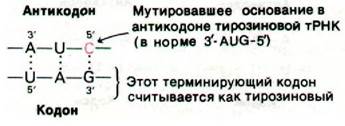
Fig. 27.9. Suppression of a chain-termination mutation by a second mutation in the tRNA molecule

Suppressor tRNAs of this type are likely to be fixed by selection primarily when the mutated tRNA is nonessential. In other words, there must be another species of tRNA that recognizes the same codons as the mutated tRNA. Indeed, E. coli possesses two different tRNAs that normally recognize the UAC and UAU codons. It is the tRNA present in a small amount that gets modified. The normal function of this minor species of tyrosine tRNA remains unclear. The existence of such a suppressor mutation raises yet another question. If the mutant codon UAG is read as tyrosine rather than as a termination signal, what happens during normal chain termination? Strangely enough, most polypeptide chains in Cells of the suppressor mutant terminate normally, perhaps because the termination signal involves more than just the UAG codon. Indeed, it is known that some coding sequences end with two different stop codons. Furthermore, suppression is not 100% efficient.
Fig. 27.10. Cytology/cytology/93.html">ELECTRON MICROGRAPHS OF 70S Ribosomes (A), 50S subunits (B), and 30S subunits (C)

Other types of mutant tRNAs have also been discovered. Missense suppressors alter mRNA reading so that a modified amino acid (e.g., Glycine instead of Arginine) is inserted in response to certain codons. Frameshift suppressors are of particular interest. One such tRNA contains an extra base in the anticodon loop. As a result, it reads four bases instead of three as a codon. For example, UUUC is read as a phenylalanine codon instead of UUU. Such a modified tRNA can suppress the insertion of an extra base.
Last update: 06/08/2026
Editorial and Educational Adaptation: This material has been compiled based on the primary/original source text. The project team performed an editorial review, corrected technical inaccuracies, structured sections, and adapted the content for an educational format.
What was processed:
- elimination of formatting defects (OCR errors, structural breaks, corrupted characters);
- editorial organization of content;
- standardization of terminology in accordance with academic sources;
- verification of factual statements against the original source text.
All mentions of the author, publication year, and origin of the primary text have been preserved in accordance with the source.