Principles of Biochemistry Volume 3 - A. Lehninger 1985
Molecular Mechanisms of Genetic Information Transfer
Protein Synthesis and Its Regulation
The "wobble" hypothesis allows a number of tRNAs to recognize multiple codons
One might expect that, in accordance with Watson-Crick base pairing, the anticodon triplet of a given tRNA would recognize only a single codon triplet, meaning a distinct tRNA should exist for each codon. However, the number of distinct tRNAs for each amino acid does not match the number of codons encoding it. It is also worth noting that some tRNAs contain the nucleoside inosine (designated as I), which incorporates the base hypoxanthine, formed from adenine following the hydrolytic removal of its 6-amino group. Molecular models show that I can form Hydrogen Bonds with three different bases—specifically U, C, and A—though this complementary interaction is weaker than the standard Watson-Crick interaction seen in conventional G-C and A-U Base Pairs. For instance, a certain Arginine tRNA features the anticodon (5') I-C-G (3'), which can recognize three different arginine codons: (5') C-G-A (3'), (5') C-G-U (3'), and (5') C-G-C (3'). The first two bases of these codons are identical (C-G) and form strong Watson-Crick pairs (highlighted in red) with the corresponding anticodon bases:
Class="center">
At the same time, the third bases of the arginine codons (A, U, and C) form comparatively weak hydrogen bonds (highlighted in black) with the I residue in the anticodon. The Study of these and other codon-anticodon pairs led Francis Crick to conclude that the third base of most codons possesses a certain degree of conformational freedom when pairing with the corresponding base of anticodons with the same Specificity—meaning, as Crick aptly put it, the third bases of such codons "wobble." Crick formulated four key postulates, collectively known as the Wobble Hypothesis.
1. The first two bases of a codon always form strong Watson-Crick pairs with the corresponding anticodon bases, contributing most significantly to coding specificity.
2. The first Base of the anticodon (read in the 5'→3' direction) allows it to read more than one codon for a given amino acid. If the first base of the anticodon is C or A, that anticodon can read only a single codon; if it is U or G, the anticodon can read two different codons. If the "wobbling" nucleoside of the anticodon is I or certain other modified residues, the anticodon can read three different codons. Thus, having I in the first position of the anticodon enables it to recognize the maximum number of codons for any given amino acid. The relationships between codons and anticodons described above are summarized in Table 29-3.
3. Codons for a given amino acid that differ at either of the first two bases require different tRNAs.
4. To translate all 61 codons corresponding to specific Amino Acids, a minimum of 32 tRNAs is required.
Table 29-3. The "wobble" base at the 5' position of the tRNA anticodon determines how many codons for a given amino acid can be recognized by that tRNA
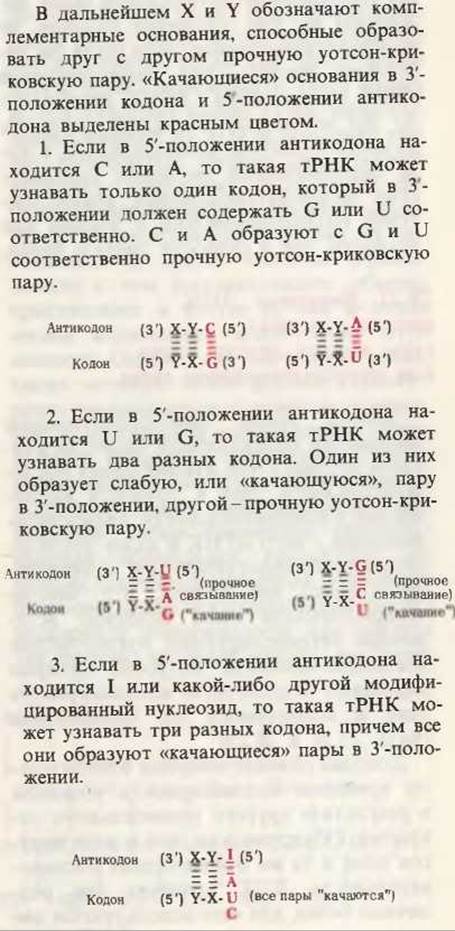
What accounts for this unexpected complexity in codon-anticodon interactions? In short, it is believed that the Specificity of the codon-anticodon interaction is ensured primarily by the first two codon bases; the "wobbling" (third) base also contributes to specificity, but because the base pair it forms is relatively weak, the tRNA can dissociate from the mRNA complex more readily during Protein Synthesis. If all three codon bases were involved in strong Watson-Crick interactions with their corresponding anticodon bases, the codon-anticodon bonds would be so robust that releasing the tRNA from the mRNA complex would occur too slowly, thus rate-limiting protein synthesis. Consequently, over the course of biochemical evolution, most codon-anticodon interactions have been optimized to balance both the accuracy and the speed of protein synthesis.
Last update: 06/08/2026
Editorial and Educational Adaptation: This material has been compiled based on the primary/original source text. The project team performed an editorial review, corrected technical inaccuracies, structured sections, and adapted the content for an educational format.
What was processed:
- elimination of formatting defects (OCR errors, structural breaks, corrupted characters);
- editorial organization of content;
- standardization of terminology in accordance with academic sources;
- verification of factual statements against the original source text.
All mentions of the author, publication year, and origin of the primary text have been preserved in accordance with the source.