Fundamentals of Molecular Biology - V.I. Rezyapkin 2009
Translation
Wobble Hypothesis
The main function of tRNA is to decode the Genetic information encoded in mRNA. tRNA is capable of recognizing sense triplets through base pairing between the anticodon and the codon. During this interaction, the bases are arranged in an antiparallel orientation relative to each other:
Class="center">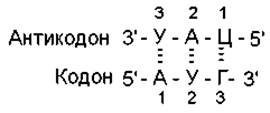
The first Base of the codon interacts with the third base of the anticodon, the second with the second, and the third with the first.
The interaction between the anticodon and the codon does not always strictly follow the rules of complementarity. Only the first two bases of the codon form canonical pairs with their corresponding anticodon bases, whereas the third base of the codon can pair with either a complementary or a non-complementary nitrogenous base of the anticodon. This feature of codon-anticodon interaction is known as wobble pairing (or ambiguous pairing). The main postulates of The wobble hypothesis were formulated by Crick:
1. The first two bases of the codon always form strong Watson-Crick pairs with the corresponding bases of the anticodon.
2. The first base of an anticodon set allows it to read more than one codon for a given amino acid.
3. Codons for a specific amino acid that differ in either of the first two bases require different tRNAs.
4. To translate all codons corresponding to specific Amino Acids (there are 61 such codons), at least 32 different tRNAs are required.
Both standard and minor nitrogenous bases can participate in non-canonical pairing. For instance, non-canonical pairs such as G=U and U=G can form between the third base of the codon and the first base of the anticodon. The composition of tRNA, including the anticodon itself, may contain minor nitrogenous bases capable of mediating non-standard pairing. For example, inosine (I), a nucleoside containing the base hypoxanthine formed by the deamination of adenine, can recognize A, G, and C:

Last update: 12/08/2026
Editorial and Educational Adaptation: This material has been compiled based on the primary/original source text. The project team performed an editorial review, corrected technical inaccuracies, structured sections, and adapted the content for an educational format.
What was processed:
- elimination of formatting defects (OCR errors, structural breaks, corrupted characters);
- editorial organization of content;
- standardization of terminology in accordance with academic sources;
- verification of factual statements against the original source text.
All mentions of the author, publication year, and origin of the primary text have been preserved in accordance with the source.