BIOCHEMISTRY - L. Stryer - 1984
VOLUME 2
PART II GENERATION AND STORAGE OF METABOLIC ENERGY
CHAPTER 11 METABOLISM: BASIC CONCEPTS AND DESIGN
11.7. ATP Hydrolysis Shifts the Equilibrium of Coupled Reactions by a Factor of 108
To better understand The Role of ATP in energy coupling, let us examine a chemical reaction that is thermodynamically unfavorable without an influx of free
energy. Suppose that the Standard Free energy change for The conversion of A to B is + 4 kcal/mol:
А ⇄ В ∆G0' = +4 kcal/mol.
In accordance with equation (13) (sec. 11.2), the Equilibrium Constant Keq of this reaction at 25°C is expressed by the ratio
Class="center">
Thus, A cannot spontaneously convert into B if the molar ratio of B to A is equal to or greater than 1.15 • 10-3. However, the conversion of A to B becomes possible even when the [B]/[A] ratio exceeds 1.15 • 10-3, provided that the reaction is coupled to the Hydrolysis of ATP. The overall equation for this new reaction will be:
А + АТР + Н2O ⇄ В + ADP + Рi + Н+
∆G0' = — 3.3 kcal/mol.
This standard free energy change (- 3.3 kcal/mol) represents the sum of ∆G0' for the conversion of A to B (+ 4 kcal/mol) and for the hydrolysis of ATP (- 7.3 kcal/mol). The equilibrium constant of this coupled reaction is expressed by the ratio:
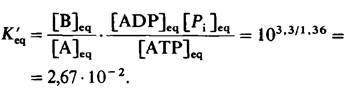
At equilibrium, The ratio of [B] to [A] is given by the equation
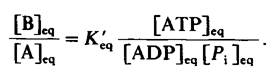
The cellular ATP-generating system maintains the [ATP]/[ADP] • [Pi] ratio at a high level, typically on the order of 500. For such a ratio,
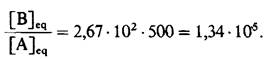
This means that ATP hydrolysis drives the conversion of A to B until the [B]/[A] ratio reaches a value of 1.34 • 105. This equilibrium ratio differs dramatically from the value of 1.15 • 10-3 for the reaction A ⇄ B in the absence of ATP hydrolysis. In other words, coupled ATP hydrolysis alters the equilibrium ratio of B to A by a factor of approximately 108.
We can see, therefore, that the thermodynamic essence of ATP's role is to function as an energy-coupling agent. Cells maintain high levels of ATP by utilizing light and oxidizable substrates as sources of free energy. The hydrolysis of a single ATP molecule dramatically shifts the equilibrium ratio of product concentration to Reactant Concentration in a coupled reaction—by a factor of roughly 10. More generally, the Hydrolysis of N molecules of ATP alters the equilibrium ratio of a coupled reaction (or sequence of reactions) by a factor of 108n. For instance, the hydrolysis of three ATP molecules in a coupled reaction changes the equilibrium ratio by a factor of 1024. Thus, a thermodynamically unfavorable sequence of reactions can be rendered thermodynamically favorable by coupling it to the hydrolysis of a sufficiently large number of ATP molecules. It should also be emphasized that A and B in the preceding coupled reaction equation have a very broad meaning. For example, A and B may represent different protein Conformations (such as During Muscle contraction). In other cases, the symbols A and B may refer to the concentrations of ions or molecules inside and outside The Cell, as in active nutrient transport. Furthermore, A and B can denote various chemical categories, notably in The Biosynthesis of complex molecules from simple precursors. In subsequent chapters, we will examine many important mechanisms of energy coupling in biological processes.
11.8. NADH and FADH2 Are the Principal Electron Carriers in Fuel Oxidation
Chemotrophs obtain free energy through The oxidation of fuel molecules such as glucose and Fatty acids. In aerobic organisms, O2 is the sole terminal electron acceptor. However, electrons are not transferred directly to O2 from fuel molecules and their degradation products. These compounds
transfer electrons to specialized carriers—either pyridine NUCLEOTIDES or flavins. The reduced forms of these carriers then deliver their high-potential electrons to O2 via the Electron Transport Chain localized in The inner mitochondrial membrane. The flow of electrons down this chain is coupled to the generation of ATP from ADP and Pi. This process, known as Oxidative Phosphorylation (Chap. 14), serves as the primary source of ATP in aerobic organisms. Additionally, the high-potential electrons generated during fuel oxidation can be utilized in biosynthetic pathways, which require reducing equivalents In addition to ATP.
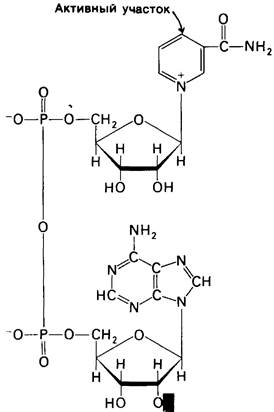
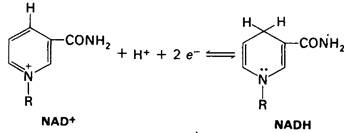
Nicotinamide adenine dinucleotide (NAD+) is the major electron acceptor in fuel oxidation (Fig. 11.8). The reactive moiety of NAD+ is its nicotinamide ring. Upon substrate oxidation, the nicotinamide ring of NAD+ accepts a hydrogen ion and two electrons, which are equivalent to a hydride ion. The reduced form of this carrier is NADH.
Fig. 11.8. Structure OF THE oxidized forms of nicotinamide adenine dinucleotide (NAD+) and nicotinamide adenine dinucleotide phosphate (NADP+). In NAD+, R = H; in NADP+, R = PO23-
NAD+ acts as an electron acceptor in numerous Reactions of the type
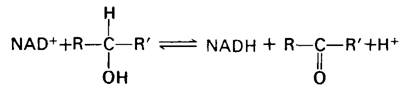
During this dehydrogenation, one hydrogen atom from the substrate is transferred directly to NAD+, while the second enters the solvent. Both electrons lost by the substrate are transferred to the nicotinamide ring.
The second major electron carrier involved in the oxidation of fuel molecules is flavin adenine dinucleotide (Fig. 11.9). The Abbreviations used for the oxidized and reduced forms of this carrier are FAD and FADH2, respectively. FAD serves as an electron acceptor in reactions of the type
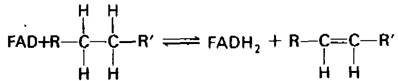
Fig. 11.9. Structure of the oxidized form of flavin adenine dinucleotide (FAD)
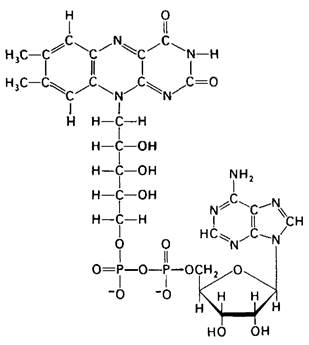
The reactive portion of FAD is its isoalloxazine ring (Fig. 11.10). Like NAD+, FAD accepts two electrons. However, unlike NAD+, FAD picks up both hydrogen atoms lost by the substrate. Group Transfer Potentials for NADH and FADH2, along with the Thermodynamics of oxidation-reduction reactions, are discussed in Chapter 14.
Fig. 11.10. Structure of the reactive parts of FAD+ and FADH2

11.9. NADPH is the Primary Electron Donor in Reductive Biosynthesis
Compounds that serve as precursors in biosynthetic pathways are generally more oxidized than the reaction products. Therefore, carrying out biosynthetic processes requires reducing equivalents in addition to ATP. For instance, during FATTY ACID BIOSYNTHESIS, the oxo group of an added C2-precursor is reduced in several steps to a methylene group. This sequence of reactions requires the uptake of four electrons
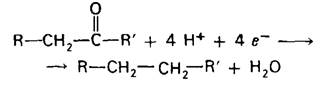
The reduced form of nicotinamide adenine dinucleotide phosphate (NADPH; Fig. 11.8) acts as the electron donor in most reductive biosynthetic processes. NADPH differs from NADH by the presence of a phosphate group esterified to the 2'-hydroxyl group of adenosine. The oxidized form of NADPH is designated as NADP+. NADPH transfers electrons in the same manner as NADH.
However, NADPH is used almost exclusively in reductive biosynthesis, whereas NADH is utilized primarily for ATP generation. The additional phosphate group on NADPH serves as a specific recognition tag for Enzymes. The Biological Significance of the functional differentiation between NADPH and NADH is discussed in Chapter 15 (p. 95).
It is important to note that NADH, NADPH, and FADH2 react very slowly with O2 in the absence of catalysts. ATP hydrolysis is also exceptionally slow without a catalyst. These molecules are kinetically entirely stable, despite a large thermodynamic driving force for the reactions of these electron carriers with O2 and for the reaction of ATP with Water. The stability of these molecules in the absence of specific catalysts is essential for their biological function, as it allows for enzymatic Regulation of the flow of Free Energy and reducing equivalents.
Last update: 06/08/2026
Editorial and Educational Adaptation: This material has been compiled based on the primary/original source text. The project team performed an editorial review, corrected technical inaccuracies, structured sections, and adapted the content for an educational format.
What was processed:
- elimination of formatting defects (OCR errors, structural breaks, corrupted characters);
- editorial organization of content;
- standardization of terminology in accordance with academic sources;
- verification of factual statements against the original source text.
All mentions of the author, publication year, and origin of the primary text have been preserved in accordance with the source.