Biochemistry - Chemical Reactions in Living Cells, Volume 2 - D. Metzler 1980
Organization of Metabolism: Catabolic Pathways
Fermentation: "Life Without Oxygen"
Fermentation Based on the Phosphogluconate and Pentose Phosphate Pathways
Certain lactic acid Bacteria of the genus Lactobacillus, as well as Leuconostoc mesenteroides, carry out heterolactic Fermentation, which is based on the Reactions of the Pentose Phosphate Pathway. This is undoubtedly due to the absence in these organisms of the key enzyme aldolase, which is required to cleave fructose-6-phosphate into two triose phosphate molecules.
The pathway of transformations shown in equation (9-39) involves reactions already familiar to the reader. Glucose is converted into ribulose-5-phosphate via the reactions of The pentose phosphate pathway. Ribulose-5-phosphate is cleaved by phosphoketolase (Fig. 8-4) into acetyl phosphate and glyceraldehyde phosphate, which are further converted into ethanol and lactate, respectively. As a result, only a single molecule of ATP is synthesized per fermented glucose molecule1).
Class="center">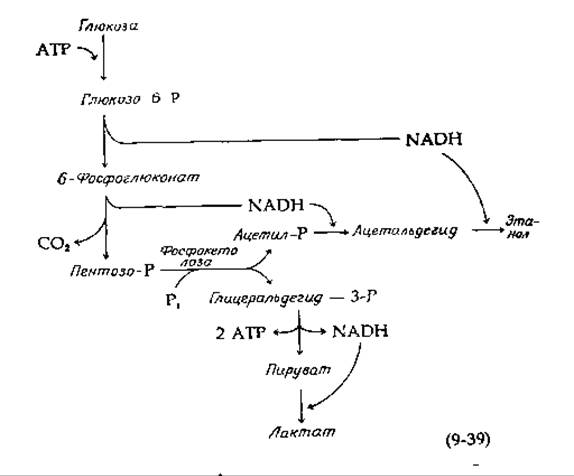
A minor modification of equation (9-39) illustrates the pathway of pentose fermentation into acetate and lactate, with the synthesis of one ATP molecule per each molecule of acetyl phosphate. An additional ATP molecule is formed during The oxidation of glyceraldehyde-3-phosphate. Since one ATP molecule is consumed to "prime" the pentose, the net yield is two ATP molecules.
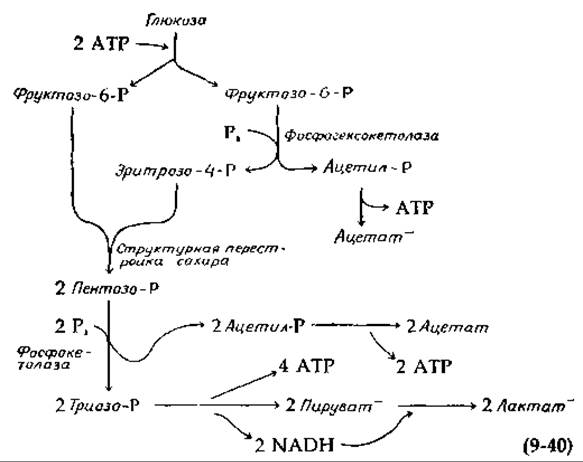
Another type of fermentation [equation (9-40)] [40] is found in bacteria of the genus Bifidobacterium. The process requires the participation of phosphoketolase and phosphoketolase (specifically phosphoketolase cleaving fructose-6-phosphate into erythrose-4-phosphate and acetyl phosphate), as well as Enzymes of the sugar rearrangement system (Section D, 3). The ATP yield is 21/2 mol per 1 mol of glucose.
Another fermentation pathway is based on the oxidation of 6-phosphogluconate via the Entner-Doudoroff Pathway [equation (9-18)]. Drawing upon the reactions of this pathway, the reader can easily construct a balanced fermentation scheme in which glucose is converted into ethanol and CO2, much like in Yeast fermentation. What would the expected ATP yield be?
1) Phosphoketolase Cleavage can be viewed as a process of Oxidative Phosphorylation. The aldehyde group of the "active glycolaldehyde" cleaved from ribulose-5-phosphate is oxidized to acyl phosphate through the reduction of —CH2OH to —CH3.
1. How many ATP molecules can be generated per molecule of palmitic acid upon its cellular oxidation to CO2 and Water? Perform the calculations assuming that the oxidation of NADH by the Components of the Mitochondrial Electron Transport chain yields 3 ATP molecules, while the oxidation of FADH2 yields 2 ATP molecules.
2. Assuming that 1 mol of ATP Supports the synthesis of 10.5 g of cellular dry weight (Ch. 3, Section G, 1), what amount of Cells (in grams) can be produced per 1 gram of palmitic acid oxidized during METABOLISM, given that all the ATP generated in the process is funneled into Cell growth?
3. How many moles of ATP can be formed upon the Complete oxidation of 1 mol of acetic acid? Upon the complete oxidation of 1 mol of glucose?
4. Compare The values of ∆G0 and the number of ATP moles generated during the complete oxidation of the following compounds:
a) acetate (pH 7);
b) a two-carbon fatty acid fragment;
c) lactate (pH 7);
d) a three-carbon fragment of glucose (1/2 molecule).
5. Branched-chain Amino Acids—valine, leucine, and isoleucine—frequently undergo Catabolism in the Organism in the following manner. Transamination leads to The formation of an α-keto acid, which undergoes oxidative decarboxylation to yield an acyl-CoA derivative. The latter then undergoes β-oxidation. What products are formed from isoleucine in this case? How are they subsequently converted into CO2? What difficulties might be encountered in the catabolism of valine and leucine? Try to propose a rational Scheme for the corresponding Catabolic pathways. Compare your proposals with the experimentally established pathways shown in Fig. 14-11.
6. The Tricarboxylic Acid Cycle requires oxaloacetate as a regenerating substrate "primer." Name four metabolic sources of this compound (not all of which necessarily occur in animals); note that two of them are amino acids.
7. Glucose metabolism begins with the action of hexokinase:

Under physiological conditions, this reaction is practically irreversible. Why?
8. Many compounds found within The Cell are synthesized from intermediates of Glycolysis and the tricarboxylic acid cycle, or from closely related substances. Using Pyruvate as the starting substrate, indicate the reactions leading to the Formation of the following compounds:
a) aspartic acid,
b) lactic acid,
c) ethanol,
d) acetoacetic acid,
e) acetone,
f) Alanine,
g) acetic acid,
h) glutamic acid,
i) δ-aminolevulinic acid,
j) propionic acid.
9. Radioactive glucose, labeled with 14C at positions 3 and 4, was incubated under anaerobic conditions with a cell-free Liver homogenate. At which positions will the resulting lactate contain 14C?
10. Consider the reactions in the tricarboxylic acid cycle of the following compounds labeled with 14C: 1-14C-pyruvate, 2-14C-pyruvate, 2-14C-acetate, and 1-14C-succinate. Indicate THE POSITION OF the label in oxaloacetate after the completion of one turn of the cycle. From which substrates will 14CO2 be produced after one turn?
11. Assume that an equilibrium has been established in a yeast cell among NAD+, NADH, glyceraldehyde-3-phosphate, 1,3-diphosphoglycerate, ethanol, and acetaldehyde.
a. What is The change in Standard Free energy for the coupled oxidation-reduction reactions involving these compounds, i.e., for the overall reaction:

b. What will be the equilibrium concentration of acetaldehyde given an ethanol concentration of 1 M and glyceraldehyde-3-phosphate and 3-phosphoglycerate concentrations of 10 mM?
c. What is the value of ΔG0 for the process in which the above reaction is coupled with the synthesis of 1 mol of ATP?
d. What will be the equilibrium concentration of acetaldehyde at the concentrations of the Other Compounds specified in part (b) and when the process is coupled with the synthesis of 1 molecule of ATP under conditions where the phosphorylation potential (Appendix 3-A) is Rp = 104?
12. Nematodes such as Ascaris lumbricoides (as well as many other invertebrates) can live under completely anaerobic conditions, obtaining energy by fermenting glucose to succinate and pyruvate [see Landsperger W. J., Harris B. G., JBC, 251, 3599–3602 (1976)].
a. What is the value of ΔG' (pH 7) for this fermentation?
b. Although pyruvate is one of the products, these organisms virtually lack pyruvate kinase. They apparently convert phosphoenolpyruvate into malate [equation (7-76)], which is subsequently transported into the Mitochondria. Outline the pathway of reactions leading from malate to the observed products within the mitochondria.
c. How many moles of ATP per mole of glucose are formed during this fermentation in the Cytosol? It is believed that an additional mole of ATP is generated through processes occurring in the mitochondria. Propose a reaction pathway for this process (see Fig. 10-11).
d. Acetate also accumulates in Ascaris. Explain how this can occur under anaerobic conditions.
13. In oysters, the pyruvate produced during the fermentation described in Problem 12 reacts with glutamate to yield alanine and α-ketoglutarate. The latter can undergo oxidative decarboxylation and be converted into propionate. Write a balanced equation for the fermentation process in which glutamate and glucose are converted into alanine, propionate, and succinate. What is the value of ΔG' (pH 7)? What should be the ATP yield per mole of glucose fermented?
Last update: 06/08/2026
Editorial and Educational Adaptation: This material has been compiled based on the primary/original source text. The project team performed an editorial review, corrected technical inaccuracies, structured sections, and adapted the content for an educational format.
What was processed:
- elimination of formatting defects (OCR errors, structural breaks, corrupted characters);
- editorial organization of content;
- standardization of terminology in accordance with academic sources;
- verification of factual statements against the original source text.
All mentions of the author, publication year, and origin of the primary text have been preserved in accordance with the source.