Human Biochemistry, Volume 1 - Murray R. 1993
Bioenergetics and Metabolism of Carbohydrates and Lipids
The Citric Acid Cycle: Catabolism of Acetyl-CoA
Amphibolic Role of the Citric Acid Cycle
Some metabolic pathways terminate with metabolites that are part of the cycle, whereas others originate from its metabolites. These include Gluconeogenesis, Transamination, deamination, and fatty acid synthesis. These processes are discussed in greater detail in subsequent chapters; their relationship with the cycle reactions is briefly outlined below.
Class="center">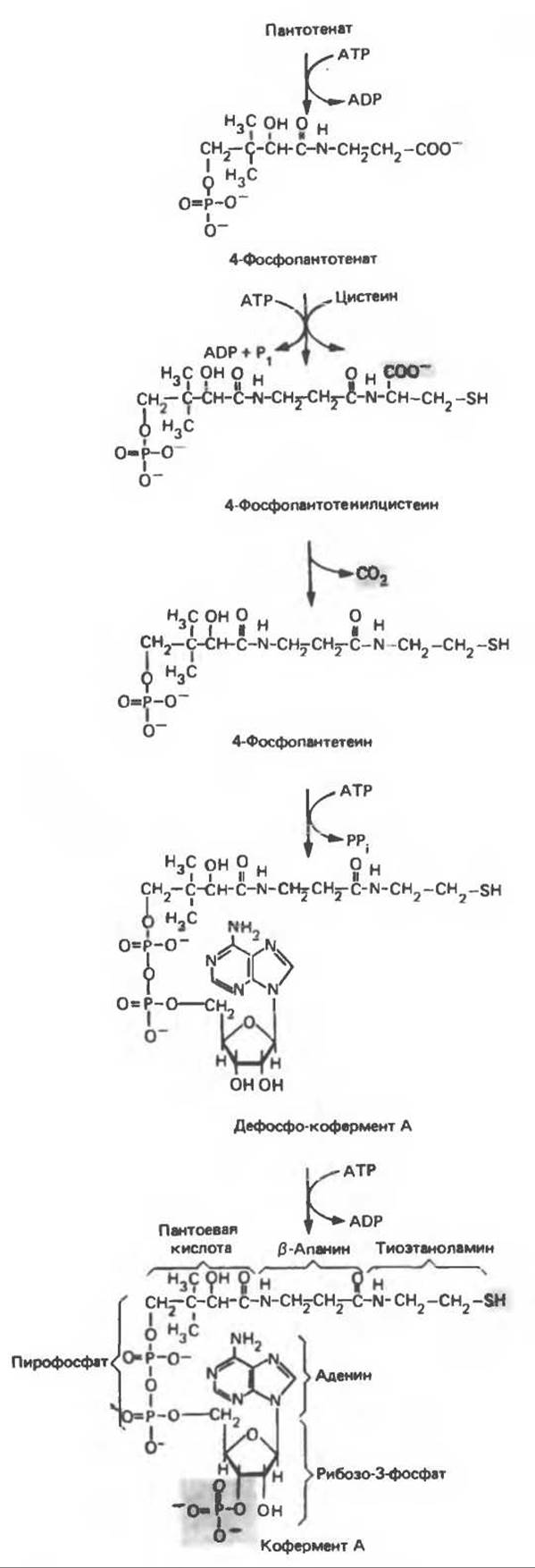
Fig. 17.6. Synthesis of coenzyme A from pantothenic acid.
Gluconeogenesis, Transamination, and Deamination
All major intermediates participating in the cycle, from citrate to oxaloacetate, are potentially glucogenic. Glucose can be synthesized from them in both The Liver and Kidneys, as these Organs contain the complete set of Enzymes required for gluconeogenesis (see p. 196). The key enzyme in gluconeogenesis is phosphoenolpyruvate carboxykinase, which catalyzes the decarboxylation of oxaloacetate (using GTP as a high-energy phosphate source) to yield phosphoenolpyruvate (Fig. 17.7):
Oxaloacetate + GTP → Phosphoenolpyruvate + СО2 + GDP.
Intermediates enter the cycle via several different reactions. One of The most significant is The formation of oxaloacetate through the carboxylation of Pyruvate, catalyzed by pyruvate carboxylase:
АТР + СО2 + Н2О + pyruvate → oxaloacetate + ADP + Рi.
This reaction maintains adequate concentrations of oxaloacetate for its Condensation with acetyl-CoA. When acetyl-CoA levels rise, it acts as an allosteric activator of pyruvate carboxylase, accelerating oxaloacetate production. Lactate, an important substrate for gluconeogenesis, enters the cycle after being converted first into pyruvate and subsequently into oxaloacetate.
In transaminase-catalyzed reactions, pyruvate is formed from Alanine, oxaloacetate from aspartate, and α-ketoglutarate from glutamate. Because these reactions are reversible, the cycle can serve as a source of carbon skeletons for the synthesis of non-Essential Amino Acids. For example:

Other Amino Acids also contribute to gluconeogenesis because, following deamination or transamination, their carbon skeletons are fully or partially integrated into the cycle. Examples include alanine, Cysteine, Glycine, hydroxyproline, Serine, Threonine, and Tryptophan, which yield pyruvate; Arginine, Histidine, glutamine, and Proline, which yield glutamate and subsequently α-ketoglutarate; isoleucine, Methionine, and valine, which yield succinyl-CoA; and Tyrosine and phenylalanine, which yield fumarate (Fig. 17.7). Substances that form pyruvate are either completely oxidized to СО2 via the pyruvate dehydrogenase pathway leading to acetyl-CoA formation, or channeled into gluconeogenesis to form oxaloacetate via carboxylation.

Fig. 17.7. Participation of The Citric Acid Cycle in transamination and gluconeogenesis. The main pathway of gluconeogenesis is indicated by bold arrows.

Fig. 17.8. Participation of The Citric Acid cycle in the synthesis of Fatty acids from glucose. See also Fig. 23.9.
For ruminants, The conversion of propionate (the primary glucogenic product of rumen Fermentation) into succinyl-CoA via methylmalonyl-CoA is of particular importance (see Fig. 20.2).
Fatty Acid Synthesis (Fig. 17.8)
Acetyl-CoA, produced from pyruvate by the action of pyruvate dehydrogenase, serves as the primary building block for long-chain fatty acid synthesis in mammals (with the exception of ruminants, in which acetyl-CoA is derived directly from acetate). Because pyruvate dehydrogenase is a mitochondrial enzyme, whereas the enzymes for fatty acid synthesis are located extra-mitochondrially, Cells must transport acetyl-CoA across the impermeable mitochondrial membrane. This "transport" is achieved as follows: acetyl-CoA enters the citric acid cycle and is incorporated into citrate; citrate is then transported out of the mitochondrion into the Cytosol, where it is cleaved back into acetyl-CoA in a reaction catalyzed by ATP-citrate lyase.
Citrate + АТР + CoA → Acetyl-CoA + Oxaloacetate + ADP + Рi.
Regulation of the Citric Acid Cycle
This topic is discussed in Chapter 22.
Boyer Р. D. (ed.) The Enzymes, 3rd ed., Academic Press, 1971. Goodwin T. W. (ed.) The Metabolic Roles of Citrate, Academic Press, 1968.
Greville G. D. Vol. 1, p. 297. In: Carbohydrate METABOLISM and
Its Disorders, Dickens F., Randle P. J., Whelan W. J. (eds), Academic Press, 1968.
Lowenstein J.M. Vol. 1, p. 146. In: Metabolic Pathways, 3rd ed., Grenberg D. M. (ed.), Academic Press, 1967.
Lowenstein J. M. (ed.) Citric Acid Cycle: Control and Compartmentation, Dekker, 1969.
Lowenstein J. M. (ed.) Citric Acid Cycle, Vol. 13. In: Methods in Enzymology. Academic Press, 1969.
Srere P. A. The enzymology of the formation and breakdown of citrate, Adv. Enzymol., 1975, 43, 57.
Last update: 06/08/2026
Editorial and Educational Adaptation: This material has been compiled based on the primary/original source text. The project team performed an editorial review, corrected technical inaccuracies, structured sections, and adapted the content for an educational format.
What was processed:
- elimination of formatting defects (OCR errors, structural breaks, corrupted characters);
- editorial organization of content;
- standardization of terminology in accordance with academic sources;
- verification of factual statements against the original source text.
All mentions of the author, publication year, and origin of the primary text have been preserved in accordance with the source.