Principles of Biochemistry, Volume 3 - A. Lehninger 1985
Selected Aspects of Human Biochemistry
Hormones
Hormones function within a complexly overlapping hierarchical system
In this chapter, we examine Hormones and how they regulate the interplay between various Organs and Tissues.
The word hormone is derived from a Greek verb meaning “to excite” or “to agitate.” A hormone is a chemical agent secreted in trace amounts by one type of tissue and transported via the bloodstream to another target tissue, where it elicits a specific biochemical or physiological response. Endocrinology, the branch of biomedical science dedicated to The Study of hormones, represents one of the most fascinating fields of biochemistry. Recently, breakthroughs in this area have opened up entirely new approaches and Perspectives. Furthermore, because hormone dysfunction leads to disease, endocrinology has become one of the most practically useful areas of biochemistry.
Numerous hormones are known, and new ones continue to be discovered. Hormones regulate not only METABOLISM but also many other bodily Functions, including Cell and tissue growth, Heart rate, Blood pressure, renal function, intestinal peristalsis, digestive enzyme secretion, Lactation, and reproduction. We will not explore all of these topics here. Because the Biochemical Mechanisms of action for most hormones remain largely unknown, we will focus solely on the biochemistry of those hormones that regulate Major Metabolic Pathways, specifically epinephrine, Insulin, Glucagon, thyroxine, and Adrenocortical Hormones.
Let us first consider the body's primary endocrine systems and some of their functional interrelationships. Figure 25-1 illustrates the anatomical distribution of the major Endocrine glands that play a crucial role in Metabolic Regulation. The term “endocrine” (“secreting internally”) indicates that these are ductless glands—that is, they secrete their products directly into the bloodstream. In addition to well-known endocrine glands such as the thyroid and pituitary, There are many other tissues, such as the Pineal Gland, the Thymus, and numerous cell clusters throughout the gastrointestinal tract, that secrete various hormones.
Class="center">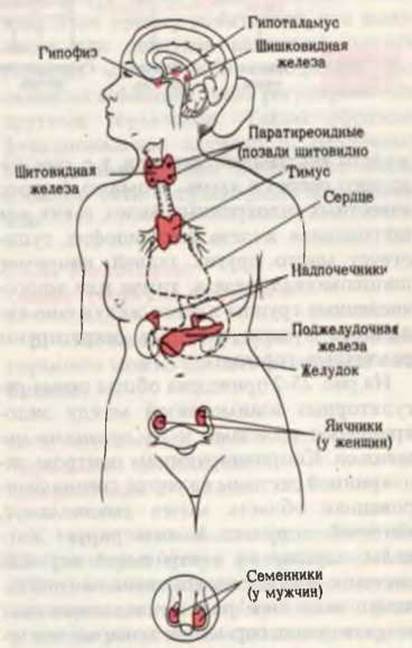
Fig. 25-1. Major endocrine glands.
Figure 25-2 presents a General Overview of the regulatory connections between endocrine glands and their target organs. The coordinating center of the Endocrine System is a specialized region of the Brain, the Hypothalamus, which receives and integrates signals originating in the Central Nervous system. In response to these signals, the hypothalamus releases a series of hypothalamic regulatory hormones that travel to the anterior pituitary, located directly beneath the hypothalamus. Each hypothalamic hormone regulates the secretion of a single anterior pituitary hormone. Some Hypothalamic hormones stimulate pituitary hormone secretion, whereas others inhibit it. Upon stimulation, Pituitary Hormones are released into the bloodstream and reach downstream endocrine glands, namely the adrenal cortex, the endocrine Pancreas, the thyroid, and the Ovaries or Testes. Consequently, these glands secrete their own specific hormones, which are then carried by the blood to Hormone Receptors located On the surface or within the Cells of their ultimate target tissues. This Relay system features yet another component: target tissue cells contain a molecular signaling agent—an intracellular second messenger—that transmits the signal from the hormone receptor to a specific intracellular Structure or enzyme, which serves as the ultimate effector of the hormone's action. Thus, each endocrine system is essentially a series of relays through which a signal from the central nervous system is transmitted to a specific effector molecule in the target cells.

Fig. 25-2. Major endocrine systems and their target tissues. Signals originating in The Nervous System pass through a series of relays before reaching the target tissue. In addition to the systems shown, hormones are secreted by the thymus and pineal gland, as well as by cell groups in the gastrointestinal tract. FSH, follicle-stimulating hormone; LH, luteinizing hormone.

Fig. 25-3. Feedback Regulation of the secretion of the THYROID HORMONES thyroxine and triiodothyronine. Elevated concentrations of these hormones in the blood inhibit the hypothalamic secretion of thyrotropin-releasing hormone (TRH) and pituitary secretion of thyrotropin. TRH secretion is also inhibited by another hypothalamic hormone, Somatostatin.
The functional activity of the endocrine system is also regulated by feedback mechanisms. Figure 25-3 illustrates an example of how such mechanisms operate. The hypothalamus dispatches thyrotropin-releasing hormone (TRH) to the anterior pituitary, thereby stimulating thyrotropin secretion; thyrotropin, in turn, stimulates The Thyroid Gland to release thyroxine and triiodothyronine, which then reach the target tissues. However, circulating thyroid hormones exert negative feedback to inhibit the hypothalamic secretion of TRH and the pituitary secretion of thyrotropin. Furthermore, TRH secretion is inhibited by somatostatin, which is produced by the hypothalamus (as well as the pancreas). This example demonstrates that the secretion or action of a single hormone can be heavily influenced or regulated by Other Hormones. Consequently, the functional activity of various endocrine systems depends upon an exceptionally complex network of regulatory interrelationships.
Last update: 06/08/2026
Editorial and Educational Adaptation: This material has been compiled based on the primary/original source text. The project team performed an editorial review, corrected technical inaccuracies, structured sections, and adapted the content for an educational format.
What was processed:
- elimination of formatting defects (OCR errors, structural breaks, corrupted characters);
- editorial organization of content;
- standardization of terminology in accordance with academic sources;
- verification of factual statements against the original source text.
All mentions of the author, publication year, and origin of the primary text have been preserved in accordance with the source.