LEHNINGER PRINCIPLES OF BIOCHEMISTRY - VOL. 2. BIOENERGETICS AND METABOLISM - 2014
PART II. BIOENERGETICS AND METABOLISM
13. BIOENERGETICS AND BIOCHEMICAL REACTION TYPES
Questions and Problems
1. Entropy changes during egg development.
Consider a system consisting of an egg in an incubator. The egg white and yolk contain Proteins, CARBOHYDRATES, and Lipids. Upon Fertilization, a single Cell develops into a complex Organism. Discuss this irreversible process and provide a qualitative Assessment of the entropy changes within the system, its surroundings, and the universe as a whole. First, clearly define the System and Its surroundings.
2. Calculation of ΔG'° from the Equilibrium Constant.
Calculate the standard free-energy changes for the following enzyme-catalyzed, metabolically important reactions at 25 °C and pH 7.0, using the given equilibrium constant data.
Class="center">
3. Calculation of the equilibrium constant from ΔG'°.
Calculate the equilibrium constants K'eq for the reactions at pH 7.0 and 25 °C, using the ΔG'° values from Table 13-4.

4. Experimental Determination of k'eq and ΔG'°.
When a 0.1 M solution of glucose-1-phosphate is incubated with a catalytic amount of phosphoglucomutase, the glucose-1-phosphate is converted to glucose-6-phosphate. The equilibrium concentrations of the components are as follows:

Calculate K'eq and ΔG'° for this reaction at 25 °C.
5. Experimental determination of ΔG'° for ATP Hydrolysis.
Direct measurement of the standard free-energy change for ATP hydrolysis is difficult because The amount of ATP hydrolyzed per minute at equilibrium is hard to measure accurately. However, ΔG′° can be calculated indirectly from the equilibrium constants of two other enzymatic reactions that have more favorable equilibrium positions:
Glucose-6-phosphate + H2O —> glucose + Pi
K'eq = 270
ATP + glucose —> ADP + glucose-6-phosphate
K'eq = 890
Determine the Standard Free energy of ATP hydrolysis at 25 °C.
6. Difference between ΔG′° and ΔG.
Consider the following conversion occurring during Glycolysis (Chapter 14):
Fructose 6-phosphate ⇄ glucose 6-phosphate
K’eq = 1.97
a) Calculate ∆G′° for the reaction (at 25 °C).
b) If the concentration of fructose 6-phosphate is adjusted to 1.5 M and that of glucose 6-phosphate to 0.50 M, What is the value of ∆G?
c) Why do ∆G′° and ∆G differ in magnitude?
7. Free energy of CTP Hydrolysis.
Compare The Structure of the nucleoside triphosphate CTP with that of ATP.

Predict The values of K'eq and ∆G′° for the following reaction:
ATP + CDP —> ADP + CTP
8. pH Dependence of ∆G.
The standard free energy of ATP hydrolysis at pH 7.0 is -30.5 kJ/mol. Will the amount of free energy released be greater or smaller if ATP hydrolysis occurs under standard conditions but at pH 5.0? Explain. Use a titration curve (or physiological profile) to account for this dependence.
9. ∆G'° of Coupled Reactions.
Glucose 1-phosphate is converted to fructose 6-phosphate in two sequential reactions:
Glucose 1-phosphate —> glucose 6-phosphate
Glucose 6-phosphate —> fructose 6-phosphate
Using the ∆G'° values from Table 13-4, calculate the equilibrium constant K'eq for the overall reaction at 25 °C:
Glucose 1-phosphate —> fructose 6-phosphate
10. Effect of the [ATP]/[ADP] Ratio on the Free Energy of ATP Hydrolysis.
Using Equation 13-4, plot the dependence of ∆G on ln Q (mass-action ratio) at 25 °C for the concentrations of ATP, ADP, and Pi specified in the table. For this reaction, ∆G'° = -30.5 kJ/mol. Using the resulting graph, explain why Metabolic Regulation aims to maintain a high [ATP]/[ADP] ratio.

11. Overcoming Unfavorable Reactions: ATP-Dependent Chemical Coupling.
The phosphorylation of glucose to glucose 6-phosphate is the initial step in Glucose Catabolism. The direct phosphorylation of glucose by Pi is described by the equation
Glucose + Pi —> glucose 6-phosphate + H2O
∆G'° = 13.8 kJ/mol
a) Calculate the equilibrium constant for the given reaction. In rat hepatocytes, the physiological concentrations of glucose and Pi are ~4.8 mM. What is the equilibrium concentration of glucose-6-phosphate produced by the direct phosphorylation of glucose with inorganic phosphate? Is this reaction viable as a metabolic step in glucose catabolism? Explain your reasoning.
b) In principle, at least one way to increase the glucose-6-phosphate concentration is to shift the reaction equilibrium to the right by increasing the intracellular concentrations of glucose and Pi. Assuming that the Pi concentration remains constant at 4.8 mM, determine what the intracellular glucose concentration must be to achieve an equilibrium glucose-6-phosphate concentration of 250 µM (a typical physiological concentration). Would this approach be physiologically feasible, given that the maximum solubility of glucose is less than 1 M?
c) The phosphorylation of glucose in The Cell is coupled to ATP hydrolysis; that is, a portion of the free energy of ATP hydrolysis drives the phosphorylation of glucose:
(1) Glucose + Pi —> glucose-6-phosphate + H2O
∆G′° = 13.8 kJ/mol
(2) ATP + H2O —> ADP + Pi
∆G′° = -30.5 kJ/mol
Overall: glucose + ATP —> glucose-6-phosphate + ADP
Calculate K'eq for the overall reaction. For ATP-dependent phosphorylation of glucose, what glucose concentration is required to yield an intracellular glucose-6-phosphate concentration of 250 µM if the concentrations of ATP and ADP are 3.38 mM and 1.32 mM, respectively? Does this type of coupling provide a physiologically feasible mechanism for glucose phosphorylation within the cell? Explain.
d) Although coupling ATP hydrolysis with glucose phosphorylation is thermodynamically sound, the precise mechanism by which this occurs remains to be clarified. Assuming that a common intermediate is required for coupling, a possible mechanism involves using ATP hydrolysis to raise the intracellular Pi concentration and thereby drive the otherwise unfavorable phosphorylation of glucose. Is this pathway plausible? (Consider the constraints imposed by the solubility of metabolic intermediates.)
e) ATP-coupled phosphorylation of glucose in hepatocytes is catalyzed by the enzyme glucokinase. This enzyme binds ATP and glucose to form a glucose-ATP-enzyme complex, and the phosphoryl group is transferred directly from ATP to glucose. Explain the advantages of this pathway.
12. Calculation of ∆G′° for ATP-coupled reactions.
Using the data from Table 13-6, determine ∆G′° for the following reactions:
a) Creatine phosphate + ADP —> creatine + ATP
b) ATP + fructose —> ADP + fructose-6-phosphate
13. Coupling ATP Cleavage to thermodynamically unfavorable reactions.
To examine the effects of coupling ATP hydrolysis under physiological conditions with a thermodynamically unfavorable biochemical reaction, consider the hypothetical conversion X —> Y, for which ∆G′° = 20 kJ/mol.
a) What is the ratio [Y]/[X] at equilibrium?
b) Suppose X and Y participate in a sequence of reactions during which ATP is hydrolyzed to ADP and Pi. The overall reaction is
X + ATP + H2O —> Y + ADP + Pi
Calculate [Y]/[X] for this reaction at equilibrium, assuming that the equilibrium concentrations of ATP, ADP, and Pi are all 1 M.
c) It is known that under physiological conditions, [ATP], [ADP], and [Pi] are not equal to 1 M. Calculate [Y]/[X] for the ATP-coupled reaction using the [ATP], [ADP], and [Pi] values characteristic of rat myocytes.
14. Calculations of ∆G under physiological concentrations.
Determine the physiological ∆G (rather than ∆G′°) for the reaction:
Creatine phosphate + ADP —> creatine + ATP
at 25 °C for neuronal Cytosol containing 4.7 mM phosphocreatine, 1.0 mM creatine, 0.73 mM ADP, and 2.6 mM ATP.
15. Free energy required for ATP synthesis under physiological conditions.
In the cytosol of rat hepatocytes, the mass-action ratio Q is
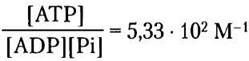
Calculate the free energy required for ATP Synthesis in rat hepatocytes.
16. “Chemical” logic.
During glycolysis, the six-carbon sugar fructose 1,6-bisphosphate is cleaved to yield two three-carbon sugars, which undergo further metabolic transformations (see Fig. 14-5). Two steps prior to the cleavage reaction, glucose 6-phosphate is isomerized to fructose 6-phosphate (see below) (an intermediate step involves the phosphorylation of fructose 6-phosphate to form fructose 1,6-bisphosphate) (p. 73).

What is the biological rationale for the isomerization step in this pathway? Hint: Consider what might happen during the Cleavage of the C—C bond without prior isomerization.
17. Mechanism of an enzymatic reaction I.
Lactate dehydrogenase is one of the Enzymes that utilize NADH as a coenzyme. The enzyme catalyzes The conversion of Pyruvate to lactate

Propose a mechanism for this reaction (use arrows to indicate the direction of electron flow).
Hint: The Mechanism of this reaction is analogous to that of any other reaction catalyzed by an NADH-dependent dehydrogenase, such as Alcohol dehydrogenase.
18. Mechanism of an enzymatic reaction II.
Biochemical reactions often appear more complex than they actually are. In the Pentose Phosphate Pathway (Ch. 14), sedoheptulose 7-phosphate reacts with glyceraldehyde 3-phosphate to yield erythrose 4-phosphate and fructose 6-phosphate, a reaction catalyzed by transaldolase.
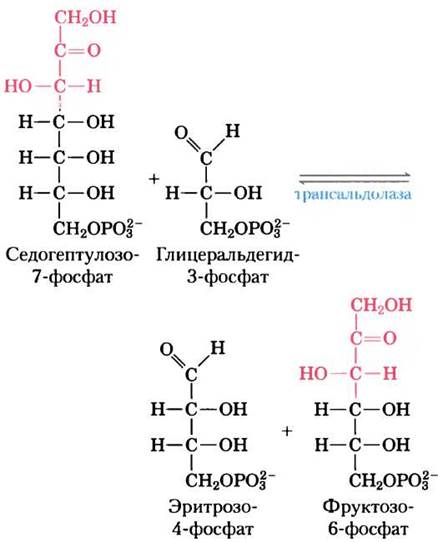
Propose a mechanism for this reaction (use arrows to indicate the direction of electron flow). Hint: Review aldol Condensation reactions and consider the name of the enzyme.
19. Daily ATP turnover in the adult human body.
a) The synthesis of ATP from ADP and Pi requires only 30.5 kJ/mol of free energy under standard conditions (1 M concentrations of all reactants). Because the actual physiological concentrations of ATP, ADP, and Pi are not 1 M, the free energy required for ATP synthesis under physiological conditions differs from ΔG’°. Calculate the free energy required for ATP synthesis in human hepatocytes, given physiological concentrations of ATP, ADP, and Pi of 3.5, 1.50, and 5.0 mM, respectively.
б) An adult human with a body mass of 68 kg (150 lb) requires 2,000 kcal (8,360 kJ) of dietary energy per day (24 h). Food is metabolized, and the released free energy is coupled to the synthesis of ATP. ATP then provides energy to drive the body's daily chemical and mechanical work. Assuming a 50% efficiency for the conversion of dietary energy into ATP, calculate the total mass of ATP used by an adult over a 24-hour period. What percentage of the total body mass does this daily ATP turnover represent?
в) Despite the vast amounts of ATP synthesized daily in The Human Body, total body mass and composition remain remarkably stable. Explain this apparent paradox.
20. Turnover rates of the γ- and β-phosphates of ATP.
If a trace amount of ATP radiolabeled at the terminal phosphate group ([γ-32P]ATP) is added to a Yeast extract, approximately half of the 32P label appears in Pi within a few minutes, while the total ATP concentration remains unchanged. Explain this observation. If the same experiment is performed using ATP radiolabeled at the central position ([β-32P]ATP), no 32P appears in Pi over the same short time interval. Why?
21. Breakdown of ATP to AMP and PPi during METABOLISM.
The Synthesis of the activated form of acetate (acetyl-CoA) is an ATP-dependent process:
Ацетат + СоА + АТР —> ацетил-СоА + АМР + PPi
a) The ∆G'° for the hydrolysis of acetyl-CoA to acetate and CoA is -32.2 kJ/mol, and for the hydrolysis of ATP to AMP and PPi, it is -30.5 kJ/mol. Calculate the ∆G'° for the ATP-dependent synthesis of acetyl-CoA.
b) Nearly all Cells contain inorganic pyrophosphatase, an enzyme that catalyzes the hydrolysis of PPi to Pi. What effect does the presence of this enzyme have on the synthesis of acetyl-CoA? Explain.
22. Energy of H+ Transport.
Gastric parietal cells contain membrane pumps that transport hydrogen ions from the cytosol (pH 7.0) into The Stomach lumen, maintaining the acidity of gastric juice (pH 1.0). Calculate the free energy required to transport 1 mol of hydrogen ions via this pump. Hint: See Chapter 11. Temperature is 25 °C.
23. Standard Reduction Potentials.
The standard reduction potential E'° of any redox pair is defined for the half-cell reaction:
Окислитель + n электронов —> восстановитель
The E'° values for the conjugate redox pairs NAD+/NADH and pyruvate/lactate are -0.32 V and -0.19 V, respectively.
a) Which conjugate pair has a greater tendency to lose electrons? Explain.
b) Which oxidizing agent is stronger? Explain.
c) If the initial concentration of each reactant and product at pH 7 is 1 M, in which direction will the reaction proceed?
Пируват + NADH + Н+⇄ лактат+ - NAD+
d) What is The change in standard free energy, ∆G′°, for the conversion of pyruvate to lactate at 25 °C?
e) What is the equilibrium constant K'eq for this reaction?
24. Energy Profile of the Respiratory Chain.
Electron transport in the mitochondrial respiratory chain can be represented by the overall equation:
NADH + Н+ + 1/2 O2 ⇄ Н2O + NAD+
a) Determine ∆Е'° for the overall reaction of electron transport in Mitochondria. Use the E'° values from Table 13-7.
b) Calculate ∆G'° for this reaction.
c) How many molecules of ATP could theoretically be synthesized in this reaction if the free energy required for ATP synthesis in the cell is 52 kJ/mol?
25. Concentration Dependence of Electromotive Force.
Calculate the electromotive force (in volts) registered by an electrode immersed in a solution containing the following mixtures of NAD+ and NADH at pH 7.0 and 25 °C, relative to a half-cell with an E'° of 0.00 V:
a) 1.0 mM NAD+ and 10 mM NADH;
b) 1.0 mM NAD+ and 1.0 mM NADH;
c) 10 mM NAD+ and 1.0 mM NADH.
26. Electron Affinities of Compounds.
Arrange the following substances in order of increasing tendency to accept electrons: a) α-ketoglutarate + CO2 (yielding isocitrate); b) oxaloacetate; c) O2; d) NADP+.
27. Direction of Oxidation-Reduction Reactions.
Which of the following reactions (in your opinion) should proceed in the forward direction under standard conditions, assuming that appropriate enzymes are present to catalyze them?
a) Malate + NAD+ —> oxaloacetate + NADH + H+
b) Acetoacetate + NADH + H+ —> β-hydroxybutyrate + NAD+
c) Pyruvate + NADH + H+ —> lactate + NAD+
d) Pyruvate + β-hydroxybutyrate —> lactate + acetoacetate
e) Malate + pyruvate —> oxaloacetate + lactate
f) Acetaldehyde + succinate —> ethanol + fumarate
Analysis of Experimental Data
28. “Tricky” Thermodynamics.
Thermodynamics is one of the most fascinating branches of science, yet the interpretation of its laws is not always correct. As an amusing example, let us consider an excerpt from a study by Robinson, Hampson, Munroe, and Vaney, published in Science in 1993. The work investigated the migration of small molecules between adjacent Nervous system cells across the synaptic cleft. It was found that the Dyes Lucifer Yellow (a small negatively charged molecule) and biocytin (a small zwitterion) moved between Two Types of glial cells (supporting cells of The Nervous System) in only one direction. Following dye injection into astrocytes, they rapidly spread to neighboring astrocytes, oligodendrocytes, or Müller cells; however, following injection into oligodendrocytes or Müller cells, they penetrated astrocytes only weakly and slowly. All of these cell types are separated from one another by synaptic clefts.
Although it was not the primary goal of the study, the authors nevertheless proposed a molecular model for such unidirectional transport (see fig.).

The figure caption reads: “A model for unidirectional dye diffusion between adjacent oligodendrocytes and astrocytes, based on pore diameter differences. Like a fish in a trap, dye molecules (black circles) can pass from astrocytes into oligodendrocytes (A), but not in the reverse direction (B).”
Although this paper underwent peer review prior to publication in this prestigious journal, in 1994 the editorial office received several letters pointing out that the assertions made by Robinson and co-authors violated The Second Law of thermodynamics.
a) Explain why the proposed model violates the second law of thermodynamics. Hint: Consider what would happen to the entropy of the system if astrocytes and oligodendrocytes, separated by a “fish-trap” type of synaptic cleft, initially contained identical dye concentrations.
b) Explain why this model is unsuitable for describing The behavior of small molecules, even though it adequately describes fishing.
c) Explain why a fish enters a trap but cannot escape from it.
d) Propose two possible mechanisms to explain the unidirectional transport of dye molecules between cells that would not violate the second law of thermodynamics.
Last update: 06/08/2026
Editorial and Educational Adaptation: This material has been compiled based on the primary/original source text. The project team performed an editorial review, corrected technical inaccuracies, structured sections, and adapted the content for an educational format.
What was processed:
- elimination of formatting defects (OCR errors, structural breaks, corrupted characters);
- editorial organization of content;
- standardization of terminology in accordance with academic sources;
- verification of factual statements against the original source text.
All mentions of the author, publication year, and origin of the primary text have been preserved in accordance with the source.