LEHNINGER PRINCIPLES OF BIOCHEMISTRY - VOL. 2. BIOENERGETICS AND METABOLISM - 2014
PART II. BIOENERGETICS AND METABOLISM
19. OXIDATIVE PHOSPHORYLATION AND PHOTOPHOSPHORYLATION
19.6. General Features of Photophosphorylation
A striking feature of the photosynthetic process is that electrons flow from Water—which has a standard reduction potential of +0.816 V—to NADP+ (standard reduction potential of -0.320 V), whereas in the mitochondrial Respiratory Chain they move in the reverse direction, from NADH to oxygen, with a release of Free energy. Because the electron flow in photosynthetic organisms is always directed against the gradient of standard reduction potential, this process cannot occur without an influx of external free energy. The required energy is supplied by light absorbed by photosynthetic organisms, which simultaneously generates a donor (with a large negative standard reduction potential) and a suitable (effective) electron acceptor. During Photophosphorylation, electrons pass through a chain of membrane-embedded carriers, including Cytochromes, Quinones, and iron-sulfur Proteins. Driven by the light-induced electron flow, H+ Protons are pumped across the thylakoid membrane, establishing a transmembrane Electrochemical Potential. Electron transfer in Photosynthesis and the coupled H+ proton pumping are catalyzed by membrane-embedded complexes structurally and functionally analogous to mitochondrial complex III. The resulting electrochemical potential serves as the driving force for the synthesis of ATP from ADP and phosphate.
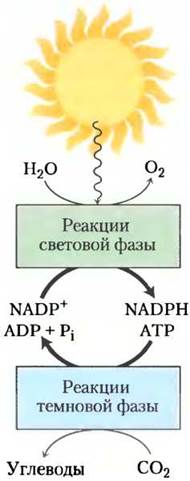
Plant photosynthesis takes place in two stages: the first comprises the light reactions, which occur only when the plant is illuminated, and the second comprises the carbon assimilation (fixation) reactions, sometimes inappropriately referred to as dark reactions, which are regulated by products formed during the light reactions (Fig. 19-44). In the light reactions, light energy is absorbed by chlorophyll and other pigments in photosynthetic Cells and stored in chemical form as two high-energy products—ATP and NADPH—with the simultaneous release of oxygen. In the carbon fixation reactions, which do not require light, the ATP and NADPH generated in the light reactions are used to reduce carbon dioxide to triose phosphates, starch, and other organic products. This chapter focuses exclusively on the light reactions that yield ATP and NADPH. The carbon fixation reactions, i.e., the reduction of CO2, are discussed in Chapter 20.
Class="center">Fig. 19-44. Solar energy drives The formation of the high-energy compounds NADPH and ATP. NADPH and ATP are subsequently utilized in carbon fixation reactions to reduce CO2 to trioses and more complex Monosaccharides, such as glucose and other triose derivatives.
Plant Photosynthesis Takes Place in METABOLISM/14.html">Chloroplasts
In eukaryotic photosynthetic cells, both the light reactions and the carbon fixation reactions take place in chloroplasts (Fig. 19-45). Chloroplasts are intracellular Organelles of highly diverse shapes, measuring up to several micrometers in diameter. Like Cell/35.html">Mitochondria, chloroplasts are bounded by a double membrane. The outer membrane is permeable to small molecules and ions, whereas the inner membrane system encloses the internal compartment of the chloroplast. This compartment contains numerous flattened membrane sacs, or vesicles, frequently interconnected, known as thylakoids, which are typically stacked into structures called grana (Fig. 19-45, b). The thylakoid membranes (lamellae) harbor all the Photosynthetic Pigments of the chloroplast and all the Enzymes required for the light reactions and ATP synthesis. Most of the enzymes involved in carbon fixation are located in the fluid that fills the internal chloroplast compartment surrounding the thylakoids, a matrix known as the stroma.
Fig. 19-45. Chloroplast: (a) schematic diagram of Structure, (b) high-magnification electron micrograph showing grana composed of stacked thylakoid membranes.

Light Induces Electron Flow in Chloroplasts
How is absorbed light energy converted into chemical energy? A key breakthrough toward answering this question was made by Robert Hill in 1937. He discovered that when a non-biological electron acceptor is added to leaf extracts containing chloroplasts and these preparations are illuminated, they evolve oxygen while simultaneously reducing the electron acceptor—a process known as the Hill reaction:

where A represents an artificial (non-biological) electron acceptor called the Hill oxidant (or Hill reagent). Among the non-biological electron acceptors used by Hill was the dye 2,6-dichlorophenolindophenol, whose oxidized form (A) is blue, whereas its reduced form (AH2) is colorless. Upon illumination of extracts containing this dye, the solution became decolorized and oxygen was released; in the dark, neither oxygen evolution nor dye reduction occurred.

This observation provided the first evidence that light energy drives The transfer of electrons from H2O to an acceptor molecule. Hill also found that carbon dioxide was not required for this reaction and that under these conditions, CO2 was not reduced to any stable form. From this, Hill concluded that the processes of oxygen evolution and carbon dioxide reduction could be uncoupled. Subsequent efforts focused on identifying the natural, biologically active analog of the Hill reagent—that is, the electron acceptor present in chloroplasts that picks up the hydrogen atoms split off from water by light. Several years later, Severo Ochoa demonstrated that NADP+ serves as this natural biological electron acceptor in chloroplasts. The reaction is described by the equation

A detailed understanding of The Mechanism of photosynthesis requires knowledge of the molecular STRUCTURE OF THE participating compounds.
Summary of Section 19.6 Selection/11.html">General features of Photophosphorylation
■ The light reactions of photosynthesis occur only when the plant is illuminated; the absorbed light energy establishes an electron flow directed from H2O, via membrane-embedded carriers, to NADP+, which is thereby reduced to NADPH. ATP is generated as a second product of the reaction.
■ In Photosynthetic Carbon Fixation reactions, the high-energy molecules NADPH and ATP are utilized to reduce CO2.
Last update: 06/08/2026
Editorial and Educational Adaptation: This material has been compiled based on the primary/original source text. The project team performed an editorial review, corrected technical inaccuracies, structured sections, and adapted the content for an educational format.
What was processed:
- elimination of formatting defects (OCR errors, structural breaks, corrupted characters);
- editorial organization of content;
- standardization of terminology in accordance with academic sources;
- verification of factual statements against the original source text.
All mentions of the author, publication year, and origin of the primary text have been preserved in accordance with the source.