Principles of Biochemistry Volume 2 - A. Lehninger 1985
Bioenergetics and Metabolism
Photosynthesis
Plant photosynthesis takes place in chloroplasts
In eukaryotic photosynthetic Cells, both light and dark reactions take place within METABOLISM/14.html">Chloroplasts, which can be regarded as the primary “power plants” of such cells. It should be noted, however, that green leaf Cells also contain Cell/35.html">Mitochondria (Section 2.8). At night, when cells receive no solar energy, mitochondria generate the necessary ATP by utilizing oxygen to oxidize CARBOHYDRATES produced in the chloroplasts during daylight hours.
Chloroplasts vary widely in shape across different plant species, but as a rule, they are significantly larger than mitochondria (Fig. 23-6). Externally, chloroplasts are bounded by a continuous and fairly fragile outer membrane. The internal membrane system encloses the inner compartment of the chloroplast. It contains numerous flattened membrane sacs, or vesicles, often connected to the inner membrane. These are the so-called thylakoids, which are typically stacked into structures known grana (Fig. 23-6). The thylakoid membranes harbor all of the chloroplast's Photosynthetic Pigments along with all the Enzymes required for the primary light reactions. Most of the enzymes involved in the dark reactions, where CO2 is reduced to glucose, reside in the fluid that fills the inner compartment of the chloroplast and surrounds the thylakoids; this fluid is called the stroma. In many species, dark reactions also take place in The Cell Cytosol. Chloroplasts can be readily isolated from extracts of ground spinach leaves by differential centrifugation (Section 13.16).
Class="center">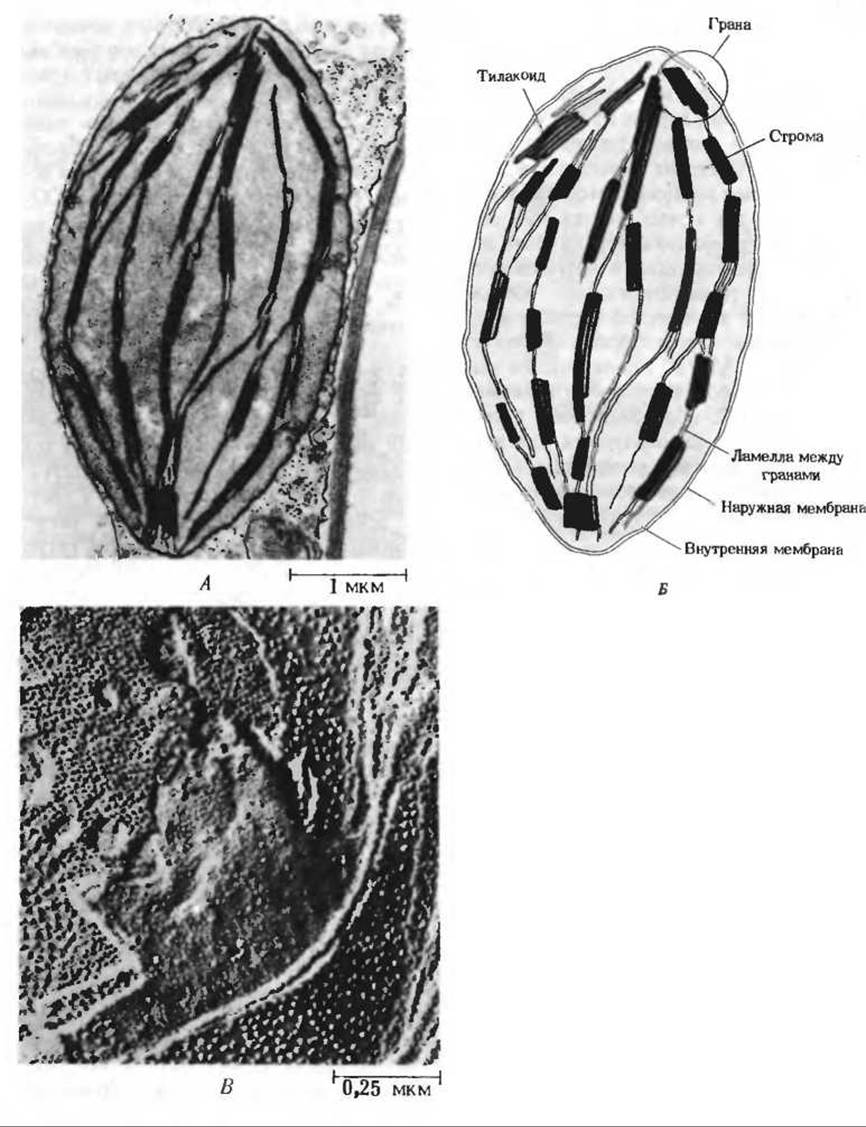
Fig. 23-6. A. Electron micrograph of a chloroplast from a spinach leaf. B. Schematic representation of its Structure. C. Electron micrograph of the inner surface of a thylakoid membrane (prepared by freeze-fracture). The pyramidal particles are believed to be molecules of enzymes involved in Photosynthesis.
Last update: 06/08/2026
Editorial and Educational Adaptation: This material has been compiled based on the primary/original source text. The project team performed an editorial review, corrected technical inaccuracies, structured sections, and adapted the content for an educational format.
What was processed:
- elimination of formatting defects (OCR errors, structural breaks, corrupted characters);
- editorial organization of content;
- standardization of terminology in accordance with academic sources;
- verification of factual statements against the original source text.
All mentions of the author, publication year, and origin of the primary text have been preserved in accordance with the source.