Biochemical Engineering Fundamentals, Part 1 - Bailey J., Ollis D. 1989
Applications of Enzyme-Catalyzed Reactions
Kinetics of Reactions Catalyzed by Immobilized Enzymes
Effect of External Mass Transfer Resistance
To help the reader grasp some of the Basic Concepts and specific terminology more easily, we will start with the simplest case. Let us assume that the enzyme is immobilized only on the outer surfaces of a flat, plate-like support. In this scenario, we only need to consider mass transfer from the solution to the support surface and the reaction occurring on that support.
One of the traditional models—referred to by biochemists as the Nernst diffusion layer, and by chemical engineers as a stagnant film or boundary layer—leads to the following expression for the substrate flux (expressed in moles per unit time per unit surface area) from the liquid phase (sometimes called the pool by biochemists) to the phase interface:
Class="center">Ns = ks(s0 - s) (4.2)
Here, s and s0 are the substrate concentrations at the phase interface and in the bulk liquid phase, respectively, and ks is the mass transfer coefficient. The latter depends on the Physical Properties of the medium as well as the hydrodynamic conditions near the phase interface, and it can be determined using established correlations discussed in Chapter 8. In particular, ks increases with a higher flow rate through a packed-bed Reactor containing an immobilized enzyme.
Under steady-state conditions, the substrate cannot accumulate on the catalyst surface; therefore, The rate of substrate delivery via mass transfer must equal the rate of its consumption in the surface reaction. Assuming that the rate of the enzymatic reaction On the surface (expressed in moles per unit time per unit surface area) follows the Michaelis–Menten Equation, we obtain

The number of parameters required to describe the system (ks, s0, vmax, and Km) can be reduced to two (Da and β) by introducing the following dimensionless variables:

Taking these parameters into account, the substrate mass balance equation takes the form

where 0 ≤ x ≤ 1.0.
At this point, It is important to emphasize the physical meaning of the Damköhler number, Da:

Thus, if Da is much less than one, the maximum mass transfer rate significantly exceeds the maximum reaction rate (low mass transfer resistance). Conversely, if the mass transfer resistance is high, this factor limits the rate of the entire process, and Da assumes values much greater than one. These regimes are known as the reaction-limited and diffusion-limited regimes, respectively.
By algebraically manipulating equation (4.5), one can easily derive a quadratic equation that allows x to be determined analytically:

where

In equation (4.7), the plus and minus signs are used for ß > 0 and ß < 0, respectively. If ß = 0, then  Using this expression for s/s0, we can evaluate the dimensionless observed reaction rate
  using either the right- or left-hand side of equation (4.7). It should be kept in mind that, in the general case, the dependence of
  on s0 is not given by the Michaelis–Menten equation. Furthermore, Km can no longer be considered equal to S1/2 when
  is exactly half of the observed maximum reaction rate
 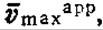 because the value of s1/2 depends on Da.
Nevertheless, the parameter s1/2 is often referred to as the apparent Michaelis constant (Kmapp) and is used to estimate The Effect of mass transfer. If the researcher's sole objective is to determine s1/2, such a simplification can be convenient, but in general, it may lead to serious errors. For example, one might conclude that the observed reaction rate is described by the following incorrect equation:

In a specific case, this equation may even satisfactorily describe the observed process kinetics, but overall it is incorrect because it fails to account for the dependence of Kmapp on The properties of the liquid medium and the hydrodynamics of the boundary layer. As experimental data show, this dependence can drastically alter the process kinetics (Fig. 4.17).
In chemical engineering, the effect of mass transfer on the overall reaction rate is traditionally expressed through the effectiveness factor η, whose physical meaning is defined as follows:

Consequently, in our case

Therefore, η ≤ 1, and thus, in general, an increase in mass transfer resistance will be accompanied by a decrease in the observed catalyst activity. Fig. 4.18 presents experimental results confirming this relationship.
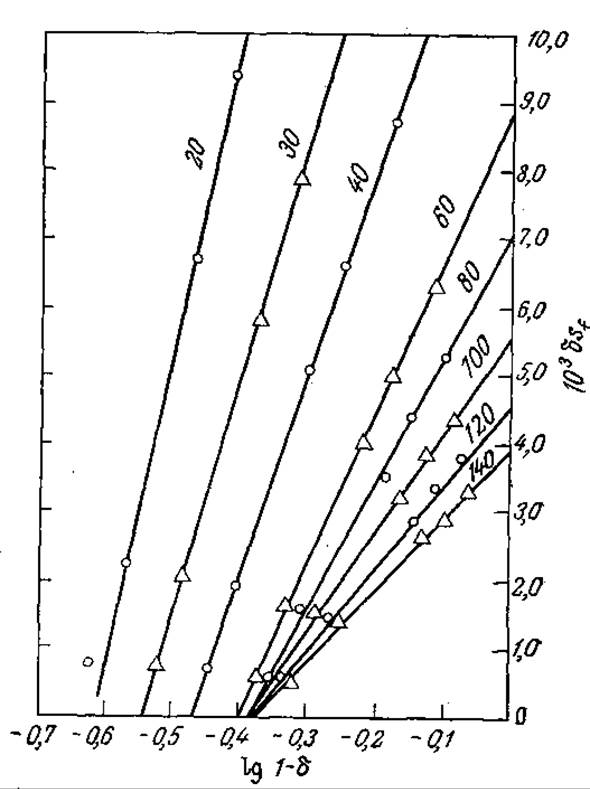
FIG. 4.17. Experimental demonstration of the relationship between the substrate transformation rate δ [δ = (sf - se)/sf, where sf and se are the substrate concentrations in the feed mixture and in the reaction products, respectively] and the flow rate [indicated by numbers on the curves (mL/h)] in an immobilized enzyme packed-bed reactor (the Hydrolysis of benzoyl-L-Arginine ethyl ester by ficin supported on carboxymethylcellulose was studied). If the process kinetics obeyed the Michaelis–Menten equation, then for ideal plug flow, the slope of all curves would be identical and equal to Km. The change in slope with varying flow rate indicates a significant effect of mass transfer on the overall process kinetics. [Reprinted with permission from: Lilly М. D., Hornby W. Е., Crook Е. М., The kinetics of Carboxymethylcellulose — Ficin in Packed Beds, Biochem. J., 100, 718 (1966).]
If the parameter Da is close to zero (a reaction that is very slow compared to the maximum mass transfer rate), then, according to equation (4.5), x approaches unity, and consequently, for the reaction-limited regime (Da→0)

In this case, the process kinetics does not differ from the true, intrinsic kinetics of the liquid–solid phase boundary reaction. Whenever a new catalyst containing an immobilized enzyme on its surface is prepared, it is always essential to evaluate experimentally how the immobilization Procedure has affected the catalytic Properties of the enzyme. The Determination of the vmax and Km parameters required for this purpose must be carried out under conditions where Da ≤ 1; only then will masking diffusion effects be eliminated.
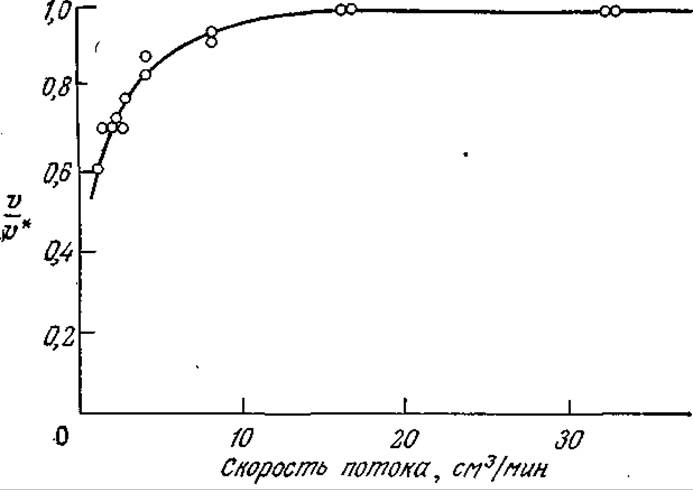
FIG. 4.18. Experimental method for detecting external diffusion effects; here v* is the reaction rate at high flow rates through the packed Column (the hydrolysis of a 4∙10-4 M solution of N-benzyl-DL-arginine n-nitroanilide by immobilized Trypsin at pH 8 and 25 °C was studied). [Reprinted with permission from: Ford J. R. et al., Recirculation Reactor System for Kinetic Studies of Immobilized Enzymes, in Enzyme Engineering, Wingard L. B., Jr. (ed.), Wiley-Interscience, New York, 1972.]
Information on the intrinsic kinetics of an enzymatic reaction is also essential when developing and designing reactors with immobilized enzymes, since this is the only way to reliably account for the Influence of the liquid medium properties, the geometry of the enzyme support, and the mixing characteristics. Many types of experimental reactors have been developed to study conventional heterogeneous catalysis reactions in the reaction-limited regime. Some of these reactors have also been used to investigate the Kinetics of Reactions Catalyzed by immobilized enzymes (Fig. 4.19). To minimize mass transfer resistance, high flow rates (large ks, small Da) were established near the catalyst in all these reactors. Regarding immobilized enzymes, this approach has several drawbacks. First, as we mentioned in Section 3.7.3, hydrodynamic stress can cause partial or even complete Denaturation of the support-bound enzymes. Second, the mechanical motion of catalyst particles against one another can lead to enzyme loss through attrition.
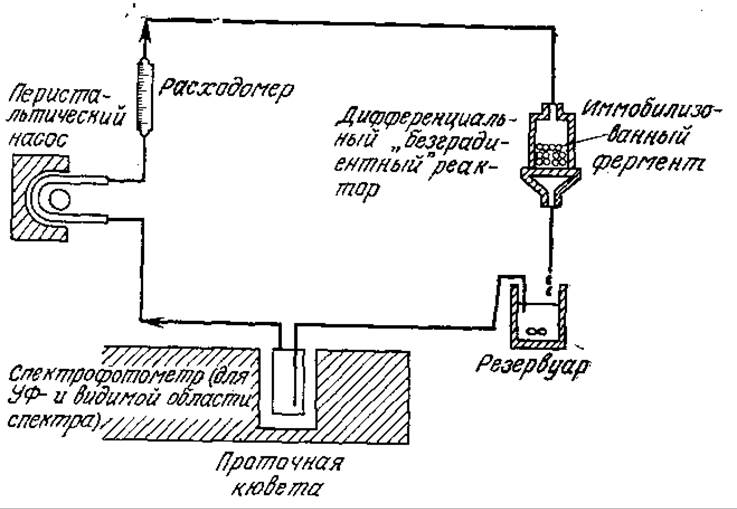
FIG. 4.19. Recirculation reactor for studying the EFFECT OF EXTERnal mass transfer on the kinetics of reactions catalyzed by immobilized enzymes.
In systems where the process rate depends on both the chemical reaction and mass transfer, the diffusion-limited regime occurs when vmax is significantly greater than kss0, i.e., at Da ≫ 1. For the diffusion-limited regime (Da → ∞, η is bounded), through a series of transformations of equation (4.7), including binomial expansion of the square ROOT, the following expressions can be obtained:

Thus, at very large values of Da, the reaction is first-order with respect to the total Substrate Concentration, and its rate v is completely independent of the intrinsic catalyst parameters vmax and Km. In this situation, the intrinsic kinetic parameters of the immobilized enzymes do not manifest themselves at all. In the diffusion-limited regime, for example, at a given s0, the observed activity remains constant even if the enzymes at the phase boundary actually lose activity, specifically due to unfavorable changes in Temperature, pH, or other process conditions. Therefore, studies on the denaturation rate of an immobilized enzyme should only be conducted under conditions as close as possible to the reaction-limited regime.
Last update: 06/08/2026
Editorial and Educational Adaptation: This material has been compiled based on the primary/original source text. The project team performed an editorial review, corrected technical inaccuracies, structured sections, and adapted the content for an educational format.
What was processed:
- elimination of formatting defects (OCR errors, structural breaks, corrupted characters);
- editorial organization of content;
- standardization of terminology in accordance with academic sources;
- verification of factual statements against the original source text.
All mentions of the author, publication year, and origin of the primary text have been preserved in accordance with the source.