Fundamentals of Biochemical Engineering, Part 1 - Bailey J., Ollis D. 1989
Application of enzyme-catalyzed reactions
Kinetics of reactions catalyzed by immobilized enzymes
Modeling of diffusion and reactions within a catalyst particle
As we have noted several times above, Enzymes are usually immobilized either by binding them to the internal surfaces of porous Supports or by entrapping them within matrices through which the substrate can diffuse. In such systems, calculating the observed rate of substrate conversion requires knowing the profile of its concentration change within the catalyst particle. In turn, determining this profile first requires establishing the steady-state material balance equation for a thin shell of permeable catalyst. Let us assume that the enzyme is immobilized within a pellet of spherical geometry. The required thin shell will then be enclosed between two concentric spheres of radii r and r+dr, respectively (Fig. 4.20). The thickness of this shell is so small that all conditions within it can be considered uniform, regardless of position.
The symbols Des and v denote the effective diffusion coefficient of the substrate and its local transformation rate, respectively. Both of these parameters differ fundamentally from their counterparts in solution processes, and there is also a significant quantitative difference between them. Let us first consider the effective diffusion coefficient, keeping in mind that the diffusion rate of any substance through a support depends on the following factors:
1. A portion of the catalyst particle's cross-section is occupied by the solid support matrix and is therefore unavailable for the diffusional transport of substrates (represented by the particle porosity parameter εр).
2. The pore network is intricately tortuous, meaning that diffusion can only occur along permitted, constantly shifting pathways (represented by the tortuosity factor τ).
3. The pores may have a very small diameter, comparable to the dimensions of the substrate molecules (restricted diffusion; represented by the parameter Kp/Kr).
Class="center">
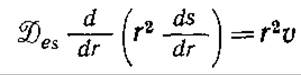
The steady-state material balance equation for a thin shell bounded by radii r and r+dr can be written as follows:

Assuming that the effective diffusion coefficient of the substrate Des is constant, dividing by 4πdr yields

In the limit as dr→0
or

FIG. 4.20. Derivation of the steady-state equation for a spherical permeable pellet of immobilized enzyme using the thin-shell concept.
We can now express the effective diffusion coefficient in terms of these parameters:

Here, Ds0 is the diffusion coefficient of the substrate in the liquid reaction medium. The porosity parameter εр must be determined experimentally for each specific support. Tortuosity factors typically range from 1.4 to 7. As for restricted diffusion, the corresponding parameter Kp/Kr can be estimated in a first approximation using the following equation:

where rs and rр are the (equivalent) radius of the substrate molecules and the characteristic pore radius, respectively. Due to the uncertainty of all parameters on the right-hand side of equation (4.14), obtaining a reliable value for Des through calculation alone is extremely difficult. Therefore, it is preferable to estimate Des from experimental studies of the overall process kinetics. We will discuss this method later, following our Analysis of the interplay between diffusion and chemical processes within the immobilized enzyme particle.
It should also be noted that mass transfer within the particle may depend on the Chemical Nature of its internal surfaces and the presence of ionized groups. Furthermore, if ionized compounds participate in or are generated by the reaction, electrical potential gradients can develop inside the catalyst particle, which in turn will alter the transport rates of charged species. Methods for analyzing and accounting for these factors can be found in the literature cited at the end of the chapter.
Assuming that the intrinsic kinetics of the local enzymatic reaction involving the immobilized enzyme obey the Michaelis–Menten Equation:

then the maximum velocity parameter in this case can be defined as the product of the enzyme loading on the support eimm (micromoles of enzyme per gram of support), the specific activity of the immobilized enzyme qEimm (micromoles of substrate converted per second per micromole of enzyme), and the particle density ρр (grams of support per unit volume):

Recall that immobilization can alter the enzyme's Structure and/or its molecular microenvironment. Consequently, The values of gE,іmm and Km for an immobilized enzyme may differ from the corresponding values for the enzyme in solution. As we noted in Section 4.4.1, it is preferable to study intrinsic enzyme kinetics under conditions where mass transfer effects contribute minimally to the overall system kinetics. We will derive the criterion for such reaction-limited conditions through the analysis presented below.
The steady-state substrate mass-balance equation, the derivation of which is shown in Fig. 4.20, is a standard second-order ordinary differential equation:

The model illustrated in the figure must be complemented by boundary conditions. The concentration profile within the catalyst particle is almost invariably symmetrical with respect to the center of the sphere; that is,

In this analysis, we assume that the Substrate Concentration at the outer surface of the pellet equals the substrate concentration s0 in the bulk liquid surrounding the pellet. (Cases involving simultaneous mass-transfer resistance in the boundary layer and within the particle will be examined in the next section.) Consequently,

The observed overall rate v0 of substrate utilization by the catalyst particle equals The rate of substrate diffusion into the pellet. Expressed in moles per unit volume of the pellet per unit time, v0 is given by

Here, Vp and Ap denote the particle volume and its external surface area, respectively. As in the previous section, we will express such rates in terms of a dimensionless parameter that characterizes METABOLISM/18.html">The Influence of diffusion effects. The effectiveness factor η is defined as

Unfortunately, if v varies nonlinearly in accordance with Equation (4.16), determining the effectiveness factor analytically is not straightforward. This requires numerically solving the boundary-value problem [Equations (4.18) through (4.20)] and subsequently using Equation (4.21) to find v0. Because these computations are rather complex and time-consuming, we will seek to present the results in the simplest yet sufficiently general form. To this end, we transform the equations above into equivalent dimensionless expressions.
Let us introduce the parameters  ; then Equation (4.18) can be rewritten in the following form:

Here, the dimensionless parameters ø and ß are defined as

The dimensionless boundary conditions corresponding to Equation (4.23) are

The physical Significance of the parameter ø, known as the Thiele modulus, is that the square of the Thiele modulus represents The ratio of the first-order reaction rate R3(vmax/Km)s0 to the diffusion rate RDess0. The saturation parameter ß serves as a measure of the deviation of local rates from first-order kinetics, with larger values of ß indicating that the reaction order approaches zero.
Let us express the effectiveness factor in terms of these dimensionless variables:

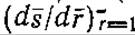
According to Equations (4.23) and (4.25),  is a function solely of
  , and therefore
  depends exclusively on β and ø. Taking Equation (4.26) into account, it follows that η depends only on the Thiele modulus and the saturation parameter:

When using expression (4.27) to estimate the effectiveness factor, a difficulty arises because the intrinsic kinetic parameters of the catalytic reaction, vmax and Km, are frequently unknown. However, simple manipulations show that the parameter vmax can be eliminated when determining η. Indeed, it follows from Equations (4.26) and (4.21) that

Substituting this expression into the right-hand side of equation (4.27)
leads to equation (4.28), which describes the implicit relationship between η, ß, and the new dimensionless observable modulus Ф, defined as follows:

(Note that Ф depends solely on the observed overall rate v0 and is independent of the intrinsic kinetic parameters of the catalytic reaction.) Solving this implicit equation allows η to be determined as a function of ß and the observable modulus Ф:
η = g(Ф, ß) (4.29)

FIG. 4.21. Effectiveness factors for immobilized enzyme catalysts with intrinsic kinetics obeying the Michaelis–Menten equation (ß=so/Km). The Definition of the dimensionless observable modulus Ф is given in equation (4.28).
Figure 4.21 shows the plots of η versus Ф given by equation (4.29) for ß → 0 and ß → ∞. Since the effectiveness factors for intermediate values of Km/s0 lie between the curves for these two limiting cases, it is readily seen that η is relatively insensitive to the latter intrinsic parameter, Km/s0.
Before proceeding to analytical solutions based on approximate kinetic evaluations, we need to derive an expression for η applicable at large values of Ф (or ø) for kinetics governed by the Michaelis–Menten equation. When the modulus Ф is sufficiently large (Ф ≥ 3; see Table 4.15), the substrate is consumed by the enzyme much faster than it diffuses into the catalyst pellet. Under such conditions, where the overall rate is controlled by mass transfer (diffusion), it can be assumed that all substrate conversion occurs within a thin shell at the outer surface of the catalyst pellet; hence, the curvature term (2/r∙ds/dr) in equation (4.18) becomes negligible. It follows that

Table 4.15. Criterion for assessing The Effect of mass transfer on overall process kinetics
Criterion |
Value η) |
Rate-controlling step |
Effect of mass transfer |
Ф < 0.3 |
~1 |
Chemical reaction |
Negligible |
Ф > 3 |
∞Ф-1 |
Diffusion |
Significant |
Substituting the right-hand side of equation (4.31) for d2s/dr2 into equation (4.30)

and then integrating with respect to s yields the following expression:

Here sc and s0 denote the substrate concentrations at the particle center (r = 0) and at its surface (r = R), respectively.
For a diffusion-limited reaction, sc ≈ 0, which allows the integral in equation (4.32) to be evaluated. Combining equations (4.21), (4.22), and (4.32) leads to the following expression for the effectiveness factor, valid for sufficiently large values of Ф or ø:
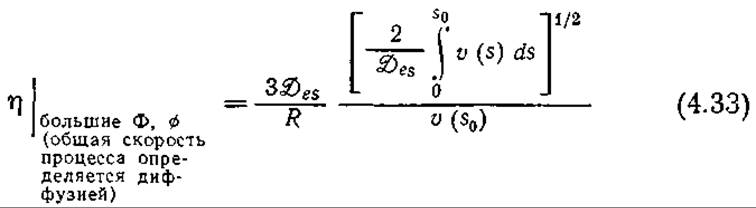
Adapting this equation for the special case of Michaelis–Menten kinetics (4.16) gives

Continuing our analysis of Michaelis–Menten kinetics, note that if first-order kinetics is assumed (which holds true when s ≪ Km), then, According to the data presented in Fig. 4.21,
v = ks (4.35)
where k = vmax/Km, and η assumes a conservative (low) estimate that is quite close to the true value. Using the linear relationship (4.35), we can analytically solve the diffusion-limited model equations, yielding

В этом выражении модуль Тила Ф равен

Equation (4.37) can be used to obtain the first-order response curve shown in Fig. 4.21, provided that the following relationship, valid for such a situation, is applied:

Another limiting case of Michaelis-Menten kinetics is typical for reactions where the order approaches zero (s ≫ Km); this situation can be defined as follows (k0 = vmax):

The joint solution of the boundary value problem [equations (4.18)–(4.20)] and the enzyme utilization function shows that the substrate concentration s depends on the radius r as follows:

This expression holds for all non-negative values of s, i.e., in the range from r = R to a certain critical radius r = Rc determined by solving equation (4.18) together with equation (4.20) subject to the following boundary conditions:

This solution leads to a cubic equation for Rc:

Thus, if equation (4.42) has a positive ROOT (Rc/R) of less than unity, a region exists within the catalyst pellet (from r = 0 to r = Rc) where s = 0 and y = 0. In such cases, the reaction takes place only in the outer shell of the particle (Rc < r ≤ R), so that

If equation (4.42) has no physically meaningful solution, then η = 1 and the rate of substrate transformation is uniform throughout the entire volume of the catalyst pellet.
Another important consequence of the relationships shown in Fig. 4.21 is the minor influence of catalyst particle geometry on the interdependence of η and ø. For instance, the effectiveness factor for a first-order reaction in a flat plate is given by

Here, Φ is defined by equation (4.37) with Vp/Ap equal to half the plate thickness. Over the entire range of Φ values, this function differs by no more than 10% from the function in equation (4.36). The greatest deviations occur when ø is close to unity; as ø increases or decreases, this difference rapidly diminishes. The negligible effect of catalyst particle geometry on the function η = f(ø) often allows The Use of the following empirical correlations for the effectiveness factor of an immobilized enzyme plate with intrinsic kinetics described by the Michaelis–Menten equation:

Here, ηd is the asymptotic value of the effectiveness factor determined by equation (4.34). These correlations, originally developed for flat-plate catalysts, can also be applied to other symmetrical particle geometries by using the ratio of particle volume to its external surface area as the characteristic length parameter in the Thiele modulus formulation.
The low sensitivity of the η function to changes in reaction order and catalyst particle geometry served as the basis for a convenient general criterion to distinguish between reaction-limited and diffusion-limited processes. This criterion (Table 4.15) reduces to a single parameter Φ, which, as we know, depends only on observable variables. This criterion is discussed in detail in [21].
In non-biological catalysis, the parameter η is generally regarded as a measure of catalyst utilization efficiency. If η differs significantly from unity, the overall process rate can be enhanced by reducing the catalyst particle size; this decreases Φ and, consequently, increases η. Such an approach can also prove useful in biological catalysis; in any case, it highlights the relationship between the particle size of the immobilized enzyme and the maximum process efficiency.
Direct investigation of intrinsic kinetics is likewise feasible only when the effectiveness factor is close to unity. Using a catalyst with sufficiently small particles (see Exercise 4.5), one can experimentally determine the kinetic behavior of the immobilized enzyme-catalyzed reaction and find the values of the corresponding kinetic parameters. This information is required to calculate the observed overall reaction kinetics for larger catalyst particles. Since effective substrate diffusion coefficients and/or total substrate concentrations are typically small In aqueous solutions, the diffusion-limited regime is generally caused by relatively large catalyst particle sizes, which may be necessary either to reduce pressure drop and flow resistance in fixed-bed reactors or to prevent catalyst particle breakdown in fluidized-bed and slurry reactors. Sometimes the reaction-limited regime is difficult to reproduce even under laboratory conditions. In such cases, data on the intrinsic kinetic parameters of the immobilized enzyme must be obtained via the analytical approach described above, based on experimental data complicated by diffusion effects. As demonstrated below with a specific example, experimental studies of immobilized enzyme kinetics also allow for the estimation of the effective substrate diffusion coefficient.
Example 4.3. Determination of the effective substrate diffusion coefficient and intrinsic kinetic parameters for an immobilized enzyme catalyst. As a starting point, let us assume that the intrinsic kinetics of the catalytic reaction follows the Michaelis–Menten equation. The characteristic intrinsic kinetic parameters of the catalyst, vmax and Km, as well as the effective substrate diffusion coefficient Des, can be determined from the results of two series of kinetic experiments: one using a catalyst with relatively large particles (yielding large values of ø and, consequently, diffusion-limited conditions), and the other using a catalyst with much smaller particles (small enough for the rate of substrate transformation to be reaction-rate-determined). In each series of experiments, it is necessary to determine the values of v0 corresponding to various s0, and then plot these relationships in Eadie–Hofstee coordinates (v0/s0 versus v0; see Section 3.2.2). At sufficiently large values of s0, the reaction is zero-order throughout the entire volume of the catalyst particles and, therefore, the effectiveness factor equals unity, while the curves for large and small catalyst particles coincide [this indicates that for the large-particle catalyst, condition (4.42) is not met and that finite substrate solubility does not limit experiments in the s0 ≫ Km range]. Thus, regardless of particle size, the curves will intercept the abscissa at a value equal to vmax.
On the other hand, if the external substrate concentration and the overall reaction rate are low, the intrinsic order of the catalytic reactions will approach unity. Then, for small particles (reaction-limited regime), v0/s0 equals vmax/Km, whereas for large immobilized enzyme particles, i.e., for the diffusion-limited regime:

Consequently, the plot of v0/s0 versus v0 will intercept the ordinate at a value equal to Vmax/Km in the case of small particles, and at a value defined by equation (4P3.1) for large particles. Thus, knowing the size of large catalyst particles and the intercepts made on the coordinate axes by the v0/s0 versus v0 curves, one can determine vmax, Km, and Des.
Fig. 4P3.1 shows the results of applying the described Procedure to $\alpha$-Chymotrypsin immobilized on Cyanogen bromide-activated Sepharose 4B. The specific activity of the immobilized enzyme $q_e$ ($q_E$ being the ratio of $v_{\text{max}}$ to the number of moles of immobilized active enzyme per unit volume of the catalyst) and $K_m$ determined in this way are 213 $\mu$mol of substrate (ATEE, $N$-acetyl-L-Tyrosine ethyl ester) per 1 $\mu$mol of active enzyme per second and 2.6 mM, respectively. These values differ significantly from the corresponding parameters of the same enzyme in solution, which are 311 $\mu$mol of ATEE per 1 $\mu$mol of active enzyme per second (specific activity) and 0.73 mM ($K_m$); it follows that immobilization noticeably alters the catalytic Properties of the enzyme. An estimation of the effective diffusion coefficient of ATEE in this catalyst yields a value of $3.8\cdot 10^{-6}$ cm$^2$/s. Such a small value of $D_es$ and the rather high activity of the immobilized enzyme suggest significant diffusion limitations even for a catalyst with a particle radius of 60 $\mu$m. The determination of the Thiele modulus $\Phi$ of this catalyst gives a value of 2.6.
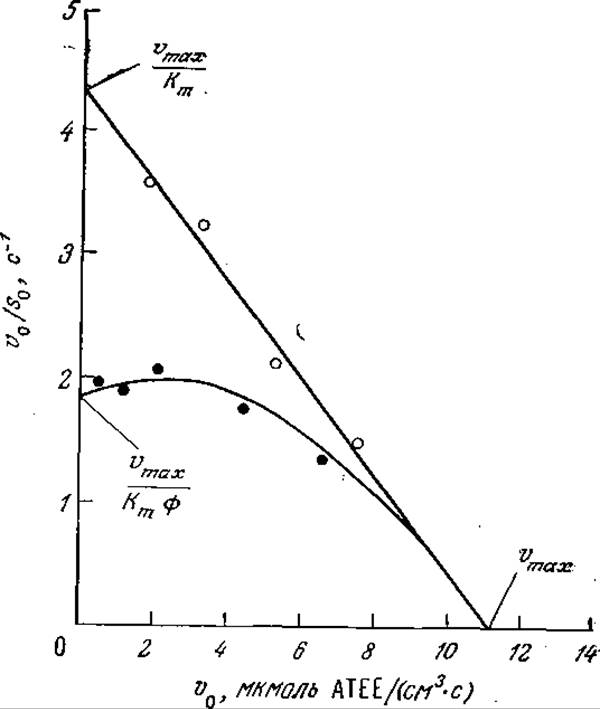
FIG. 4P3.1. Dependence of S0/v0 on v0 for $\alpha$-chymotrypsin immobilized on large (R = 60 µm; ○) and small (R = 10 µm; ●) particles of BrCN-activated Sepharose 4B. [Experimental data adapted from: Clark D. S., Bailey J. E., Structure-Function Relationships in Immobilized Chymotrypsin Catalysis, Biotech. Bioeng., 25, 1027 (1983).]
When developing catalysts based on extremely expensive and highly active supported metals, the common goal is to localize the actual catalyst within a thin outer shell of the support particles. Obviously, the same approach is applicable when designing catalysts based on immobilized enzymes: by using the maximum allowable particle size of the support for a given process, one can minimize the required amount of enzyme. Several methods are fundamentally suitable for preparing such catalysts. It has been recently demonstrated that in catalysts prepared by impregnating a porous support with an enzyme solution, the distribution of the biocatalyst within the support particle can be highly non-uniform. As we will see in Exercise 4.10, this non-uniform enzyme distribution affects both the apparent activity and the inactivation behavior of the immobilized enzyme catalyst.
Before addressing the issue of Simultaneous mass transfer resistance in the solution and within the catalyst particles, it should be emphasized that, much like enzymatic reactions in free solution, The kinetics of a reaction catalyzed by an immobilized enzyme may differ from the irreversible single-substrate conversion described by the Michaelis–Menten equation. A comprehensive analysis of the kinetics of other reaction types involving immobilized Enzymes can be found in the literature cited at the end of the chapter; here, we shall limit ourselves to a few General Remarks. First of all, It is worth noting that for a reversible reaction, the minimum substrate concentration inside the catalyst particle equals its equilibrium concentration. Consequently, when calculating the asymptotic effectiveness factor using, for example, equation (4.33), the lower limit of integration must be set to the equilibrium value. Interestingly, due to differing diffusion coefficients of various species, the stoichiometric ratios inside the catalyst particle may deviate from the Stoichiometry of the same process in solution. This phenomenon is examined in greater detail in Exercise 4.8.
We conclude our study of systems where the process rate is governed by both diffusion and reaction with a brief analysis of a fascinating scenario: when the substrate acts as an inhibitor of its own immobilized enzyme-catalyzed reaction. If the bulk substrate concentration s0 exceeds the concentration corresponding to the maximum reaction rate (see Section 3.4.1), the decrease in substrate concentration within the catalyst particle will lead to an increase in the local reaction rate to values exceeding the rate at the external surface of the particle. Under certain conditions, effectiveness factors greater than unity can be observed in this situation. Such behavior, paradoxical at first glance but actually quite straightforward to explain, is possible for any autocatalytic reaction—that is, a system in which the reaction rate increases with time.
Last update: 06/08/2026
Editorial and Educational Adaptation: This material has been compiled based on the primary/original source text. The project team performed an editorial review, corrected technical inaccuracies, structured sections, and adapted the content for an educational format.
What was processed:
- elimination of formatting defects (OCR errors, structural breaks, corrupted characters);
- editorial organization of content;
- standardization of terminology in accordance with academic sources;
- verification of factual statements against the original source text.
All mentions of the author, publication year, and origin of the primary text have been preserved in accordance with the source.