Biological Chemistry - Berezov T. T., Korovkin B. F. 1998
Blood
Chemical Composition of Blood
Non-protein Nitrogenous Components of Blood
The non-protein nitrogen content in whole Blood and plasma is nearly identical, ranging from 15 to 25 mmol/L. Blood non-protein nitrogen comprises the nitrogen of urea (50% of total non-protein nitrogen), Amino Acids (25%), ergothioneine* (8%), uric acid (4%), creatine (5%), creatinine (2.5%), ammonia and indican (0.5%), and other nitrogen-containing non-protein substances (Polypeptides, NUCLEOTIDES, nucleosides, Glutathione, bilirubin, Choline, histamine, etc.). Thus, non-protein nitrogen consists primarily of the nitrogen from End products of simple and complex Protein METABOLISM.
Blood non-protein nitrogen is also referred to as residual nitrogen, i.e., the nitrogen remaining in the filtrate after protein precipitation. In healthy individuals, fluctuations in blood non-protein (residual) nitrogen levels are minimal and primarily depend on Dietary Protein Intake. Under various pathological conditions, blood non-protein nitrogen levels increase—a state known as azotemia. Depending on the underlying causes, azotemia is classified into retention and production types. Retention azotemia develops As a result of inadequate urinary excretion of nitrogenous waste products while their entry into the bloodstream remains normal. This type can, in turn, be renal or extrarenal.
* Ergothioneine is betaine-2-mercaptohistidine, a compound found in erythrocytes and also detected in The Liver and urine.
In renal retention azotemia, the concentration of residual nitrogen in the blood increases due to impaired Excretory Function of the Kidneys. A sharp rise in residual nitrogen occurs mainly at the expense of urea. In such cases, urea nitrogen accounts for 90% of blood non-protein nitrogen, compared to 50% under normal conditions. Extrarenal retention azotemia may arise from severe circulatory failure, a drop in blood pressure, and decreased renal blood flow. Frequently, extrarenal retention azotemia results from an obstruction to urine outflow after its formation in the Kidney.
Production azotemia develops due to the excessive entry of nitrogenous products into the bloodstream as a consequence of accelerated tissue protein breakdown during extensive inflammation, trauma, Burns, cachexia, etc. Mixed-type azotemias are also frequently observed.
As noted, quantitatively, the principal end product of protein Metabolism in the Body is urea. It is generally accepted that urea is 18 times less toxic than other nitrogenous substances. In ACUTE RENAL FAILURE, blood urea concentration reaches 50–83 mmol/L (normal range 3.3–6.6 mmol/L). An elevation of blood urea up to 16–20 mmol/L (calculated as urea nitrogen)* indicates moderately impaired renal function, up to 35 mmol/L signifies severe impairment, and above 50 mmol/L represents very severe impairment with an unfavorable prognosis. Sometimes, The ratio of blood urea nitrogen to blood residual nitrogen is determined (as a percentage):
Class="center">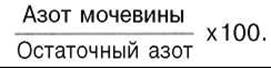
Normally, this ratio is below 48%. In renal failure, it increases and can reach up to 90%, whereas in impaired urea-synthesizing liver function, it decreases (below 45%).
Uric acid is another important non-protein nitrogenous substance found in the blood. Recall that in humans, uric acid is the end product of purine base metabolism. Normally, the concentration of uric acid in whole blood is 0.18–0.24 mmol/L (in blood serum—approximately 0.29 mmol/L). An elevated blood uric acid level (hyperuricemia) is the primary symptom of Gout. In gout, serum uric acid levels rise to 0.5–0.9 mmol/L or even 1.1 mmol/L.
Residual nitrogen also includes the nitrogen of Amino Acids and polypeptides. Blood constantly maintains a certain level of free amino acids. Some of these are of exogenous origin, meaning they enter the bloodstream from the digestive tract, while others are generated through The breakdown of tissue Proteins. Glutamic Acid and Glutamine account for nearly one-fifth of the amino acids present in plasma (Table 17.2). The concentration of free amino acids in serum and plasma is virtually identical, though it differs from their level in erythrocytes. Normally, the ratio of Amino Acid Nitrogen concentration in erythrocytes to that in plasma ranges from 1.52 to 1.82. This ratio is highly stable, deviating from normal only in certain pathological conditions.
* The nitrogen content of urea (2 atoms with a molar mass of 14) is 2.14 times less than that of urea itself (molar mass 60).
Table 17.2. Concentration of free amino acids in human Blood Plasma
Amino acid |
Concentration, µmol/L |
Amino acid |
Concentration, µmol/L |
360-630 |
144-363 |
||
92-172 |
20-34 |
||
Asparagine |
50-150 |
30-100 |
|
Aspartic acid |
2-30 |
50-200 |
|
Valine |
188-274 |
70-150 |
|
Glutamic acid |
54-175 |
160-176 |
|
Glutamine |
514-568 |
30-90 |
|
100-400 |
78-83 |
||
110-135 |
Phenylalanine |
85-115 |
|
Isoleucine |
122-153 |
Citrulline |
10-50 |
Leucine |
130-252 |
Cystine |
84-125 |
Determining total blood peptide levels is performed relatively rarely. It should be borne in mind that many blood Peptides function as biologically active compounds, making their measurement of significant clinical interest. Such compounds include kinins (see Chapter 8).
Last update: 06/08/2026
Editorial and Educational Adaptation: This material has been compiled based on the primary/original source text. The project team performed an editorial review, corrected technical inaccuracies, structured sections, and adapted the content for an educational format.
What was processed:
- elimination of formatting defects (OCR errors, structural breaks, corrupted characters);
- editorial organization of content;
- standardization of terminology in accordance with academic sources;
- verification of factual statements against the original source text.
All mentions of the author, publication year, and origin of the primary text have been preserved in accordance with the source.