Biological Chemistry - Berezov T. T., Korovkin B. F. 1998
Carbohydrate Metabolism
Glycogen Synthesis and Degradation
Glycogen Synthesis (Glycogenesis)
Glycogen is the primary form of carbohydrate storage in animals and humans. It accumulates mainly in the Liver (accounting for up to 6% of liver mass) and in skeletal Muscles, where its content rarely exceeds 1%. Due to the significantly greater mass of skeletal muscles, total glycogen stores in Muscle tissue exceed those in the liver. Glycogen is present in the Cytosol as granules ranging from 10 to 40 nm in diameter. Under Electron Cell/15.html">Microscopy, glycogen granules appear electron-dense. Studies have shown that these granules contain not only glycogen itself, but also Enzymes that catalyze Glycogen Synthesis and degradation. However, glycogen granules differ from multienzyme complexes (such as the Pyruvate dehydrogenase complex); the degree of structural Organization in glycogen granules is lower than that of multienzyme complexes. It should be emphasized that the Synthesis and Breakdown of glycogen in The Cell proceed via distinct metabolic pathways. Specifically, it was once believed that Glycogen phosphorylase (phosphorylase a) catalyzes both glycogen degradation and synthesis, because in vitro experiments demonstrated the reversibility of the glycogen phosphorylase reaction. However, it was later established that within the living cell (in vivo), phosphorylase a catalyzes glycogen breakdown exclusively, whereas glycogen synthesis is mediated by an entirely different enzyme. Both processes—glycogen synthesis and degradation—regulate Blood glucose levels and maintain a glucose reserve to support high-intensity muscular activity.
First, glucose undergoes phosphorylation facilitated by the enzyme hexokinase, and additionally by glucokinase in the liver. Subsequently, glucose-6-phosphate is converted into glucose-1-phosphate under the action of the enzyme phosphoglucomutase*:
Class="center">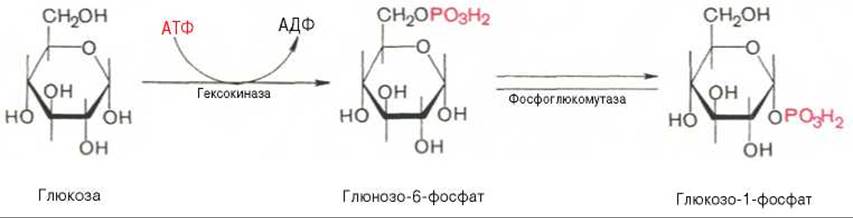
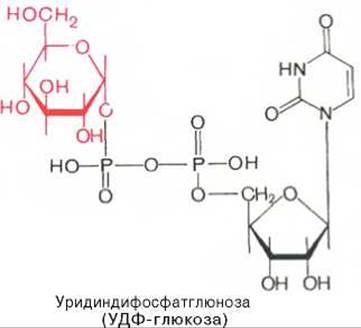
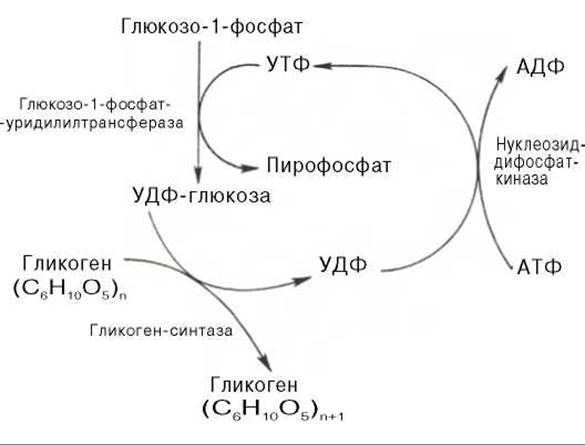
The resulting glucose-1-phosphate is directly channeled into glycogen synthesis. In The First stage of synthesis, glucose-1-phosphate reacts with UTP (uridine triphosphate) to form uridine diphosphate glucose (UDP-glucose) and pyrophosphate. This reaction is catalyzed by the enzyme glucose-1-phosphate uridylyltransferase (UDP-glucose pyrophosphorylase):
Глюкозо-1-фосфат + УТФ <=> УДФ-глюкоза + Пирофосфат.
Below is the structural formula of UDP-glucose:
* Glucose-1,6-bisphosphate serves as a cofactor in this reaction, generated via a reaction catalyzed by phosphoglucokinase: glucose-1-phosphate + ATP <=> glucose-1,6-bisphosphate + ADP.
The Second Stage—The formation of glycogen—involves The transfer of the glucose moiety from UDP-glucose to a glycogen glucoside chain (acting as a "primer"). This forms an a-(1—>4) glycosidic bond between carbon atom 1 of the incoming glucose residue and the 4-hydroxyl group of a chain glucose residue. This reaction is catalyzed by the enzyme glycogen synthase. It is crucial to reiterate that the reaction catalyzed by glycogen synthase only takes place if the polysaccharide chain already contains more than 4 D-glucose residues.

The resulting UDP is subsequently rephosphorylated to UTP at the expense of ATP, thereby restarting the entire cycle of glucose-1-phosphate transformations.
Overall, the Formation of the a-1,4-glucosidic branch (the "amylose" branch) of glycogen can be represented by the following scheme:
It has been established that Glycogen synthase is incapable of catalyzing the formation of the a-(1—>6) bonds found at glycogen branch points. This process is catalyzed by a specialized enzyme known as the branching enzyme, or amylo-(1—>4)—>(1—>6)-transglucosylase. The latter catalyzes the transfer of a terminal oligosaccharide fragment consisting of 6 or 7 glucose residues—taken from the non-reducing end of a side chain containing at least 11 residues—to the 6-hydroxyl group of a glucose residue in the same or another glycogen chain, thereby creating a new side chain.
Branching increases glycogen solubility. Furthermore, branching generates A large number of non-reducing terminal residues, which serve as the sites of action for glycogen phosphorylase and glycogen synthase.
Thus, branching accelerates both the synthesis and breakdown of glycogen.
The ability to store glycogen (primarily in The Liver and muscles, and to a lesser extent in other Organs and Tissues) establishes a normal physiological carbohydrate reserve. When Energy Expenditure increases due to Central Nervous system activation, glycogen degradation typically intensifies, leading to glucose production.
In addition to the direct transmission of nerve impulses to effector organs and tissues, CNS stimulation enhances The activity of several Endocrine glands (such as The adrenal medulla, Thyroid Gland, and Pituitary Gland), whose Hormones promote glycogen breakdown, primarily in the liver and muscles (see Chapter 8).
As noted, the effects of catecholamines are largely mediated by cAMP, which activates tissue protein Kinases. Protein kinases subsequently phosphorylate a range of Proteins, including Glycogen synthase and phosphorylase b—enzymes involved in Carbohydrate METABOLISM. Phosphorylated glycogen synthase exhibits low or complete lack of intrinsic activity, but is significantly activated by the positive modulator glucose-6-phosphate, which increases the enzyme's Vmax. This form of glycogen synthase is designated as the D-form, or dependent form, because its activity relies on glucose-6-phosphate. The dephosphorylated form of glycogen synthase, known as the I-form or independent form, remains active even in the absence of glucose-6-phosphate.
Thus, adrenaline exerts a dual effect on carbohydrate metabolism: it inhibits glycogen synthesis from UDP-glucose—since maximal activity of the D-form of glycogen synthase requires very high concentrations of glucose-6-phosphate—and it accelerates glycogen degradation by promoting the formation of active phosphorylase a. Overall, the net effect of adrenaline is to accelerate The conversion of glycogen into glucose.
Last update: 06/08/2026
Editorial and Educational Adaptation: This material has been compiled based on the primary/original source text. The project team performed an editorial review, corrected technical inaccuracies, structured sections, and adapted the content for an educational format.
What was processed:
- elimination of formatting defects (OCR errors, structural breaks, corrupted characters);
- editorial organization of content;
- standardization of terminology in accordance with academic sources;
- verification of factual statements against the original source text.
All mentions of the author, publication year, and origin of the primary text have been preserved in accordance with the source.