Biochemistry and Molecular Biology - Belyasova N.A. 2002
Metabolism. Energy-requiring processes
Metabolism of nitrogen-containing compounds
Excretion of ammonia from the body
During amino acid degradation, which in mammals takes place in the Liver, ammonia is released. In addition, significant amounts of ammonia are produced during The breakdown of Purines and Pyrimidines. Part of the ammonia is immediately consumed for the Synthesis of Other Amino Acids and nitrogenous bases, while the remaining portion must be rapidly inactivated or excreted from the body, as this compound is a potent cellular toxin.
In organisms at lower levels of development, as well as in aquatic animals, ammonia is excreted directly from Cells, or via the gills in the case of fish, for example. Such animals are termed ammonotelic. In most terrestrial vertebrates, including mammals and humans, ammonia is converted into urea. Organisms that eliminate the majority of their ammonia in the form of urea are called ureotelic. Finally, there are uricotelic organisms (birds and reptiles), which convert ammonia into uric acid and excrete it in solid form.
The properties of urea as a substance through which ammonia nitrogen is excreted from ureotelic organisms include its neutral, non-toxic, and low-molecular-weight nature, its ability to easily cross membrane barriers (via passive diffusion), and its high Water solubility. Urea is readily transported by the Blood and excreted in the urine.
Urea is synthesized in liver cells through a cyclic sequence of reactions known as The Urea Cycle.
The urea cycle. One of the nitrogen atoms in the urea molecule is derived from ammonia, and the second from aspartate. The carbon atom of urea originates from a CO2 molecule.
In the first step, free ammonia and carbon dioxide react in an ATP-dependent process to form a molecule of carbamoyl phosphate, which contains an anhydride bond and is characterized by a high carbamoyl group transfer potential. The carbamoyl residue is transferred to Ornithine by ornithine transcarbamylase, yielding citrulline (Fig. 16.13).
In the next step, involving argininosuccinate synthase, a second amino group—contributed by aspartate—is incorporated into the cycle. The Condensation of citrulline with aspartate is also coupled with ATP Hydrolysis and leads to The formation of argininosuccinate.
In The final stage, mediated by argininosuccinate lyase, the substrate is cleaved into Arginine and fumarate. Arginine is then hydrolyzed by arginase into urea and ornithine, which can once again accept a carbamoyl group. Fumarate can be converted into oxaloacetate (via TCA cycle reactions), which is subsequently transformed into aspartate through Transamination involving glutamate. Aspartate can then re-enter the urea cycle by condensing with citrulline (Fig. 16.13).
Class="center">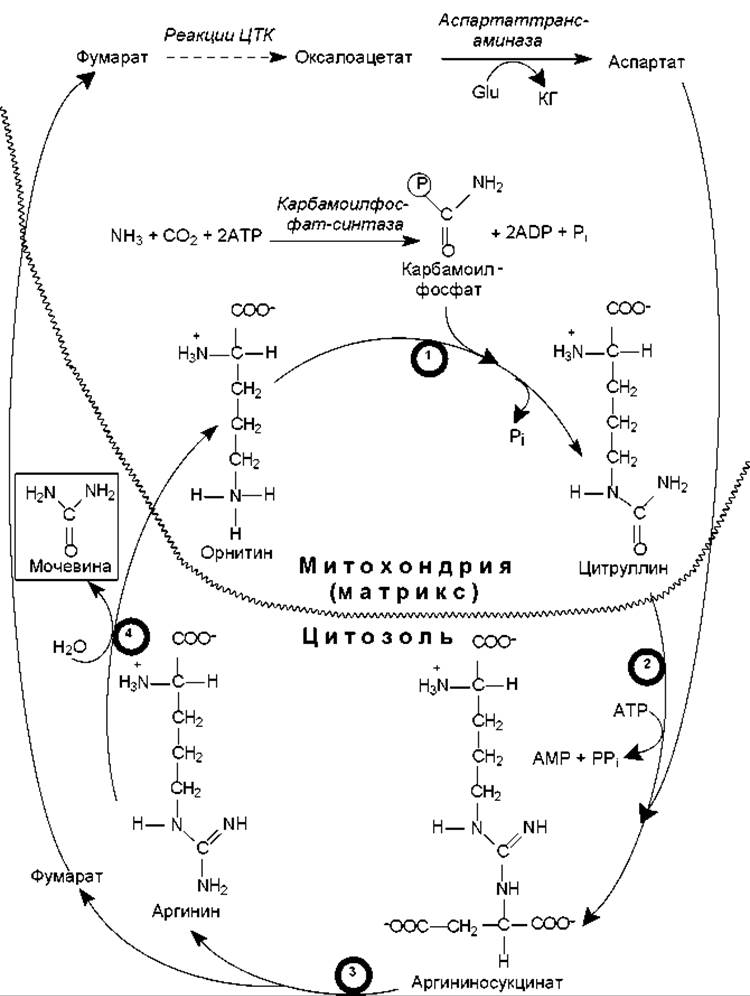
Fig. 16.13. The urea cycle. The enzyme names are enclosed in circles beneath the arrows: 1 — ornithine transcarbamylase; 2 — argininosuccinate synthase; 3 — argininosuccinate lyase; 4 — arginase. Abbreviations: Glu — glutamate; KG — a-ketoglutarate
The compartmentalization of the urea cycle spans the Cell/35.html">Mitochondria and the Cytosol: the reactions of carbamoyl phosphate formation, its incorporation into citrulline, and The conversion of fumarate to aspartate occur in the mitochondrial matrix. The remaining three reactions (the formation of argininosuccinate, arginine and fumarate, and ornithine and urea) take place in the cytosol.
The formation of a single urea molecule consumes four high-energy ATP bonds, meaning that The process of ammonia detoxification requires a high energy investment from The Cell.
The Regulation of the urea cycle rate is determined by the first reaction. The enzyme catalyzing it, carbamoyl phosphate synthetase I, is allosterically activated by N-acetylglutamate, an ornithine precursor, and is virtually inactive in its absence.
The urea cycle is the primary pathway for ammonia detoxification. However, even ureotelic organisms are capable of excreting a small fraction of ammonia directly via the hydrolytic deamidation of glutamine and the Oxidative Deamination of glutamate in Kidney cells. The released ammonia diffuses across the cell membranes of the renal tubules into the renal tubular lumen (urine), where it combines with protons to form ammonium ions. In this form, ammonia can no longer cross the membrane barrier to return to the cell and is thus completely excreted in the urine.
Several hereditary disorders are known that involve impairments of the urea cycle due to defects within its enzyme system. These conditions are invariably associated with elevated concentrations of ammonia in Tissues and blood (hyperammonemia), which can even be fatal. Such disorders primarily affect the systems most sensitive to declining ATP levels—namely, Nerve Cells and the Brain. This can be explained by the fact that high ammonia concentrations shift the equilibrium of the reversible Glutamate dehydrogenase-catalyzed reaction toward glutamate formation, which inevitably depletes a-ketoglutarate reserves. However, a-ketoglutarate is an intermediate of the TCA cycle, and its excessive consumption leads to a slowdown of The Citric Acid Cycle—the primary supplier of reducing equivalents for the Respiratory Chain. As a result, The rate of ATP production decreases.
Last update: 06/08/2026
Editorial and Educational Adaptation: This material has been compiled based on the primary/original source text. The project team performed an editorial review, corrected technical inaccuracies, structured sections, and adapted the content for an educational format.
What was processed:
- elimination of formatting defects (OCR errors, structural breaks, corrupted characters);
- editorial organization of content;
- standardization of terminology in accordance with academic sources;
- verification of factual statements against the original source text.
All mentions of the author, publication year, and origin of the primary text have been preserved in accordance with the source.