Molecular Biology: Protein Structure and Functions - Stepanov V.M. 2005
Post-translational Protein Modification
Intramolecular Rearrangements in Proteins
A polypeptide chain—the primary product of METABOLISM/35.html">Protein Biosynthesis—frequently undergoes chemical alterations that modify its Covalent Structure. Such modifications can occur either co-translationally (during Translation) or post-translationally, often after the Spatial Structure of the protein has already been established. The sheer diversity of these reactions, which complete protein maturation or alter its functional properties, is vast, numbering between 300 and 400. Post-translational modification reactions are sometimes referred to as Processing, emphasizing that they essentially finalize protein biosynthesis. This term is not entirely precise, however, since certain reactions, such as phosphorylation, can occur repeatedly on the same molecule to regulate its activity, while others presumably serve as a signal for protein degradation.
Post-translational modifications are typically catalyzed by specific Enzymes, although intramolecular protein transformations that occur without the participation of external enzymes are also known. These functional, directed post-translational modifications are generally distinguished from more or less random, damaging reactions—which are also quite numerous—that occur with Proteins in vivo, affecting their structural integrity and functional properties. Examples include oxidation reactions, random proteolysis, non-enzymatic protein deamidation, and the attachment of glucose to the amino groups of certain proteins (such as Hemoglobin) under conditions of elevated Blood sugar in diabetes, among others.
Post-translational modifications are non-template processes; they are not directly encoded and therefore often proceed incompletely, leading to The formation of Multiple Forms of a given protein as products of partial conversion.
What is the Functional Significance of post-translational modifications? This question can be answered in a generalized way as follows. First, despite the remarkable richness of structures formed by amino acid residues and their ensembles within the spatial architecture of a protein, this diversity is far from limitless. Of course, the formation of complexes with Cofactors (such as metals and Coenzymes) dramatically expands a protein's functional capabilities. Yet, even this pathway is not always sufficient. In such cases, the structural repertoire of the protein can be enriched through the targeted Modification of the side chains of specific amino acid residues, or sometimes of the molecule as a whole. Second—and no less importantly—certain post-translational modification reactions, particularly reversible ones, make it possible to regulate The activity of a protein or entire groups of proteins in response to the changing needs of The Cell.
It is worth noting that post-translational modifications, unlike the preceding stages of translation, are highly individualized and sometimes unique to a single protein. Examples of such reactions include the hydroxylation of Proline residues in Collagen, the iodination of thyroglobulin, and several others. The Specificity of post-translational modification opens up Prospects for the selective targeting of the processing and, consequently, the function of specific proteins.
Next, we will examine some of the most important types of post-translational modifications.
This group of transformations stands apart because they are not catalyzed by any enzyme; instead, they result from an intramolecular reaction presumably guided by the specific spatial STRUCTURE OF THE precursor protein. This latter feature brings such reactions close to catalytic ones, which is why they are sometimes described as autocatalytic processes, although the analogy is not entirely accurate because in this case, the "Active Site" acts only once rather than repeatedly, as enzymes do.
The proenzyme of Histidine decarboxylase from lactic acid Bacteria (Lactobacillus) as well as Clostridium perfringens is synthesized as a single polypeptide $\pi$-chain with a molecular mass of 34 kDa. During intramolecular activation, it is converted into $\alpha$ and $\beta$ chains with molecular masses of 25 and 9 kDa, respectively. The $\alpha$ chain bears a pyruvic acid residue at its amino terminus, which acts as a distinctive cofactor within the enzyme's active site and interacts with the amino group of the histidine undergoing decarboxylation. This Pyruvate residue is functionally analogous to Pyridoxal phosphate—a typical cofactor in Amino acid metabolism enzymes. Notably, the $\pi$-chain and its Cleavage product, composed of the $\alpha$ and $\beta$ chains, form a hexameric quaternary structure.
Of particular interest is the non-hydrolytic cleavage pathway of the $\pi$-chain into the $\alpha$ and $\beta$ chains. In the Amino Acid Sequence connecting the future $\alpha$ and $\beta$ chains,
Class="center">
presumably under The Influence of spatially proximate Functional groups of prohistidine decarboxylase, a rearrangement takes place in which adjacent Serine residues directly participate. First, the carbonyl group of the preceding serine residue is transferred from the amino group to the hydroxyl group of the next residue:
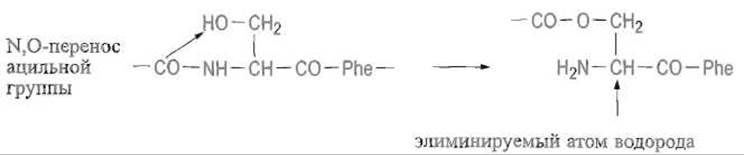
This is the so-called N,O-acyl migration. Next, the acyl component ($\beta$-chain) is eliminated non-hydrolytically via the abstraction of the $\alpha$-hydrogen atom of the serine residue ($\beta$-elimination), leaving a highly unstable dehydroalanine residue at the amino terminus of the newly formed $\alpha$-chain:
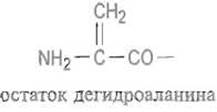
Dehydroalanine is presumably isomerized into an imino derivative of the pyruvate residue, which then reacts with Water, releasing ammonia and converting into a pyruvate residue:

It should be emphasized that the actual Cleavage of the polypeptide chain in this case occurs without the participation of water, via a non-hydrolytic pathway. Interestingly, Other Enzymes of amino acid metabolism—such as lyases that remove ammonia from phenylalanine or histidine to yield the corresponding unsaturated acids (cinnamic acid in the case of phenylalanine or urocanic acid in the case of histidine)—exhibit a similar transformation. However, this leads not to the cleavage of the peptide chain, but to the formation of dehydroalanine, which is presumably stabilized within the spatial structure of the enzyme. The precursor of dehydroalanine in these instances is likely an activated derivative of serine or Cysteine. In such enzymes, dehydroalanine is incorporated into the catalytic center, functioning as an electrophilic group. It is worth noting that electrophilic groups are not characteristic of classically constructed proteins.
Last update: 13/08/2026
Editorial and Educational Adaptation: This material has been compiled based on the primary/original source text. The project team performed an editorial review, corrected technical inaccuracies, structured sections, and adapted the content for an educational format.
What was processed:
- elimination of formatting defects (OCR errors, structural breaks, corrupted characters);
- editorial organization of content;
- standardization of terminology in accordance with academic sources;
- verification of factual statements against the original source text.
All mentions of the author, publication year, and origin of the primary text have been preserved in accordance with the source.