Molecular Biology of the Cell - Volume 1 - Alberts B., Bray D., Lewis J., Raff M., Roberts K., Watson J. 1994
Molecular Organization of Cells
Plasma Membrane
Membrane Carbohydrates
CARBOHYDRATES are present On the surface of all Eukaryotic Cells. They occur as oligosaccharide and polysaccharide chains covalently attached to Membrane Proteins (Glycoproteins) and Lipids (Glycolipids). The carbohydrate content of Cell/30.html">The Plasma Membrane ranges from 2 to 10% of the membrane weight. Most plasma membrane proteins that project onto The Cell surface are linked to sugar residues. At the same time, fewer than one in ten lipid molecules in the outer monolayer of most Plasma Membranes is associated with carbohydrates (see Section 6.1.6). Since lipid molecules outnumber protein molecules in the membrane by fifty-fold, this means that in a typical membrane, there are more lipid molecules linked to carbohydrates than protein molecules. However, a glycoprotein such as Glycophorin can have A large number of side oligosaccharide chains, whereas each glycolipid molecule has only one. In addition, many plasma membranes contain integral proteoglycan molecules. Proteoglycans consist of long polysaccharide chains attached to a protein core and are found mainly on the outer surface of The Cell as part of the Extracellular matrix. In some cases, however, the core of integral proteoglycans appears to span The Lipid Bilayer.
6-18
6.3.1. Carbohydrates in Introduction/36.html">Biological Membranes are located exclusively on the non-cytosolic surface [18]
As we already know, biological membranes are highly asymmetric: the outer and inner monolayers differ in both lipid and protein composition. The same Asymmetry is observed in the distribution of carbohydrates; the carbohydrate chains of the majority of glycolipids, glycoproteins, and proteoglycans in internal and plasma membranes are localized exclusively on the non-cytosolic side of the membrane. In plasma membranes, sugar residues project onto the outer surface of the cell, whereas in internal membranes they face the interior of the membrane-bounded compartment. There are two distinct ways in which Oligosaccharides can be attached to membrane glycoproteins: they can be N-linked to asparagine residues in the polypeptide chain or O-linked to Serine or Threonine residues. N-linked oligosaccharides typically contain about 12 sugars and are built on a common core consisting of mannose residues. O-linked oligosaccharides are usually shorter (about 4 sugar residues in length).
One of the simplest ways to demonstrate the presence of sugars on the cell surface is to use carbohydrate-binding proteins called Lectins. There are A number of proteins that possess sites that recognize and bind specific sequences of sugar residues. They were originally isolated from plant seeds. Some lectins are extremely toxic and serve to deter animals that might eat the seeds. More recently, it has been shown that lectins are present not only in plants but also in many other organisms, including animals. Some of them are located on the cell surface and appear to be involved in cell-Cell Recognition (see Fig. 5-42). Because lectins bind to glycoproteins, proteoglycans, and glycolipids on the cell surface, they are widely used in cell biology as biochemical markers to localize and isolate sugar-containing plasma membrane molecules. Table 6-2 lists the most commonly used plant lectins and their sugar specificities.
Class="center">Table 6-2. The most popular commercial plant lectin preparations and the sugars they recognize
|
Lectins |
Sugar Specificity |
|
Concanavalin A |
a-D-glucose and a-D-mannose |
|
Soybean lectin |
a-galactose and N-acetyl-D-galactosamine |
|
Wheat germ lectin |
N-acetylglucosamine |
|
Lotus seed lectin |
Fucose |
The term cell coat, or glycocalyx, is often used to describe the carbohydrate-rich peripheral zone on The surface of most eukaryotic cells. When labeled lectins or various stains, such as ruthenium red, are used, this zone is clearly visible in electron micrographs (Fig. 6-39). Although carbohydrates are primarily attached to molecules within the plasma membrane, the glycocalyx can also contain Glycoproteins and Proteoglycans that are secreted by cells and then adsorbed onto the cell surface (Fig. 6-40). Some of these adsorbed macromolecules are Components of the extracellular matrix. Thus, the question of where the plasma membrane ends and the extracellular matrix begins can be considered purely semantic.

Fig. 6-39. Electron micrograph of the surface of a lymphocyte stained with ruthenium red to provide a contrasting image of the cell coat (glycocalyx). (Courtesy of A. M. Glauert and G. M. W. Cook.)
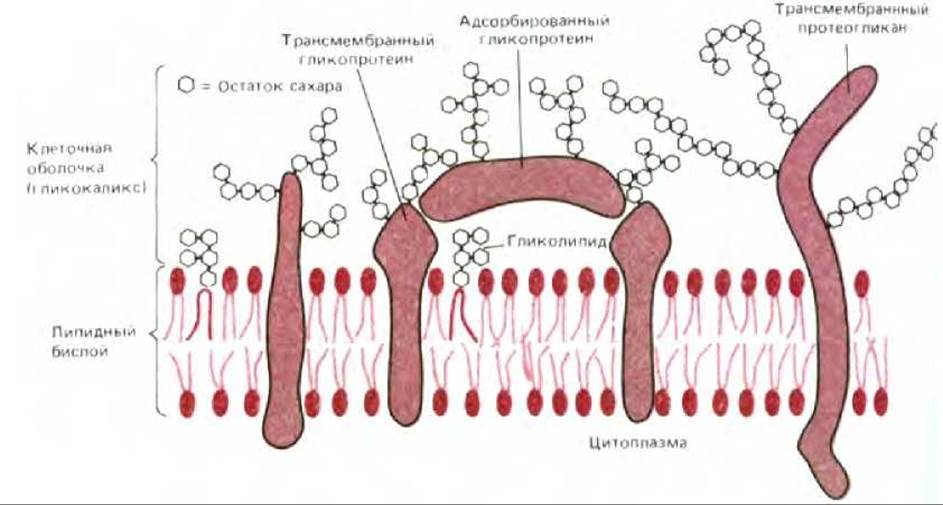
Fig. 6-40. Schematic diagram of the cell coat (glycocalyx), consisting of the oligosaccharide side chains of glycolipids and integral membrane glycoproteins, and the polysaccharide chains of proteoglycans. Some Cells also contain adsorbed glycoproteins and proteoglycans (not shown). Note that all carbohydrates are located on the outer side of the membrane. Some integral glycoproteins and proteoglycans may be covalently linked via specific oligosaccharides to phosphatidylinositol in the outer monolayer of the plasma membrane (see Fig. 6-14).
Clearly, the high concentration of carbohydrates on the cell surface must have a significant effect on many Functions of the plasma membrane. However, The Nature of this effect is not yet understood. The structural complexity of some oligosaccharides, as well as the fact that carbohydrates are located exclusively on the cell surface, suggests an important role for carbohydrates in cell-cell and cell-matrix recognition processes. In some cases, there is strong evidence for this role (see Sections 15.4.2 and 15.4.9), but more often, such functions of cell-surface carbohydrates are very difficult to prove unequivocally.
Summary
In the plasma membranes of all eukaryotic cells, most proteins located on the cell surface, as well as some lipid molecules in the outer lipid monolayer, are covalently linked to oligosaccharide chains. Some plasma membranes contain integral proteoglycan molecules in which several polysaccharide chains are covalently linked to a transmembrane protein or a lipid-linked core protein. Although the function of cell-surface carbohydrates is not yet fully understood, it seems likely that at least some of them participate in cell-cell and cell-matrix recognition processes.
Last update: 12/08/2026
Editorial and Educational Adaptation: This material has been compiled based on the primary/original source text. The project team performed an editorial review, corrected technical inaccuracies, structured sections, and adapted the content for an educational format.
What was processed:
- elimination of formatting defects (OCR errors, structural breaks, corrupted characters);
- editorial organization of content;
- standardization of terminology in accordance with academic sources;
- verification of factual statements against the original source text.
All mentions of the author, publication year, and origin of the primary text have been preserved in accordance with the source.