Biochemistry - The Chemical Reactions of Living Cells, Volume 3 - D. Metzler 1980
Growth, Differentiation, and Chemical Communication in Cells
Tissue Differentiation and Developmental Biology
Cell Recognition
There is yet another type of Cell migration that ensures the sorting and aggregation of dispersed Cells, as described in Chapter 1, Section D, 3 [166]. Such cells recognize and bind to one another, a capacity of critical importance in tissue morphogenesis. What is the mechanism that enables cells to recognize their own kind within a heterogeneous mixture of different cells? Researchers have successfully isolated specific tissue-specific adhesion molecules that induce the aggregation of specific types of embryonic cells [167–170]. One such isolated factor promotes the aggregation of embryonic Brain cells, whereas another targets retinal cells. These adhesion molecules, or aggregation factors, were found to be Glycoproteins, with their Specificity apparently determined by their oligosaccharide components [169]. The Plasma Membrane surface also bears specific compounds that inhibit cell aggregation; these compounds have been isolated in soluble form [171].
Class="center">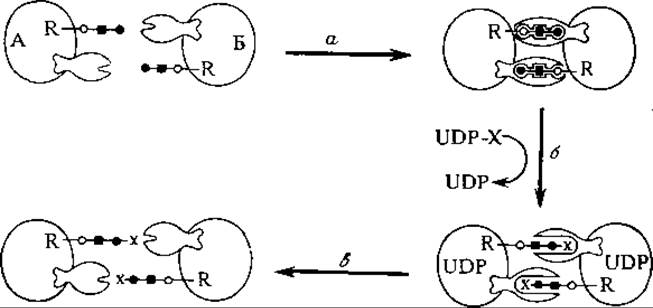
FIG. 16-15. Schematic representation of the putative role of surface Glycosyltransferases and their substrates in Cell Adhesion. Cells A and B contain both substrates (R-bearing groups) and Enzymes with unmasked active sites. It is hypothesized that upon completion of the reaction, a change occurs in The Structure of The Cell surface; this may account for certain contact phenomena, in particular contact inhibition and induction. a — initial adhesion resulting from The formation of a transferase-substrate complex; b — completion of the reaction, leading to altered cell properties; c — cell detachment [168].
Of particular note is the hypothesis proposing that oligosaccharide chains of glycoproteins On the surface of one cell bind to a specific glycosyltransferase on The surface of another [172, 173]. As a result of this interaction, the cells are held together, but following The transfer of an additional glycosyl residue to the oligosaccharide during the transferase reaction, the Surface Properties of the glycoprotein-bearing cell must change (Fig. 16-15). This, in turn, leads to cell deaggregation. Glycosyltransferases, as well as acceptor molecules, have indeed been detected on the external surface of cell membranes [174, 175]. Enzymes with this localization, sometimes referred to as ectoenzymes, presumably originally constituted part of the intracellular glycosylation system (located in The Endoplasmic reticulum) but were subsequently translocated to the plasma membrane at the cell surface [175]. This system has attracted intense interest because the loss of contact inhibition in Cancer cells may stem from alterations in The properties of some of its components (Chapter 1, Section D, 3 in).
Edelman [175a] has suggested that cell-cell recognition shares commonalities with immunological recognition (Section 7 of this chapter, as well as Chapter 7, Section B.4). It is possible that this process involves a proteolytic cascade, analogous to The Complement System (Box 5-F), as well as the cytoplasmic network (Chapter 5, Section B.4).
Last update: 06/08/2026
Editorial and Educational Adaptation: This material has been compiled based on the primary/original source text. The project team performed an editorial review, corrected technical inaccuracies, structured sections, and adapted the content for an educational format.
What was processed:
- elimination of formatting defects (OCR errors, structural breaks, corrupted characters);
- editorial organization of content;
- standardization of terminology in accordance with academic sources;
- verification of factual statements against the original source text.
All mentions of the author, publication year, and origin of the primary text have been preserved in accordance with the source.