Biochemistry: The Chemical Reactions of Living Cells, Volume 3 - D. Metzler 1980
Growth, Differentiation, and Chemical Communication in Cells
Tissue Differentiation and Developmental Biology
Developmental Programs in Multicellular Organisms
As we have already seen, Cells are constantly receiving chemical signals both directly from adjacent cells and through the surrounding extracellular fluids; in response, they release specific compounds or otherwise modify their Structure/108.html">Surface Properties. This raises the question of whether such intercellular interactions can give rise to the 200 specialized Cell types characteristic of mammalian organisms. The fact that even bacterial cells can switch from one developmental program to another makes this hypothesis plausible. In lower animals, at a certain stage of oocyte development, DNA Synthesis shuts down, and The Cell begins accumulating large amounts of RNA, which is later utilized during embryonic development. At the Cytology/cytology/16.html">Early stages of Embryogenesis, the primary organizing role is played by factors such as egg polarity and the concentration gradient of its components. Consequently, egg nuclei respond to external stimuli in a way that establishes the initial polarity of the embryo. At the earliest Selection/3.html">Stages of development, The process of differentiation is readily reversible. Later on, however, converting a differentiated cell into an embryonic-type cell becomes difficult or even impossible. Gurdon's experiments (Section B.2 of this chapter) demonstrate that The Nucleus of a differentiated cell usually (if not always) contains the complete genetic material. This fact is in no way contradicted by numerous experimental findings showing that, at early developmental stages, cells located in different Regions of the embryo follow distinct internal genetic programs, acting as if their pathway of differentiation were predetermined. In some cases, it creates the impression that a kind of "developmental clock" is wound, fully dictating the subsequent course of differentiation.
This view is supported by the existence of stem cells, which retain certain embryonic characteristics; with each division of a stem cell, a new stem cell plus a differentiated cell are produced. The latter phenomenon is difficult to explain solely as a reaction to environmental chemical signals. According to some observations, animal cells have a limited division potential [176, 177]. For example, normal human embryonic diploid fibroblasts grown in culture divide approximately 50±10 times before dying, regardless of culture conditions. Fibroblasts obtained from older individuals die after fewer cell divisions. Similarly, animal cells with a shorter lifespan, such as mouse cells, die more rapidly in culture (after 14–28 divisions) [177]. These observations suggest the existence of an internal program that predetermines the timing of cell death. However, There are also observations that contradict this Conclusion [178], so overall, METABOLISM/2.html">THE CONCEPT OF an upper limit to the number of divisions of differentiated cells remains unproven.
A third line of evidence supporting the existence of internal developmental programs comes from careful embryological studies. In particular, it has been shown that in the chick embryo, the limb bud (whose length equals the combined diameters of 20 cells) contains cells that subsequently differentiate in a completely autonomous manner into distinct elements of the organ. If this developmental zone from one limb bud is transplanted onto a second, symmetrical bud, a limb will develop there with twice the normal number of bone and Cartilage elements [179].
Modern theories of development accept the existence of specific genetic programs and view the entire developmental process as the result of a combination of cellular responses to Hormones and Inducers, coupled with The Influence of an internal genetic program [179]. At present, we can only offer preliminary guesses regarding The Nature of these internal programs. Nevertheless, highly plausible models have been proposed in which a developmental clock counts the number of cell divisions and, at the appropriate moment, switches certain genes off while turning others on [180]. Specific hypotheses have been put forward concerning the chemistry of such a clock. For instance, it has been pointed out that, contrary to the notion of high DNA stability, this compound readily mutates under the influence of Chemical factors. One can postulate the existence of specialized Enzymes that directionally modify DNA at specific sites. Indeed, it is known that DNA contains a specific amount of additional methyl groups that can, for example, mark individual regions (Chapter 2, Section D.8). Another possibility is the Deamination of Amino-containing bases at specific sites, such as within palindromic sequences.
It is quite possible that the following chain of events takes place. Under the action of a specific enzyme, adenine in an AT base pair may be deaminated to inosine. As a result, following Cell Division, one daughter cell will receive an unmodified DNA molecule, whereas In the second cell, the AT base pair will be replaced by a UC pair. During the next Replication cycle, a GC pair will form. Thus, in a fraction of the daughter cells, an AT-to-GC substitution occurs at a specific DNA site. Such a simple substitution, induced by a specialized enzyme produced at a specific developmental stage, can alter the expression of certain genes in some cells. It is quite probable that another enzyme is capable of reversing this effect, i.e., converting the modified base pair back to its original form. For example, the deamination of cytosine followed by DNA replication will lead to The formation of an AU pair, which, after a second round of DNA replication, reverts to the original AT pair. If specific palindromic sites are accessible and repeatedly duplicated, one can imagine that the action of the modifying enzyme propagates sequentially along the entire length of the Chromosomes in both directions. This is precisely how the activation of specific genes after a specific number of cell divisions could come about (for details, see Holliday and Pugh [180]).
Fig. 16-16 illustrates how a hypothetical enzyme E1 can modify a DNA region by methylating a base in one of two palindromic sequences. This enzyme, which is postulated to have a rather unusual Specificity, must also methylate a second site in the complementary strand, but outside the palindromic region. Upon replication, one DNA molecule remains unchanged, whereas the second will serve as a substrate for enzyme E2. The action of the latter will result in the methylation of the second half of the palindrome and of all descendant DNA molecules. As a result of the combined action of enzymes E1 and E2, modified cells will diverge increasingly from unmodified ones—in other words, a differentiation process will unfold, similar to that occurring in stem cells undergoing differentiation. A somewhat different model (though also postulating an enzyme of rather unusual specificity) explains The Mechanism of internal cell division counting, analogous to the AT–GC transition postulate [180].
Class="center">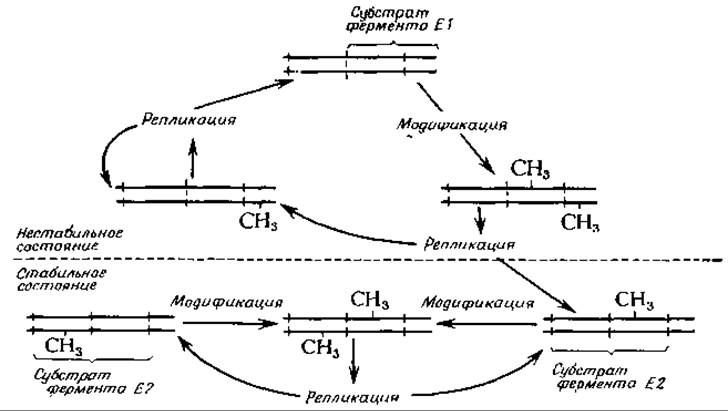
FIG. 16-16. Segregation of methylated DNA from an unmethylated precursor. The first modifying enzyme, E1, methylates one-half of the palindromic sequence and the adjacent sequence in the complementary strand. During replication, a substrate is generated for the second enzyme, E2, which methylates the second half of the palindrome and all subsequent generations of DNA molecules. In the presence of E1 and E2, stable modified cells are continuously generated from unmodified or partially modified cells. Upon inactivation or disappearance of E1, stable modified and unmodified cells are produced (Holliday R., Pugh J. E., Science, 187, 227, 1975).
How, then, can we account for the totipotency of differentiated cell nuclei? There is abundant evidence that the oocyte Cytoplasm contains factors that switch off the Transcription of specialized genes. It appears as though some mechanism advances the hands of the developmental clock, compelling cells to differentiate. It is quite likely that, as long as no significant loss of DNA from The Genome has occurred, the modified DNA is enzymatically converted back to its original unmodified form. When considering methylated DNA, it is highly significant that in the absence of enzymes E1 and E2 in the oocyte cytoplasm (Fig. 16-16), no further methylation will take place during Cleavage. By the gastrula stage, when the developmental clock presumably begins to tick, methylated bases should be absent from the DNA of most cells.
Last update: 06/08/2026
Editorial and Educational Adaptation: This material has been compiled based on the primary/original source text. The project team performed an editorial review, corrected technical inaccuracies, structured sections, and adapted the content for an educational format.
What was processed:
- elimination of formatting defects (OCR errors, structural breaks, corrupted characters);
- editorial organization of content;
- standardization of terminology in accordance with academic sources;
- verification of factual statements against the original source text.
All mentions of the author, publication year, and origin of the primary text have been preserved in accordance with the source.