Medical Genetics - V. M. Zaporozhan 2005
Etiology of Hereditary Diseases
Non-Mendelian Inheritance in Humans
Genomic Imprinting
As noted above, functionally speaking, most genes inherited from the father and mother are completely equivalent. However, it is now clear that certain processes (especially during embryonic development) are controlled exclusively either by the paternal Gene or by the maternal one. In other words, the male and female genomes in mammals are functionally nonequivalent.
The mechanism regulating the Functional differences between the paternal and maternal genomes is known as genomic imprinting. Imprinted genes are mammalian genes that are inherited from the mother or father in a repressed ("silent") state. Gene inactivation occurs during gametogenesis and is associated with the methylation of cytosine nitrogenous bases, which represses (inactivates) the gene. Methylation affects only specific genes, with some being repressed during oogenesis and others during Spermatogenesis. This methylation is carried out by DNA methyltransferase Enzymes and is thus under Genetic control. Cytosine is methylated when it is adjacent to guanine in a CpG site, where C stands for cytosine, p for the phosphodiester bond in the sugar-phosphate backbone of the molecule, and G for guanine. During METABOLISM/36.html">DNA Replication in mitotic divisions of somatic Cells, the methylation of cytosine bases is maintained automatically.
The very same gene may behave as imprinted (inactive) in certain cells and at specific stages of ontogenesis. At the same time, this exact gene can be normally expressed in other cells or even in the same cells, but at a different stage of development.
Genomic imprinting is considered an epigenetic phenomenon. This means that heritable changes in Gene Expression occur without any alteration in the DNA sequence. Epigenetic reprogramming takes place in germline cells. In germ Cell precursors, demethylation occurs, allele-specific methylation associated with imprinted genes is erased, and expression of both allele genes is observed. In mature Germ Cells, methylation is restored and the repression of certain genes resumes in a sex-specific manner.
Thus, genomic imprinting is an epigenetic process that occurs during oogenesis and spermatogenesis, leading to functional differences between allele genes inherited from the father and the mother. In other words, genomic imprinting is the process responsible for the varying activity of certain allele genes received by an Organism from its parents. The phenomenon of genomic imprinting is known only in placental mammals.
Genomic imprinting was demonstrated in experiments on mouse embryos in 1983–1986. Studies by Surani et al., as well as McGrath and Solter, showed that normal embryonic development in mice requires both paternal and maternal Chromosomes (i.e., both egg and sperm nuclei). Combinations of two male or two female pronuclei taken from different fertilized mouse eggs lead to the arrest of embryonic development. Specifically, in the case of androgenesis (a combination of two sperm nuclei and the absence of an egg Nucleus), a small embryo formed along with trophoblast derivatives—extraembryonic membranes and the Placenta—of practically normal size. Conversely, in the case of gynogenesis (a combination of two egg nuclei and the absence of a male nucleus), a rather large embryo developed alongside very small extraembryonic membranes. In both instances, embryonic development soon ceased.
Similar abnormalities are observed in cases of uniparental disomy in humans. The functional nonequivalence of maternal and paternal genomes is also seen in human triploidy.
These findings indicate that paternal genes ensure The Development of extraembryonic membranes, while maternal genes control the Development of the embryo. Consequently, normal mammalian development requires two sets of chromosomes—one maternal and one paternal. This explains why parthenogenesis (development without Fertilization) has never been observed in any of the more than 4,500 known species of mammals.
It is estimated that between 200 and 500 human genes are imprinted. Most imprinted genes are arranged in clusters and are localized across multiple Human chromosomes: 1, 5, 6, 7, 11, 13, 15, 19, 20, and X. Imprinted genes play a crucial role in regulating organismal GROWTH AND DEVELOPMENT during both the prenatal and postnatal periods. Phenotypic traits controlled by imprinted genes can be altered not only by Mutations in these genes but also through disruptions in the epigenetic program regulating gene expression.
Disorders caused by the malfunction of imprinted genomic regions are referred to as Genomic Imprinting Disorders. The first imprinting syndromes described were Prader–Willi and Angelman syndromes. Both syndromes result from the exact same mutation: a deletion of the long arm of chromosome 15 (15q11–13). Prader–Willi syndrome develops when the mutation is inherited from the father, whereas Angelman syndrome occurs when it is inherited from the mother. These same syndromes can also arise from uniparental disomy or isodisomy. If an individual inherits both chromosome 15s from the mother, Prader–Willi syndrome develops (reflecting the absence of paternal alleles, just like inheriting a paternal deletion); conversely, if both chromosomes are inherited from the father (lacking maternal alleles), Angelman syndrome develops. For other Examples of genomic imprinting disorders caused by uniparental disomy, see Table 2.8.
The loss of imprinting in certain genes may play a significant role in the development of Multifactorial Diseases.
Today, there is no doubt that genomic imprinting is involved in the Etiology of tumor growth. Imprinting defects that lead to the biallelic expression of the imprinted Insulin-like growth factor 2 (IGF2) locus in various Tissues and Organs can drive uncontrolled growth in these structures. The gene is located on chromosome 11 (11p15.5). Normally, the maternal gene is imprinted while the paternal gene is expressed. An imprinting defect on the right or left side of the body leads to hemihyperplasia on the corresponding side, in the Kidney it leads to isolated nephromegaly, and an imprinting defect across all cells (Beckwith–Wiedemann syndrome) leads to generalized overgrowth (Fig. 2.15). Examples of oncogenes and tumor suppressor genes subject to imprinting are listed in Table 2.7.
Table 2.7. Examples of imprinted oncogenes and tumor suppressor genes
|
Gene |
Chromosomal locus |
Effect of paternal origin |
|
P73 |
1p36 |
Loss of the maternal allele leads to neuroblastoma. Loss of monoallelic gene expression and a switch to biallelic expression (loss of imprinting) in the Lungs and Kidneys leads to tumor development in these organs |
|
NOEY2 |
1p31 |
Loss of the paternal allele leads to breast and Ovarian Cancer |
|
N-Myc |
2p24.1 |
Amplification of the paternal allele is associated with the development of neuroblastoma |
|
IGF2 |
6q25.3 |
Loss of the imprinted status of the gene on the maternal chromosome and a transition to biallelic gene expression (loss of imprinting) with its overexpression leads to rhabdomyoma and Other types of cancer |
|
KvLQTl |
11p15.5 |
Loss of maternal allele-specific methylation of the gene region leads to hepatocellular carcinoma |
|
CDKNIC (p57 KIP2) |
11p15.5 |
Loss of the maternal allele leads to Lung Cancer. Reduced expression of the maternal allele is associated with hepatocarcinoma |
Class="center">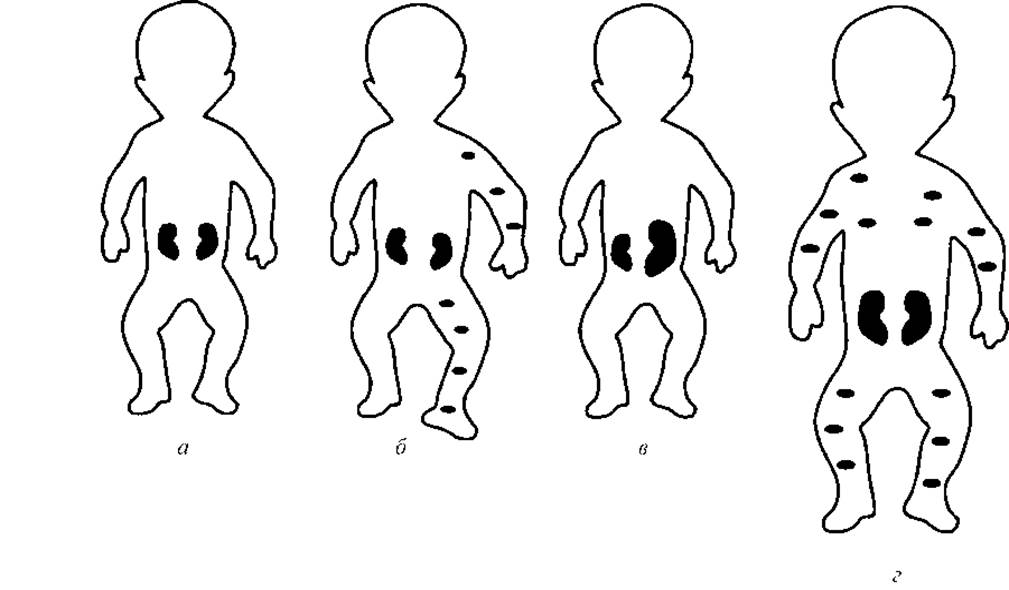
Fig. 2.15. The effects of insulin-like growth factor 2 (IGF2) in human genomic imprinting disorders. The severity and pattern of Tissue and organ overgrowth in children may depend on the number and localization of cells exhibiting elevated IGF2 gene expression (indicated by black oval circles):
a — normal; b — hemihyperplasia; c — isolated nephromegaly; d — generalized overgrowth
Imprinted genes are not only vital for controlling organismal growth during the prenatal and postnatal periods, but they also participate in regulating cognitive processes and behavioral CHARACTERISTICS OF THE individual.
Last update: 11/08/2026
Editorial and Educational Adaptation: This material has been compiled based on the primary/original source text. The project team performed an editorial review, corrected technical inaccuracies, structured sections, and adapted the content for an educational format.
What was processed:
- elimination of formatting defects (OCR errors, structural breaks, corrupted characters);
- editorial organization of content;
- standardization of terminology in accordance with academic sources;
- verification of factual statements against the original source text.
All mentions of the author, publication year, and origin of the primary text have been preserved in accordance with the source.