Pediatric Medical Genetics - S.I. Smiian 2003
General Principles of Medical Genetics
Fundamentals of Inheritance and Hereditary Pathology
The substance that carries hereditary traits is called Chromosomes (due to their strong staining property). Chromosomes are visible in The Nucleus during Cell Division. Every living Organism is characterized by a specific number, shape, and size of chromosomes. The number of chromosomes does not reflect an organism's level of development (a rabbit has more than a human). In humans, a somatic cell has 46 chromosomes, of which 44 are autosomes—identical in males and females—and 2 are large sex chromosomes: XX in females and XY in males. The Y chromosome is the smallest, which is why females have approximately 4% more genetic material. The decisive factor in determining the sex of offspring is the sperm cell, as the egg is neutral and carries a single X chromosome. Sex is determined at the moment of Fertilization, and nothing can alter it thereafter. Consequently, to control sex, one must influence the sperm before fertilization occurs. If The Cell is fertilized by a sperm bearing an X chromosome, the gamete will form an XX combination and a girl will be born; if the sperm carries a Y chromosome, fertilization will yield XY and a boy will be born. Sperm with a Y chromosome are lighter and more motile, which is why the male-to-female sex ratio at fertilization is 130 to 100. However, spontaneous abortions more frequently involve an XY fetus. In some families, the father's sperm with X chromosomes have higher motility, resulting in the birth of exclusively girls.
The Moscow Institute of Mother and Child Care has developed recommendations for family sex Selection of children. Their effectiveness approaches 100%. However, these recommendations are provided only to families with hereditary sex-linked pathologies. Widespread dissemination of this knowledge among the general population could lead to imbalances in the sex Structure of society, should every family wish to have more boys than girls. Therefore, this practice is used exclusively for medical purposes.
Chromosomes consist of factors passed down from generation to generation known as genes. Each chromosome contains hundreds or thousands of genes. DNA molecules serve as the carriers of hereditary information within genes. Some genes function individually, while others require cooperation with partners. Most significant human traits—such as Hair, eye, and Skin color, height, facial features, and even intelligence—depend on the action and interaction of multiple genes. It is well established that brown eye color dominates blue; thus, brown-eyed parents may occasionally have a blue-eyed child via a recessive pattern, whereas blue-eyed parents will exclusively have blue-eyed children. Traits such as red hair and a snub Nose exhibit recessive inheritance.
Genes are stable. They are transmitted unchanged from parents to children over thousands of generations. However, this stability is not absolute. During a mutation, the original Gene becomes mutant and programs The Development of an altered trait. The mutant gene is equally stable: once it arises, it is passed on unchanged to subsequent generations.
Depending on the stage at which the pathological hereditary information occurs, medical genetics classifies diseases into:
1. Chromosomal Disorders — caused by abnormalities in chromosome number and structure.
They are subdivided into Autosomal anomalies (Down syndrome, Edwards syndrome, Patau syndrome) and sex chromosome anomalies (Shereshevsky-Turner syndrome, Klinefelter syndrome).
2. Gene disorders — caused by abnormalities in gene structure.
A distinction is made between monogenic (monofactorial) diseases, where the defect is associated with a mutation in a single chromosomal locus (gene), and polygenic (multifactorial) diseases, caused by the combined effect of Mutations across multiple chromosomal loci. Gene disorders include metabolic diseases:
— disturbances in Amino acid METABOLISM (phenylketonuria);
— disturbances in Carbohydrate Metabolism (alactasia, galactosemia);
— disturbances in Lipid Metabolism (lipidoses);
— disturbances in mucopolysaccharide metabolism (Mucopolysaccharidoses).
Hereditary pathologies manifest at different ages. Many diseases and malformations arise embryonically and may lead to miscarriages. Other illnesses appear after birth, most commonly in childhood, though they can also emerge in adults. For instance, familial Friedreich's ataxia first manifests at ages 6–12, whereas cerebellar ataxia typically presents in young adults aged 20–30. Gout appears in older or even advanced age.
The general semiotics of hereditary pathology allow for the suspicion and Diagnosis of most genetic diseases. First and foremost is the genetic Anamnesis (the presence of Hereditary diseases in the family, infant deaths, spontaneous miscarriages, prolonged Infertility, etc.). Additionally, indicators include dysmorphic stigmata (the greater the number of stigmata, the higher the probability of a hereditary disease), low birth weight, high morbidity and mortality, mental retardation, Vision and Hearing defects, musculoskeletal anomalies, and internal organ abnormalities.
It is essential to distinguish between congenital and hereditary pathology. Congenital conditions encompass not only hereditary diseases but also other illnesses and anomalies that developed intrauterinely.
Congenital Malformations include defects of the Skull, face (cleft palate, cleft lip), limb Skeleton (polydactyly, Syndactyly), and a range of Heart and internal organ defects. The cause of these anomalies may be a pathological mutagenic factor, in which case their inheritance pattern can be traced through pedigree analysis.
However, such malformations are frequently caused by environmental teratogens acting on the fetus during Critical Periods of Organogenesis. Specifically, these factors may include Fetal Hypoxia, intrauterine infections, acute vitamin deficiencies, exposure to chemicals and physical agents during Pregnancy, and even The Use of certain medications by the expectant mother. Such mimics of hereditary defects and diseases are called phenocopies. They are not inherited, yet they may occur in multiple family members if the harmful factors persisted or continue to act after the affected child's birth.
Genetic Disorders are inherited according to Mendel's Laws. There are 3 MAIN TYPES OF inheritance, although considerable Variability in their phenotypic expression exists.
It should be noted that in humans, only a few traits are completely dominant. The categorization of human traits as dominant or recessive, much like in animals, is conditional. It is not the gene itself that is dominant or recessive, but the specific trait being evaluated. A geneticist considers the dominance or recessiveness of a gene's effect under specific conditions rather than as a fixed property.
Certain dominant genes are characterized by moderate or mild manifestations in the heterozygous state and lethal effects in the homozygous state.
Autosomal dominant inheritance. Phenotypically, under this type of inheritance, the pathological condition appears in heterozygotes. The pathological trait is encountered in every Generation of the pedigree and manifests in heterozygotes. If there are numerous siblings in a single generation, The ratio of affected to healthy siblings is approximately 1:1 (Fig. 1).
Class="center">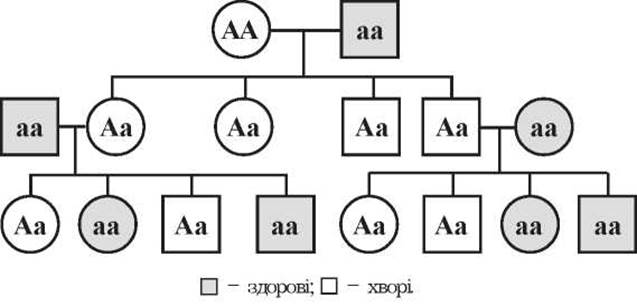
Fig. 1. Schematic diagram of the transmission of a pathological trait (A) in dominant inheritance.
Complete penetrance of pathological manifestations is by no means always observed. Most commonly, it is below 100%. Individuals without overt signs of the disease may occur in a given generation while remaining heterozygotes, as evidenced by the expression of the disease in their children. For example, penetrance for autosomally inherited monogenic retinoblastoma in children is approximately 90%.
Dominant disorders are characterized by varying degrees of clinical expression, not only among different families, but even within the same family. For example, in multiple neurofibromatosis, some family members exhibit widespread generalized neurofibromas, whereas others display only a few cutaneous lesions.
The clinical manifestations of certain dominant disorders may appear at different ages, even within a single family. A classic example is Huntington's chorea, where the onset of symptoms has been recorded anywhere from 11 to 75 years of age, with the highest peak occurring between 41 and 45 years.
Autosomal Recessive Inheritance. Phenotypically, heterozygotes with this mode of transmission are indistinguishable from healthy individuals, as they show no clinical signs of the disease. For the trait to manifest, the pathological gene must be in a homozygous state. Homozygotes are formed through several types of matings.
Matings in which both parents are heterozygotes occur most frequently. According to Mendel, the expected offspring ratio is 1:2:1, meaning 1 child will be affected, 2 children will be heterozygotes, and 1 child will not carry the pathological gene. The risk of having an affected child is 25 %.
Matings where both parents are homozygotes are rare. Theoretically, all offspring should be affected. However, instances have been described—such as in albinism—where all children born to such parents were healthy. These cases indicate that the parents carry mutations in different Regions of the gene. Such occurrences should be classified as compound heterozygotes, even though the mutations belong to the same gene. This is one of the manifestations of the Genetic heterogeneity of the disease.
Matings between heterozygotes and homozygotes in practice generally occur as consanguineous marriages. The Mendelian segregation of affected and healthy individuals will be 1:1, meaning half of the offspring will be affected and the other half healthy. The trait will appear In the second generation, resembling dominant inheritance. This mode of transmission is termed pseudodominant.
Conditions inherited in an autosomal recessive manner include albinism, amaurotic idiocy, Sickle-Cell Anemia, microcytic anemia, hypophosphatemia, Hirschsprung's disease, congenital glaucoma, cystic fibrosis, and the majority of inherited Metabolic Disorders (Fig. 2).
Sex-Linked Inheritance is determined by the localization of pathological genes on the sex X-chromosomes.
In dominant sex-linked inheritance, an affected woman transmits the mutant gene to both daughters and sons, whereas a man transmits it only to his daughters, as his sons inherit his Y chromosome. This pattern of inheritance is characteristic of vitamin D-resistant Rickets. An X-linked recessive gene manifests in the female phenotype only in the homozygous state, but it invariably manifests in males. Heterozygous females are phenotypically healthy, yet they are carriers of the mutant gene and can transmit the disease to their sons. Duchenne muscular dystrophy and hemophilia are inherited in this manner. Y-linked inheritance is characterized by the transmission of a gene localized on the Y chromosome exclusively to sons (Figs. 3, 4).
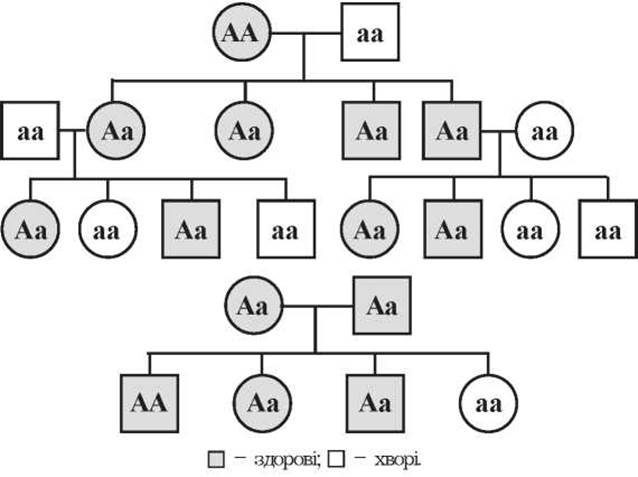
Fig. 2 Diagram of the transmission of a pathological trait (A) in recessive inheritance.
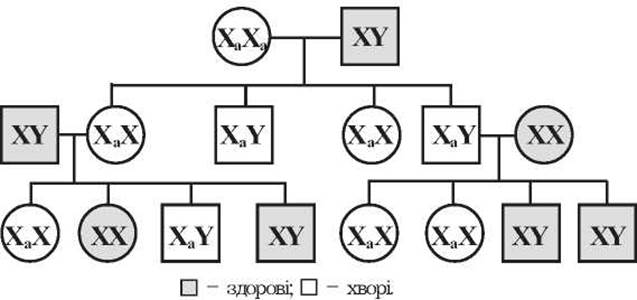
Fig. 3. Diagram of the transmission of a pathological trait (a) in X-linked dominant inheritance.
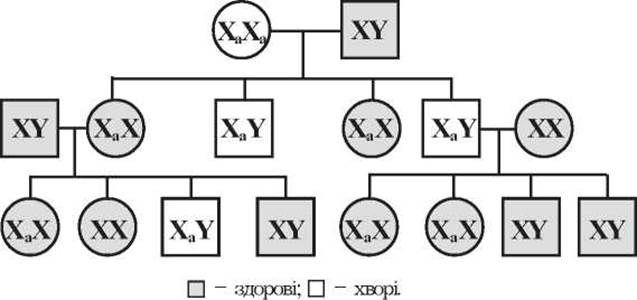
Fig. 4. Diagram of the transmission of a pathological trait (a) in X-linked recessive inheritance.
Last update: 11/08/2026
Editorial and Educational Adaptation: This material has been compiled based on the primary/original source text. The project team performed an editorial review, corrected technical inaccuracies, structured sections, and adapted the content for an educational format.
What was processed:
- elimination of formatting defects (OCR errors, structural breaks, corrupted characters);
- editorial organization of content;
- standardization of terminology in accordance with academic sources;
- verification of factual statements against the original source text.
All mentions of the author, publication year, and origin of the primary text have been preserved in accordance with the source.