Medical Genetics - V. M. Zaporozhan 2005
Clinical-Genealogical Method
Characteristics of Pedigrees with Various Inheritance Patterns
Autosomal Recessive Inheritance
This type of inheritance is characterized by the mutant Gene manifesting its effect only in the homozygous state. The disease-causing gene is designated as the recessive gene a, while the normal gene is designated as A. Affected individuals have the genotype aa, whereas unaffected individuals are either AA or Aa. In the heterozygous state (Aa), the gene can be transmitted across generations without phenotypic expression. The first affected individual may appear many generations after the mutation occurred, specifically when both the father and mother are heterozygous carriers of the same gene.
Recessively inherited diseases are typically characterized by complete penetrance, while variable expressivity is rarely observed.
Pedigrees with an autosomal recessive inheritance pattern (Fig. 4.4) exhibit the following features:
1. A small number of affected individuals in the pedigree (less than 25%).
2. Both males and females are affected with equal frequency.
3. The parents of an affected child are usually unaffected and serve as heterozygous carriers of the gene (Aa).
4. In a large family, there may be more than one affected child. The condition primarily affects siblings rather than direct descendants (parents to children, as seen in dominant inheritance, often referred to as horizontal transmission).
5. For heterozygous parents, the risk of having an affected child is 25%. In large families, The ratio of unaffected to affected children approaches 3:1.
Class="center">
6. An affected father or mother gives birth to unaffected children (AA x aa).


Fig. 4.5. Pedigree showing pseudodominance in alkaptonuria—an autosomal recessive disorder resulting from consanguineous marriages.
7. If both the father and mother are affected, all their children will be affected.

8. Often, the parents of an affected individual are Blood relatives, especially if the disease is rare in the population. For more common conditions, it may simply be the result of a chance meeting between two heterozygous carriers.
Atypical pedigrees may occasionally be encountered in known recessive inheritance patterns.
1. In cases of multiple consanguineous relationships, a pedigree may resemble that of an Autosomal dominant inheritance pattern (pseudodominance), featuring direct transmission of the trait from parent to child and a 50% probability of producing affected children (Fig. 4.5). Unlike true dominant inheritance, these characteristics are observed in only two generations and do not involve collateral Branches of the pedigree.
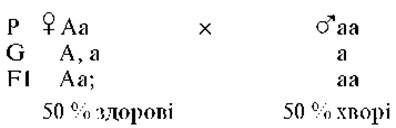
2. Instances are known where an affected child is born even though only one parent is affected while the other is not a carrier (AA x aa), or when only a single parent is a heterozygous carrier (AA x Aa). This is explained by uniparental disomy or isodisomy. The derivation of both Chromosomes from a single parent is proven using molecular Genetic Methods.
3. Affected parents may occasionally have unaffected children As a result of genetic heterogeneity in hereditary disorders, where the same condition can be caused by Mutations in different genes. If the mother's disease is caused by one recessive mutant gene (aaBB) and the father's by another (AAbb), all children in the family will be unaffected, though they will be double heterozygotes. This phenomenon is observed in albinism, visual impairments, congenital deafness, and other conditions (Fig. 4.6).

Fig. 4.6. Pedigree involving deaf-mutism, illustrating genetic heterogeneity. Both parents are affected by hereditary deaf-mutism; they have affected siblings, and both come from consanguineous marriages. However, their two sons are not deaf (they are heterozygous for two different deaf-mutism genes).

Last update: 11/08/2026
Editorial and Educational Adaptation: This material has been compiled based on the primary/original source text. The project team performed an editorial review, corrected technical inaccuracies, structured sections, and adapted the content for an educational format.
What was processed:
- elimination of formatting defects (OCR errors, structural breaks, corrupted characters);
- editorial organization of content;
- standardization of terminology in accordance with academic sources;
- verification of factual statements against the original source text.
All mentions of the author, publication year, and origin of the primary text have been preserved in accordance with the source.