Medical Genetics - V. M. Zaporozhan 2005
Clinical-Genealogical Method
Characteristics of Pedigrees with Various Inheritance Patterns
Sex-Linked Inheritance
This is the Inheritance of Traits determined by genes located on the sex Chromosomes. It includes X-linked dominant, X-linked recessive, and Y-linked Patterns of inheritance. All types of Sex-Linked Inheritance are characterized by varying frequencies of affected males and females in a pedigree.
X-Linked Inheritance
The Features of X-linked inheritance are determined by the following:
1. Females have two X chromosomes, whereas males have an X and a Y chromosome. Since many genes on the X and Y chromosomes are non-homologous, the genes on the X chromosome in males lack a counterpart (a hemizygous state).
2. Daughters and sons inherit an X chromosome from their mother, but only daughters inherit one from their father; accordingly, X-linked disorders are never transmitted from father to son.
Genes localized on the X chromosome can be either dominant or recessive.
X-linked recessive inheritance. The pathological Gene is designated as Xa, and the normal allele as XA. The genotype of a healthy female is designated as XAXA or XAXa (a heterozygous carrier), and that of a healthy male as XA. The genotype of an affected female is XaXa, and that of an affected male is XaY (or XA depending on the context, but keeping the format).
X-linked recessive inheritance (Fig. 4.7) is characterized by the following:
1. Males are predominantly affected (XaY), because in a hemizygous male, the disease gene will always manifest phenotypically.
2. All children of an affected father are healthy.
3. Affected males transmit the pathological allele to all their daughters, who become heterozygous carriers of the gene.
4. Transmission of the disorder from father to son is never observed, since a son always inherits the Y chromosome from his father.
Class="center">
Fig. 4.7. Pedigree in X-linked recessive inheritance

5. An affected son inherits the disorder from a healthy mother who is a heterozygous carrier of the pathological gene. In inherited cases, affected boys may have affected brothers and maternal uncles. A son's condition may also be caused by a new mutation in the mother's X chromosome.
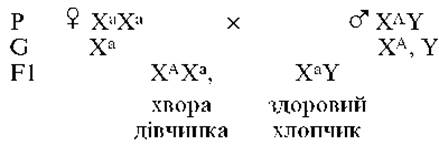
6. In a marriage between a carrier female and a healthy male, all daughters are healthy (50% of them are carriers), 50% of the sons are affected, and 50% of the sons are healthy.

7. The birth of an affected daughter is possible in a marriage between a carrier female and an affected male: 50% of daughters are healthy, 50% are carriers, 50% of sons are affected, and 50% are healthy (Fig. 4.8).
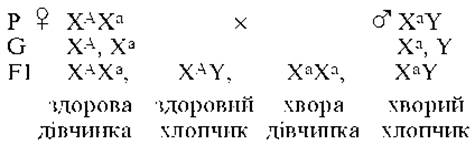
Some difficulties may arise during pedigree analysis. In heterozygous gene carriers, the trait may manifest phenotypically due to the preferential inactivation of the X chromosome carrying the normal allele (Barr bodies).
If the Xa gene has a lethal effect, all male fetuses that inherit this gene perish. Heterozygous female carriers are healthy, but half of their male offspring die. As a result, The ratio of female to male offspring in the pedigree will be 2:1.
Sometimes affected males (e.g., in Duchenne muscular dystrophy) leave no offspring because they die before reaching Puberty or are sterile.
X-linked dominant inheritance. The pathological gene is designated as XA, and the normal allele as Xa. The genotype of a healthy female is designated as XaXa, and that of a healthy male as XaY (or XA). The genotype of an affected female is XAXA or XAXa, and that of an affected male is XAY.
X-linked dominant inheritance (Fig. 4.9) has the following features:
1. Both males and females are affected, but the number of affected females in the pedigree is twice that of males.
2. Children are affected only if one of the parents is affected. Healthy parents have only healthy children.
3. The disease can be traced in every generation.
4. If the mother is heterozygous (XAXa), 50% of both daughters and sons inherit the trait.

Fig. 4.8. Pedigree showing two females homozygous for hemophilia. The parents of the females are first cousins (after F. Vogel and A. Motulsky)

5. All daughters and no sons inherit the trait from an affected father, since a son inherits the Y chromosome from his father.
6. Females present with a milder form of the disease because they are more frequently heterozygous (XAXa). In hemizygous males (XY), the disease manifests in a more severe form. The dominant gene may be lethal in male embryos. In such cases, all affected individuals in the pedigree are exclusively female (Fig. 4.10).
Y-linked inheritance pattern
The Y chromosome contains genes that control Spermatogenesis, body and limb growth, tooth development, hypertrichosis of the ear rim, and other traits (holandric traits). Since the Y chromosome is transmitted from father to son, pedigrees are characterized by the following features (Fig. 4.11):
1. Only males are affected.
2. All sons inherit the trait from an affected father.

Fig. 4.9. Pedigree for X-linked dominant inheritance
Pathological Mutations affecting spermatogenesis cannot be inherited because affected individuals are sterile. However, transmission of the gene is possible via In vitro Fertilization.
All inheritance patterns discussed above are associated with nuclear DNA mutations.
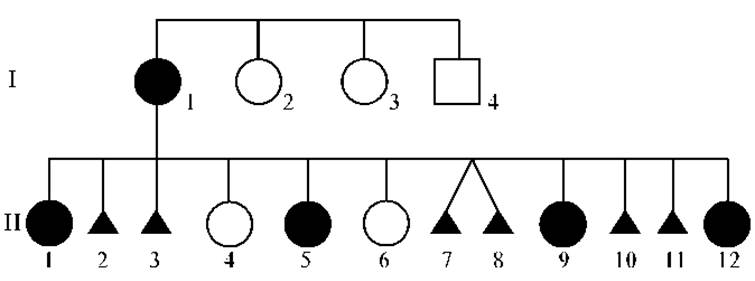
Fig. 4.10. Pedigree for X-linked inheritance in cases of embryonic lethality of the pathological gene in male embryos (Bloch-Sulzberger syndrome)

Fig. 4.11. Pedigree for Y-linked trait inheritance (hypertrichosis of the ear rim)
Last update: 11/08/2026
Editorial and Educational Adaptation: This material has been compiled based on the primary/original source text. The project team performed an editorial review, corrected technical inaccuracies, structured sections, and adapted the content for an educational format.
What was processed:
- elimination of formatting defects (OCR errors, structural breaks, corrupted characters);
- editorial organization of content;
- standardization of terminology in accordance with academic sources;
- verification of factual statements against the original source text.
All mentions of the author, publication year, and origin of the primary text have been preserved in accordance with the source.