MEDICAL BIOLOGY, ANATOMY, HUMAN PHYSIOLOGY AND PATHOLOGY - Ya.I.Fedonyuk 2010
BIOLOGY
CHAPTER 1. BIOLOGICAL FOUNDATIONS OF HUMAN VITAL ACTIVITY
1.4. ONTOGENETIC LEVEL OF LIFE ORGANIZATION
1.4.2. Fundamentals of human genetics
Patterns of trait inheritance in Dihybrid and polyhybrid crosses. Mendel's third law
In a dihybrid cross between homozygous peas with yellow and smooth seeds (AABB) and homozygous peas with green and wrinkled seeds (aabb), all F1 first-generation hybrids had yellow and smooth seeds, which demonstrates Mendel's first law—the uniformity of first-generation hybrids. Yellow color and smooth seed shape are dominant traits, while green color and wrinkled seed shape are recessive. Upon self-pollination of the F1 first-generation hybrids, the F2 second-generation progeny yielded four phenotypic classes in the ratio: 9 yellow smooth : 3 yellow wrinkled : 3 green smooth : 1 green wrinkled (9:3:3:1). In other words, besides plants with seeds identical to the parental forms, plants whose seeds displayed new combinations of parental traits were obtained. Upon further analysis, Mendel established that for any single, independently taken pair of traits, the seeds were distributed in an approximate 3:1 ratio, just as in a monohybrid cross. Thus, a dihybrid cross acts as two independent Monohybrid Crosses superimposed upon one another.
Mendel explained the experimental results by the independent assortment of genes controlling seed color and shape. These genes initially combined in the first generation and then segregated independently of each other In the second. Therefore, each trait is inherited independently of the other as if it existed on its own (seed color is inherited independently of seed shape). This forms The basis of Mendel's third law—the law of independent assortment: when crossing homozygous individuals that differ in two (or more) pairs of alternative traits, independent inheritance and combination of traits are observed in the second generation, provided the genes for these traits are located in different pairs of homologous Chromosomes. The cytological basis of this law is Meiosis, during which non-homologous chromosomes segregate independently and can combine in any possible way.
To understand The Essence of the phenomena occurring in a dihybrid cross, let us examine its genetic diagram (Fig. 1.60).
Class="center">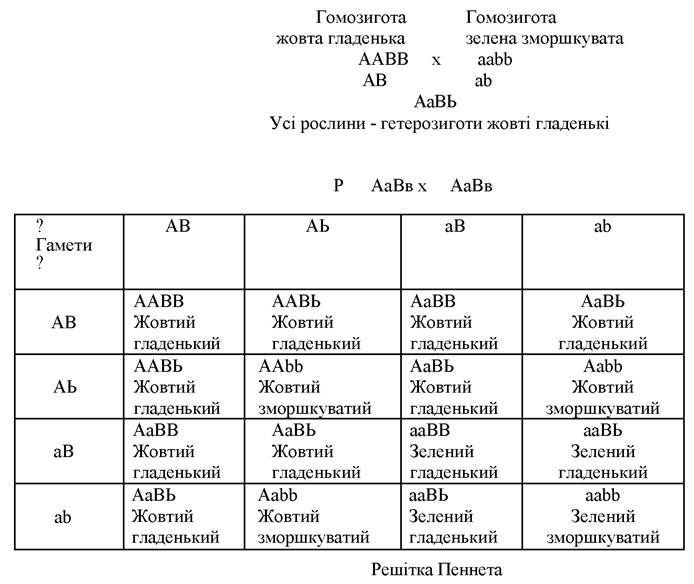
Fig. 1.60. Diagram of a dihybrid cross illustrating Mendel's third law — the law of independent assortment.
A — dominant allele for yellow pea seed color; a — recessive allele for green seed color;
B — dominant allele for smooth seed shape; b — recessive allele for wrinkled seed shape.
A Punnett square is a grid proposed by geneticist R. Punnett to determine The ratio of phenotypic classes. Since four types of Gametes are formed in a dihybrid cross, the number of zygote types is 16 (4x4), which corresponds to the number of Cells in the Punnett square.
Applying Mendel's laws, one can predict segregation for more complex crosses as well: trihybrid, tetrahybrid, etc. These are always underpinned by monohybrid cross segregation.
General formulas for gamete formation and segregation:
2n — number of gamete types;
4n — number of gamete combinations in The formation of the F2 second generation; (3:1)n — phenotypic segregation in the F2 second generation; (1:2:1)n — genotypic segregation in the F2 second generation; 2n — number of phenotypic classes; 3n — number of genotypic classes in the F2 second generation; n — number of genes (traits) in the heterozygous state. The patterns of trait inheritance established by Mendel have received a modern interpretation:
1. Each trait in an Organism is controlled by an allele pair of a specific Gene.
2. During meiosis, each allele pair segregates, and each gamete receives one allele from each pair.
3. During the formation of male and female gametes, any allele from one pair can end up in either gamete together with any allele from another pair.
4. Each allele is transmitted from generation to generation as a discrete, unchanging unit of heredity.
5. An organism inherits one allele (for each trait) from each parent.
Last update: 08/08/2026
Editorial and Educational Adaptation: This material has been compiled based on the primary/original source text. The project team performed an editorial review, corrected technical inaccuracies, structured sections, and adapted the content for an educational format.
What was processed:
- elimination of formatting defects (OCR errors, structural breaks, corrupted characters);
- editorial organization of content;
- standardization of terminology in accordance with academic sources;
- verification of factual statements against the original source text.
All mentions of the author, publication year, and origin of the primary text have been preserved in accordance with the source.