MEDICAL BIOLOGY, ANATOMY, HUMAN PHYSIOLOGY AND PATHOLOGY - Y.I. Fedoniuk 2010
BIOLOGY
SECTION 1. BIOLOGICAL BASES OF HUMAN VITAL ACTIVITY
1.4. ONTOGENETIC LEVEL OF LIFE ORGANIZATION
1.4.2. Basics of Human Genetics
Inheritance Patterns in Monohybrid Crosses. Mendel's First and Second Laws
In Gregor Mendel's experiments, when pure-breeding (homozygous) peas with yellow seeds (AA) were pollinated with pollen from peas with green seeds (aа), all first-generation hybrids (F1) had yellow seeds. The direction of the cross did not affect the inheritance pattern: in the reciprocal cross, when green-seeded peas were pollinated with pollen from yellow-seeded peas, all first-generation hybrids also had yellow seeds. Mendel obtained analogous results in experiments studying the inheritance of other pairs of alternative traits (red and white flower color, smooth and wrinkled seed shape). In all cases, the first-generation hybrids displayed the trait of only one parent, while the trait of the other parental form did not appear. Mendel referred to the phenomenon where first-generation hybrids express the trait of one parental form as dominance (Latin dominantic - ruling), the trait that appeared in the first-generation hybrids (yellow color) as dominant, and the opposite trait (green color) that did not appear in the first-generation hybrids as recessive (Latin recessum - retreat). This discovered regularity formed The basis of Mendel's first law - the law of uniformity of first-generation hybrids (the law of dominance): when crossing homozygous individuals that differ in a single pair of alternative traits, all offspring in the first generation are uniform in phenotype and genotype. Phenotypically, all individuals exhibit the dominant trait; genotypically, they are heterozygous (Fig. 1.58).
Class="center">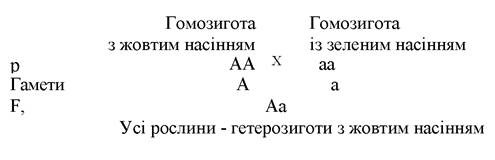
Fig. 1.58. Scheme of a monohybrid cross illustrating Mendel's first law - the law of uniformity of F1 first-generation hybrids.
Cytological basis of this law: homozygous parents (AA x aa) during Meiosis form Gametes of only one type - A and a, respectively. The combination of these gametes during Fertilization produces zygotes of only one type - Aa.
Mendel's second law. Upon self-pollination of first-generation hybrids (F1), Mendel obtained 8,023 peas In the second generation (F2), of which 6,022 had yellow seeds and 2,001 had green seeds, which corresponded to a ratio of approximately 3 yellow : 1 green. The appearance of individuals with traits of both original parental forms (dominant and recessive) in the second generation (F2) is called segregation. Segregation obeys certain statistical regularities and forms the basis of Mendel's second law - the law of segregation: when crossing two heterozygous individuals (hybrids) analyzed for a single pair of alternative traits, phenotypic segregation is observed in the offspring in a 3:1 ratio, and genotypic segregation in a 1:2:1 ratio. Phenotypically, 3/4 of the individuals (75%) exhibit the dominant trait, and 1/4 (25%) exhibit the recessive trait. Genotypically, 1/4 of the individuals (25%) are dominant homozygotes (AA), 2/4 (50%) are heterozygotes (Aa), and 1/4 (25%) are recessive homozygotes (aa). Genotypic segregation (1 AA : 2 Aa : 1 aa) is illustrated in the diagram (Fig. 1.59).
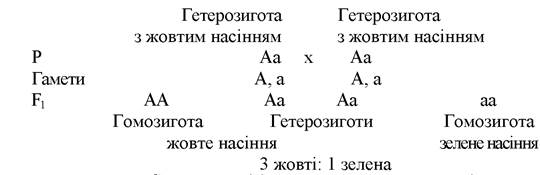
Fig. 1.59. Scheme of a monohybrid cross illustrating Mendel's second law - the law of segregation in a phenotypic ratio of 3:1 and a genotypic ratio of 1 AA : 2 Aa : 1 aa.
The cytological basis of The Second Law is meiosis: first-generation hybrids F1 (Aa) form Two Types of gametes (eggs and sperm) during meiosis - A and a, the combination of which during crosses produces Three types of zygotes: AA, Aa, and aa. Therefore, uniformity cannot exist in the second generation F2, because segregation is based on The phenomenon of non-blending of alleles in hybrids (the law of purity of gametes).
The Law of Purity of Gametes
The fact that the recessive trait (green seed color), which was absent in the first-generation hybrids F1, reappeared in 1/4 of the second-generation hybrids F2, was explained by Mendel by the fact that it is not the traits themselves that are inherited, but hereditary factors (genes) that determine their development, and that these factors are discrete. In F1 hybrids (Aa), There are two hereditary factors: one of them, A, is responsible for yellow seed color, and the other, a, for green. Allelic genes, while in a heterozygous state, do not fuse, do not alter one another, and, without losing their individuality, are transmitted into the gametes. Gametes are "pure": they carry only one of the two alleles of a given Gene. This regularity was named the law of the "purity of gametes." Its cytological basis is meiosis, which was discovered much later than Mendel's Laws. During meiosis, only one of the two homologous Chromosomes, and consequently only one allele from each pair, enters each gamete.
Last update: 08/08/2026
Editorial and Educational Adaptation: This material has been compiled based on the primary/original source text. The project team performed an editorial review, corrected technical inaccuracies, structured sections, and adapted the content for an educational format.
What was processed:
- elimination of formatting defects (OCR errors, structural breaks, corrupted characters);
- editorial organization of content;
- standardization of terminology in accordance with academic sources;
- verification of factual statements against the original source text.
All mentions of the author, publication year, and origin of the primary text have been preserved in accordance with the source.