MEDICAL BIOLOGY, HUMAN ANATOMY, PHYSIOLOGY AND PATHOLOGY - Ya.I. Fedoniuk 2010
ANATOMY, PHYSIOLOGY, PATHOLOGY
CHAPTER 5. BLOOD AND LYMPH CIRCULATION. PATHOLOGY THEREOF
CARDIOVASCULAR DISEASES
HYPERTENSIVE DISEASE
Hypertensive disease, or essential arterial Hypertension, is a condition in which elevated Blood pressure is not associated with primary organic lesions of Organs or systems. Hypertensive disease is one of the most common cardiovascular disorders.
Arterial hypertensions that arise As a result of various pathological processes as a symptom of other conditions are called secondary, or symptomatic. In this context, arterial hypertension, being a consequence of the underlying disease, often determines the severity of its clinical course. Currently, there are more than 50 diseases accompanied by the symptom of arterial hypertension. Among them, three main groups are distinguished: hypertensions caused by lesions of the Central Nervous system, Kidneys, and major vessels.
Three stages of hypertensive disease are distinguished.
Stage I is the preclinical ("functional") stage, characterized only by episodic increases in blood pressure (transient hypertension). At this stage, Hypertrophy of the muscular layer and elastic structures of arterioles and small Arteries, along with moderate Left Ventricular Hypertrophy, can be observed.
Stage II is characterized by widespread arterial changes and a period of sustained blood pressure elevation.
The most typical sign of hypertensive disease is alterations in arterioles manifested by plasma imbibition of their walls, followed by hyalinosis and sclerosis.
Stage III involves secondary organ damage resulting from arterial alterations and impaired organ blood flow.
Based on the predominance of vascular, hemorrhagic, necrotic, and sclerotic Changes in the Heart, kidneys, and Brain, the following clinico-morphological forms of hypertensive disease are distinguished: cardiac, cerebral, and renal.
The cardiac form of hypertensive disease manifests as Various Forms of CORONARY HEART DISEASE: myocardial infarction, angina pectoris, and cardiosclerosis.
The cerebral form manifests through various types of cerebrovascular disorders. Cerebral hemorrhages (hemorrhagic stroke) are more common, whereas ischemic strokes occur less frequently. Chronic Hypoxia leads to neuronal atrophy and their replacement by glial Cells.
The renal form of hypertensive disease is characterized by both acute manifestations—such as renal infarction and arteriolar Necrosis of the Kidney—and chronic manifestations, notably arteriolar hyalinosis and arteriolosclerosis.
Depending on The rate of symptom progression and the duration of the disease, the following clinical courses of hypertensive disease are identified:
a) benign hypertensive disease (slowly progressive and non-progressive);
b) malignant hypertensive disease (rapidly progressive).
Malignant arterial hypertension, or the malignant phase of arterial hypertension, is a syndrome characterized by extremely high blood pressure levels (typically exceeding 220/120 mm Hg) accompanied by retinal hemorrhages and exudates, frequently with papilledema. Renal involvement leading to uremia is characteristic, though not mandatory.
Excessive activation of the renin-angiotensin-aldosterone system, alongside natriuresis and hypovolemia, plays a major role in the Pathogenesis of malignant arterial hypertension.
The causes underlying The Development of hypertensive disease remain unknown.
The initiating link in the pathogenesis of hypertensive disease is hyperactivity of the neural centers regulating blood pressure, which develops under the Influence of the aforementioned factors, with psycho-emotional stress being the primary one.
Increased activity of the sympathoadrenal system is the main factor driving the blood pressure elevation during the initial period of hypertensive disease. This period is marked by The formation of a hyperkinetic circulatory state, characterized by increased Cardiac Output with minimal changes in peripheral resistance.
During the stabilization period of hypertensive disease, particularly in its later stages, the renal mechanism assumes a significant role. Renal ischemia leads to continuous stimulation of renin production within the juxtaglomerular apparatus. Renin combines with blood angiotensinogen to form the polypeptide angiotensin I. Over time, Amino Acids become involved in the process, yielding the peptide angiotensin II, which exerts a pressor effect and has therefore been named hypertensin.
Aldosterone hypersecretion causes sodium retention in the arteriolar walls, which increases their sensitivity to pressor agents. Furthermore, calcium diffuses into The Cell along with sodium; its elevated intracellular content leads to prolonged contraction of the Cytology/cytology/32.html">Smooth Muscle tissue, thereby increasing its vascular tone.
The pathomorphological presentation is determined by the stages of Essential Hypertension, its clinical course, and associated complications.
The main anatomical hallmarks of essential hypertension are Left ventricular myocardial hypertrophy (Fig. 5.52) and an increase in the muscle mass predominantly of small arteries with an outer diameter of 100 µm or less. Three types of arterial lesions are observed: arterial hyalinosis, arteriosclerosis, and fibrinoid necrosis. The primary lesion affecting elastic-type arteries is atherosclerosis.
Class="center">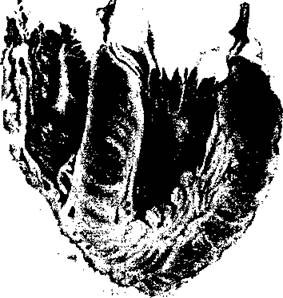
Fig. 5.52. Hypertrophy
On macroscopic examination, the kidneys are firm, reduced in size—accounting for up to 0.25% of their normal weight—and exhibit a granular surface (Primary Granular Contracted kidney). Microscopic examination reveals sclerotic changes in the arterioles of the kidneys, heart, and brain.
Last update: 08/08/2026
Editorial and Educational Adaptation: This material has been compiled based on the primary/original source text. The project team performed an editorial review, corrected technical inaccuracies, structured sections, and adapted the content for an educational format.
What was processed:
- elimination of formatting defects (OCR errors, structural breaks, corrupted characters);
- editorial organization of content;
- standardization of terminology in accordance with academic sources;
- verification of factual statements against the original source text.
All mentions of the author, publication year, and origin of the primary text have been preserved in accordance with the source.