MODERN BOTANY - P. RAVEN - 1990
SECTION II. ENERGY AND LIVING CELLS
CHAPTER 7. PHOTOSYNTHESIS
Dark Reactions
During the Second Stage of Photosynthesis, the chemical energy stored during the light reactions is used to reduce carbon. The carbon available to photosynthetic Cells is supplied in the form of carbon dioxide. Algae and cyanobacteria have been shown to assimilate carbon dioxide dissolved in Water. In most plants, СО2 reaches the photosynthetic cells through specialized pores called Stomata, located in leaves and green stems (Fig. 7-14).
Class="center">Fig. 7-14. Scanning electron micrograph of stomata on the lower surface of a poplar (Populus) leaf. Carbon dioxide enters the photosynthetic cells through the stomata

The Calvin Cycle: The C3 Pathway
Carbon reduction takes place in the stroma of the chloroplast through a cycle of reactions known as the Calvin cycle (named after Melvin Calvin, who was awarded the Nobel Prize for its discovery). The Calvin cycle is analogous to the Krebs cycle because the starting compound is regenerated at the end of the cycle.
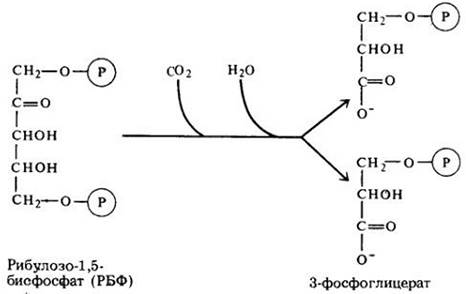
The starting (and ending) compound of the Calvin cycle is a five-carbon sugar with two phosphate groups: ribulose-1,5-bisphosphate (RuBP). The process begins when carbon dioxide enters the cycle and is fixed onto RuBP. The resulting compound is then split into two molecules of 3-phosphoglycerate (Fig. 7-15). (Each molecule of 3-phosphoglycerate consists of three carbon atoms, hence the alternative name for the Calvin cycle, the C3 pathway.)
Fig. 7-15. Calvin and his coworkers conducted short-term illumination experiments with photosynthetic algae in an atmosphere of radioactive carbon dioxide (14СО2). They discovered that the radioactive carbon is first incorporated into ribulose-1,5-bisphosphate, which is then immediately cleaved into two molecules of 3-phosphoglycerate. The radioactive carbon (highlighted in a different color) is subsequently detected in one of the two resulting molecules. This reaction marks the beginning of the Calvin cycle
Ribulose bisphosphate carboxylase—The enzyme catalyzing these key reactions—is the most abundant protein in the chloroplast, accounting for 15% of the total chloroplast protein. (It is said to be the most abundant protein in the world; can you guess why?) This enzyme is localized On the surface of the thylakoid membranes.
The complete cycle is illustrated in Fig. 7-16. As in the Krebs cycle, each individual reaction is catalyzed by a specific enzyme. During every turn of the cycle, one molecule of СО2 is reduced and one molecule of RuBP is regenerated. Six turns of the cycle, absorbing six carbon atoms, are required to produce a six-carbon sugar, glucose. The overall equation for glucose synthesis can be written as follows:
6СО2 + 12NADPH2 + 18ATP —> 1 Glucose + 12NADP + 18ADP + 18Рi + 6Н2О.
An intermediate product of the cycle is glyceraldehyde-3-phosphate. This same compound is formed during Glycolysis through The breakdown of fructose-1,6-bisphosphate. The Synthesis of glucose from glyceraldehyde-3-phosphate proceeds via analogous, yet reverse, reactions utilizing the energy of phosphate bonds.
Fig. 7-16. Overall Summary of the Calvin cycle. With each turn of the cycle, one molecule of carbon dioxide enters. The result of six turns is shown here (six molecules of СО2 are required to synthesize two molecules of glyceraldehyde-3-phosphate). Six molecules of ribulose-1,5-bisphosphate, a five-carbon compound, react with six molecules of СО2 to yield twelve molecules of 3-phosphoglycerate, a three-carbon compound, which are subsequently converted into twelve molecules of glyceraldehyde-3-phosphate. Ten of these are rearranged to form six five-carbon molecules of ribulose-1,5-bisphosphate. The remaining two molecules of glyceraldehyde-3-phosphate represent the "net gain" of the Calvin cycle. The energy driving the Calvin cycle is supplied in the form of ATP and NADPH2 produced during the light reactions

The C4 Pathway of Photosynthesis
The Calvin cycle is not the only pathway for carbon fixation in dark reactions. In some plants, the initial product of fixation is not the three-carbon molecule 3-phosphoglycerate, as in the Calvin cycle, but a four-carbon compound, oxaloacetate (which is also formed in the Krebs cycle). Plants that utilize this pathway are referred to as C4 plants, in contrast to C3 plants, which operate solely via the Calvin cycle. (The C4 pathway is also known as the Hatch-Slack cycle, named after the Australian plant physiologists who played a pivotal role in its discovery.)
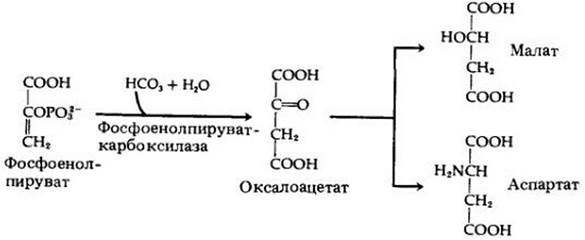
Oxaloacetate is formed when СО2 is fixed onto phosphoenolpyruvate. This reaction is catalyzed by the enzyme phosphoenolpyruvate carboxylase (Fig. 7-17). Oxaloacetate is then reduced to malate or converted, via The addition of an amino group, into aspartate. These reactions take place in the mesophyll cells. The next step is striking: malate (or aspartate, depending on the plant species) is transported from the mesophyll cells into the bundle sheath Cells of the leaf, where it is decarboxylated to yield СО2 and Pyruvate. The СО2 then enters the Calvin cycle, reacting with RuBP to form phosphoglycerate and other cycle intermediates, while pyruvate returns to the mesophyll cells to react with ATP, regenerating phosphoenolpyruvate (Fig. 7-18). Thus, the plant's anatomy facilitates the spatial Separation of the C4 pathway and the Calvin cycle within the leaves of C4 plants.
Fig. 7-17. Carbon dioxide fixation via the C4 pathway. Carbon dioxide interacts with phosphoenolpyruvate in the presence of the enzyme phosphoenolpyruvate carboxylase. The oxaloacetate produced in this reaction is either reduced to malate or converted to aspartate via amination (the Addition of an NН2 group). These steps will be discussed further in connection with the release of СО2 that enters the Calvin cycle
The two primary carboxylating Enzymes utilize different forms of СО2 as substrates. Ribulose bisphosphate carboxylase utilizes СО2, which is present in The Cell at a concentration of about 15 – 20 µM in equilibrium with the air. Meanwhile, phosphoenolpyruvate carboxylase utilizes the hydrated form of carbon dioxide, НСО-3. At pH 8.0, НСО3 is found in the cell at a concentration of 15 – 20 µM in equilibrium with the air phase. Ribulose bisphosphate carboxylase is located in the METABOLISM/14.html">Chloroplasts, whereas phosphoenolpyruvate carboxylase is found in the Cytoplasm ground substance.
Fig. 7-18. The carbon fixation pathway in C4 plants. СО2 is initially fixed in the mesophyll cells to form oxaloacetate, which is rapidly converted into malate. Malate is then transported to the bundle sheath cells, where СО2 is released. The released СО2 is utilized in the Calvin cycle, yielding starch and sucrose. Pyruvate returns to the mesophyll cell to regenerate phosphoenolpyruvate. Shown here is a leaf of a C4 plant, specifically corn (Zea mays)

Typically, the leaves of C4 plants feature a distinctive arrangement of mesophyll cells surrounding a layer of large bundle sheath cells, forming two concentric layers around the vascular bundle (Fig. 7-19). This ring-like Cellular Organization is known as Kranz anatomy (from the German word Kranz, meaning "wreath").
In some C4 plants, the Chloroplasts of mesophyll cells have well-developed grana, whereas those in the bundle sheath cells have poorly developed grana or lack them altogether (Fig. 7-18). Furthermore, during photosynthesis, chloroplasts in the bundle sheath cells typically accumulate larger and more numerous starch grains than do the mesophyll chloroplasts.
Fig. 7-19. Transverse section of a corn leaf (Zea mays). As typical for a C4 plant, the vascular bundles are surrounded by large, chloroplast-containing bundle sheath cells, which in turn are encircled by a layer of mesophyll cells. The C4 pathway occurs in the mesophyll cells, whereas the Calvin cycle takes place in the bundle sheath cells.

Efficiency of C4 Plants
CO2 fixation in C4 plants requires a higher energy input than in C3 plants. In the C4 pathway, a molecule of phosphoenolpyruvate must be generated for each assimilated molecule of CO2, consuming two high-energy ATP phosphate groups. Thus, C4 plants require five ATP molecules to fix a single molecule of CO2, compared to only three ATP molecules for C3 plants.
One might wonder why C4 plants evolved such a complex and energetically costly mechanism to supply carbon dioxide to the Calvin cycle. This becomes clear upon considering that photosynthesis in C3 plants is invariably accompanied by Photorespiration—a light-driven process in which oxygen is consumed and CO2 is released (Fig. 7-20). Photorespiration is a wasteful process. Unlike mitochondrial Respiration, photorespiration is not coupled with Oxidative Phosphorylation AND yields no ATP. Moreover, photorespiration diverts reducing equivalents, normally produced in the light reactions for glucose Biosynthesis, toward oxygen reduction. Under normal atmospheric conditions, up to 50% of the carbon assimilated during photosynthesis in C3 plants can be reoxidized to CO2 via photorespiration. Consequently, while such active photorespiration severely limits the efficiency of C3 plants, it is virtually absent in C4 plants.
The primary substrate oxidized during photorespiration in C3 plants is glycolic acid. It is oxidized within the Peroxisomes of photosynthetic cells and originates from the oxidative breakdown of ribulose bisphosphate, catalyzed by ribulose bisphosphate carboxylase—the key enzyme converting CO2 into phosphoglycerate. How does this occur?
Ribulose bisphosphate carboxylase can facilitate the interaction of RuBP with either CO2 or O2. When CO2 concentrations are high and oxygen concentrations are relatively low, ribulose bisphosphate carboxylase fixes CO2 onto RuBP to produce phosphoglycerate. Conversely, under low CO2 and relatively high O2 concentrations, the enzyme exhibits oxygenase activity, attaching O2 to RuBP to yield phosphoglycolate and phosphoglycerate instead of the two molecules of phosphoglycerate normally produced during carboxylation. Phosphoglycolate is subsequently converted into glycolic acid, the substrate for photorespiration.
High CO2 and low O2 concentrations restrict photorespiration. Accordingly, C4 plants hold a significant advantage over C3 plants because the CO2 fixed via the C4 pathway is actively pumped from the mesophyll cells into the bundle sheath cells, thereby maintaining a high CO2/O2 ratio in the regions where ribulose bisphosphate carboxylase activity is concentrated. This favors the carboxylation reaction. Furthermore, because the Calvin cycle and photorespiration occur within the inner layer of bundle sheath cells, any CO2 released during photorespiration can be refixed in the outer layer of mesophyll cells via the active C4 pathway. As a result, CO2 generated by photorespiration does not escape the leaf. In addition, C4 plants utilize external CO2 more efficiently than C3 plants because phosphoenolpyruvate carboxylase is not inhibited by O2. Consequently, the net photosynthetic rate of C4 grasses, such as corn (Zea mays), sugarcane (Saccharum officinale), and sorghum (Sorghum vulgare), can be 2 to 3 times higher than that of C3 grasses, such as wheat (Triticum aestivum), rye (Secale cereale), oats (Avena sativa), and rice (Oryza sativa).
C4 plants evolved primarily in the tropics and are particularly well adapted to high insolation, elevated temperatures, and drought. The optimal Temperature for photosynthesis is higher in C4 plants than in C3 plants; C4 plants thrive even at temperatures that would be detrimental to many C3 species. By utilizing a more efficient mechanism of CO2 utilization, C4 plants can achieve the same photosynthetic rates as C3 plants while suffering much lower water loss, as they can keep a smaller number of stomata open. An Analysis of the Geographical Distribution of C4 species in North America shows that they are most abundant in high-temperature climatic zones. However, monocots and dicots differ in their response patterns to high temperatures. For instance, C4 grasses predominate in regions with extremely high growing-season temperatures (Fig. 7-21), whereas C4 dicots are widespread in areas characterized by extreme drought during the growing season.
Fig. 7-20. Reactions Catalyzed by ribulose bisphosphate carboxylase. Reaction 1 is favored by high CO2 and low oxygen concentrations. Reaction 2 typically occurs under low CO2 and high oxygen concentrations (normal ambient air conditions).

Fig. 7-21. Numbers indicate the percentage of herbaceous species utilizing the C4 photosynthetic pathway across 32 locations in North America. The highest percentages are characteristic of regions with high growing-season temperatures.

A striking illustration of the distinct growth habit of C4 plants can be observed in lawns, which in the northern United States consist of C3 grasses such as Kentucky bluegrass (Poa pratensis) or colonial bentgrass (Agrostis tenuis). Large crabgrass (Digitaria sanguinalis), which often crowds out these dark-green, fine-leaved grasses with its yellowish-green, broad leaves, is a C4 grass that grows much more rapidly during the hot summer months than temperate C3 grasses.
Currently, all known plants exhibiting C4 photosynthesis are flowering plants spanning 19 families (3 monocot and 16 dicot families); however, no single family consists exclusively of C4 species. Undoubtedly, this photosynthetic pathway has evolved multiple times independently.
Crassulacean acid metabolism, designated as CAM metabolism1, evolved in numerous succulent plants, including cacti (Cactaceae) and stonecrops (Crassulaceae). Plants are classified as CAM when their photosynthetic cells can fix CO2 in the dark via phosphoenolpyruvate carboxylase, producing malic acid that is stored in vacuoles. During the subsequent light period, malic acid is decarboxylated, and the released CO2 is transferred to RuBP within the Calvin cycle in the same cell. Thus, like C4 plants, CAM plants utilize both the C3 and C4 pathways, but they differ from C4 plants in that these pathways are separated temporally (in time) rather than spatially (in space).
1Named after the initial letters of "Crassulacean acid metabolism". — Ed.
CAM plants rely heavily on nocturnal carbon accumulation for photosynthesis because their stomata remain closed during the day to prevent water loss. This provides a clear advantage in the high-insolation, water-stressed environments where CAM plants typically live. Because all atmospheric CO2 uptake in CAM plants occurs at night, their water-use efficiency can be significantly higher than that of C3 or C4 plants. During prolonged droughts, some CAM plants keep their stomata closed both day and night, sustaining a low metabolic rate through the refixation of internal CO2. Under these conditions, substantial amounts of CO2 are fixed into malic acid at night, released the following day, and refixed via the Calvin cycle.
CAM metabolism is more widespread among vascular plants than C4 photosynthesis. It occurs in at least 23 families of flowering plants, predominantly dicots, including familiar houseplants such as Kalanchoë daigremontiana, wax plant (Hoya carnosa), and snake plant (Sansevieria zeylanica). However, not all CAM plants are succulents; two Examples with lower degrees of succulence are the pineapple (Ananas comosus) and Spanish moss (Tillandsia usneoides), both belonging to the bromeliad family (Bromeliaceae, monocots). Furthermore, evidence suggests that certain non-flowering plants exhibit traits of CAM metabolism, including the exotic gymnosperm Welwitschia mirabilis (see Fig. 18-35), quillworts (Isoetes, Figs. 17-19, 17-20), and several ferns.
Adaptive Significance of Photosynthetic Mechanisms
From the foregoing Structure/133.html">Discussion of C3, C4, and CAM photosynthetic types, it is evident that the photosynthetic mechanism is not the sole factor determining a plant's habitat. Although extremely important, all three photosynthetic types present distinct Advantages and disadvantages, and a plant can successfully compete only when the benefits of its specific photosynthetic pathway outweigh other environmental pressures. For example, while C4 plants are generally more tolerant of high temperatures and drought than C3 species, they cannot successfully compete with C3 plants at temperatures below 25°C, partly due to greater chilling sensitivity. Likewise, CAM plants are exceptionally well adapted to severe drought conditions, conserving water by closing their stomata during the day. However, this trait severely restricts their capacity to absorb and assimilate CO2. Consequently, CAM plants grow slowly and are poor competitors against C3 and C4 species under less extreme conditions. Thus, each type of photosynthetic pathway comes with certain evolutionary trade-offs inherent to its mechanism.
Last update: 07/08/2026
Editorial and Educational Adaptation: This material has been compiled based on the primary/original source text. The project team performed an editorial review, corrected technical inaccuracies, structured sections, and adapted the content for an educational format.
What was processed:
- elimination of formatting defects (OCR errors, structural breaks, corrupted characters);
- editorial organization of content;
- standardization of terminology in accordance with academic sources;
- verification of factual statements against the original source text.
All mentions of the author, publication year, and origin of the primary text have been preserved in accordance with the source.